

Notes
Questions
Solve and graph
\(\textbf{1)}\) \(-4\lt4x+6\le18 \) The answer is \(-\frac{5}{2}\lt x\le3\)
\(\,\,\,\,\,\,-4\lt4x+6\le18\)
\(\,\,\,\,\,\,-10\lt4x\le12\)
\(\,\,\,\,\,\,\frac{-10}{4}\lt x\le \frac{12}{4}\)
\(\,\,\,\,\,\,\)The answer is \(-\frac{5}{2}\lt x\le3\)
\(\,\,\,\,\,\,-4\lt4x+6\le18\)
\(\,\,\,\,\,\,-10\lt4x\le12\)
\(\,\,\,\,\,\,\frac{-10}{4}\lt x\le \frac{12}{4}\)
\(\,\,\,\,\,\,\)The answer is \(-\frac{5}{2}\lt x\le3\)
\(\textbf{2)}\) \(5x-4\lt34 \) and \( -5x-8\le-8\) The answer is \(x\lt \frac{38}{5} \) and \( x\ge 0\)
\(\,\,\,\,\,5x-4\lt34\)
\(\,\,\,\,\,5x\lt38\)
\(\,\,\,\,\,x\lt \frac{38}{5}\)
\(\,\,\,\,\,\,\)and
\(\,\,\,\,\,-5x-8\le-8\)
\(\,\,\,\,\,-5x\le0\)
\(\,\,\,\,\,x\ge0\)
\(\,\,\,\,\,\,\)The answer is \(x\lt \frac{38}{5}\) and \(x\ge0\)
\(\,\,\,\,\,5x-4\lt34\)
\(\,\,\,\,\,5x\lt38\)
\(\,\,\,\,\,x\lt \frac{38}{5}\)
\(\,\,\,\,\,\,\)and
\(\,\,\,\,\,-5x-8\le-8\)
\(\,\,\,\,\,-5x\le0\)
\(\,\,\,\,\,x\ge0\)
\(\,\,\,\,\,\,\)The answer is \(x\lt \frac{38}{5}\) and \(x\ge0\)
\(\textbf{3)}\) \(3\lt 6-2x \le18\) The answer is \(-6\le x\lt \frac{3}{2}\)
\(\,\,\,\,\,3\lt 6-2x \le18\)
\(\,\,\,\,\,-3\lt -2x \le12\)
\(\,\,\,\,\,\frac{3}{2}> x \ge -6\)
\(\,\,\,\,\,\,\)The answer is \(-6\le x\lt \frac{3}{2}\)
\(\,\,\,\,\,3\lt 6-2x \le18\)
\(\,\,\,\,\,-3\lt -2x \le12\)
\(\,\,\,\,\,\frac{3}{2}> x \ge -6\)
\(\,\,\,\,\,\,\)The answer is \(-6\le x\lt \frac{3}{2}\)
\(\textbf{4)}\) \(4x-5\lt 35 \) and \( 4-x\le-10 \) The answer is No Solution
\(\,\,\,\,\,4x-5\lt35\)
\(\,\,\,\,\,4x\lt40\)
\(\,\,\,\,\,x\lt10\)
\(\,\,\,\,\,\,and\)
\(\,\,\,\,\,4-x\le-10\)
\(\,\,\,\,\,-x\le-14\)
\(\,\,\,\,\,x\ge14\)
\(\,\,\,\,\,x\lt10\) and \(x\ge14\)
\(\,\,\,\,\,\,\)The answer is No Solution
\(\,\,\,\,\,4x-5\lt35\)
\(\,\,\,\,\,4x\lt40\)
\(\,\,\,\,\,x\lt10\)
\(\,\,\,\,\,\,and\)
\(\,\,\,\,\,4-x\le-10\)
\(\,\,\,\,\,-x\le-14\)
\(\,\,\,\,\,x\ge14\)
\(\,\,\,\,\,x\lt10\) and \(x\ge14\)
\(\,\,\,\,\,\,\)The answer is No Solution
\(\textbf{5)}\) \(x+3\gt8 \) or \( 2x\lt 16 \) The answer is All Real Numbers
\(\,\,\,\,\,x+3\gt8\)
\(\,\,\,\,\,x\gt5\)
\(\,\,\,\,\,\,or\)
\(\,\,\,\,\,2x\lt16\)
\(\,\,\,\,\,x\lt8\)
\(\,\,\,\,\,x\gt5\) or \(x\lt8\)
\(\,\,\,\,\,\,\)The answer is All Real Numbers
\(\,\,\,\,\,x+3\gt8\)
\(\,\,\,\,\,x\gt5\)
\(\,\,\,\,\,\,or\)
\(\,\,\,\,\,2x\lt16\)
\(\,\,\,\,\,x\lt8\)
\(\,\,\,\,\,x\gt5\) or \(x\lt8\)
\(\,\,\,\,\,\,\)The answer is All Real Numbers
See Related Pages\(\)
\(\bullet\text{ Compound Inequality Calculator}\)
\(\,\,\,\,\,\,\,\,\text{(Symbolab.com)}\)
\(\bullet\text{ Solving Inequalities Addition and Subtraction}\)
\(\,\,\,\,\,\,\,\,4+x\ge12…\)
\(\bullet\text{ Solving Inequalities Multiplication and Division}\)
\(\,\,\,\,\,\,\,\,4x\lt 16…\)
\(\bullet\text{ Solving Multi-step Inequalities}\)
\(\,\,\,\,\,\,\,\,18-4x \lt 2…\)
\(\bullet\text{ Andymath Homepage}\)
In Summary
A compound inequality is a mathematical statement that combines two inequalities. They may use the words “and” or “or”. For example, the statement \(x \gt 2\) and \(x \lt 6\) is a compound inequality that represents the set of all values of x that are greater than 2 and less than 6. It may also be expressed as \(2 \lt x \lt 6\).
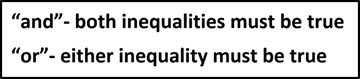
To solve a compound inequality, you solve the two separate inequalities, and then combine them. The solution to a compound inequality with the word “and” is the intersection (meaning BOTH inequalities must be true) of the solutions to the individual inequalities, while the solution to a compound inequality with the word “or” is the union (meaning EITHER of the inequalities must be true) of the solutions to the individual inequalities.