

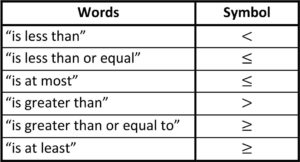
Solving inequalities using multiplication and division is similar to solving equations, with one important difference: when multiplying or dividing both sides by a negative number, you must reverse the inequality sign. For example, a greater-than sign becomes a less-than sign. Inequalities describe a range of possible solutions rather than just one value, and they can also be used to represent real-world situations involving minimums, maximums, and limits.
Notes

Questions
Solve for x.
\(\textbf{1)}\) \(3x\gt18\) The answer is \(x\gt6\)
\(\,\,\,\,\,\,3x\gt18\)
Divide both sides by 3.
\(\,\,\,\,\,\,\frac{3x}{3}\gt\frac{18}{3}\)
\(\,\,\,\,\,\,x\gt6\)
Since we divided by a positive number, the inequality sign stays the same.
\(\,\,\,\,\,\,3x\gt18\)
Divide both sides by 3.
\(\,\,\,\,\,\,\frac{3x}{3}\gt\frac{18}{3}\)
\(\,\,\,\,\,\,x\gt6\)
Since we divided by a positive number, the inequality sign stays the same.
\(\textbf{2)}\) \(5x\lt-45\) The answer is \(x\lt-9\)
\(\,\,\,\,\,\,5x\lt-45\)
Divide both sides by 5.
\(\,\,\,\,\,\,\frac{5x}{5}\lt\frac{-45}{5}\)
\(\,\,\,\,\,\,x\lt-9\)
Since 5 is positive, the inequality sign stays the same.
\(\,\,\,\,\,\,5x\lt-45\)
Divide both sides by 5.
\(\,\,\,\,\,\,\frac{5x}{5}\lt\frac{-45}{5}\)
\(\,\,\,\,\,\,x\lt-9\)
Since 5 is positive, the inequality sign stays the same.
\(\textbf{3)}\) \(6x\ge21\) The answer is \(x\ge3.5\)
\(\,\,\,\,\,\,6x\ge21\)
Divide both sides by 6.
\(\,\,\,\,\,\,\frac{6x}{6}\ge\frac{21}{6}\)
\(\,\,\,\,\,\,x\ge3.5\)
The inequality sign stays the same because 6 is positive.
\(\,\,\,\,\,\,6x\ge21\)
Divide both sides by 6.
\(\,\,\,\,\,\,\frac{6x}{6}\ge\frac{21}{6}\)
\(\,\,\,\,\,\,x\ge3.5\)
The inequality sign stays the same because 6 is positive.
\(\textbf{4)}\) \(-5x\le20\) The answer is \(x\ge-4\)
\(\,\,\,\,\,\,-5x\le20\)
Divide both sides by -5.
\(\,\,\,\,\,\,\frac{-5x}{-5}\ge\frac{20}{-5}\)
\(\,\,\,\,\,\,x\ge-4\)
The inequality sign reverses because we divided by a negative number.
\(\,\,\,\,\,\,-5x\le20\)
Divide both sides by -5.
\(\,\,\,\,\,\,\frac{-5x}{-5}\ge\frac{20}{-5}\)
\(\,\,\,\,\,\,x\ge-4\)
The inequality sign reverses because we divided by a negative number.
\(\textbf{5)}\) \(\displaystyle\frac{x}{5}\lt-10\) The answer is \(x\lt-50\)
\(\,\,\,\,\,\,\frac{x}{5}\lt-10\)
Multiply both sides by 5.
\(\,\,\,\,\,\,5\cdot\frac{x}{5}\lt-10\cdot5\)
\(\,\,\,\,\,\,x\lt-50\)
Since 5 is positive, the inequality sign stays the same.
\(\,\,\,\,\,\,\frac{x}{5}\lt-10\)
Multiply both sides by 5.
\(\,\,\,\,\,\,5\cdot\frac{x}{5}\lt-10\cdot5\)
\(\,\,\,\,\,\,x\lt-50\)
Since 5 is positive, the inequality sign stays the same.
\(\textbf{6)}\) \(-\displaystyle\frac{x}{6}\ge12\) The answer is \(x\le-72\)
\(\,\,\,\,\,\,-\frac{x}{6}\ge12\)
Multiply both sides by -6.
\(\,\,\,\,\,\,(-6)\left(-\frac{x}{6}\right)\le12(-6)\)
\(\,\,\,\,\,\,x\le-72\)
The inequality sign reverses because we multiplied by a negative number.
\(\,\,\,\,\,\,-\frac{x}{6}\ge12\)
Multiply both sides by -6.
\(\,\,\,\,\,\,(-6)\left(-\frac{x}{6}\right)\le12(-6)\)
\(\,\,\,\,\,\,x\le-72\)
The inequality sign reverses because we multiplied by a negative number.
\(\textbf{7)}\) \(\displaystyle\frac{x}{3}\le9\) The answer is \(x\le27\)
\(\,\,\,\,\,\,\frac{x}{3}\le9\)
Multiply both sides by 3.
\(\,\,\,\,\,\,3\cdot\frac{x}{3}\le9\cdot3\)
\(\,\,\,\,\,\,x\le27\)
The inequality sign stays the same because 3 is positive.
\(\,\,\,\,\,\,\frac{x}{3}\le9\)
Multiply both sides by 3.
\(\,\,\,\,\,\,3\cdot\frac{x}{3}\le9\cdot3\)
\(\,\,\,\,\,\,x\le27\)
The inequality sign stays the same because 3 is positive.
\(\textbf{8)}\) \(-\displaystyle\frac{x}{7}\le-7\) The answer is \(x\ge49\)
\(\,\,\,\,\,\,-\frac{x}{7}\le-7\)
Multiply both sides by -7.
\(\,\,\,\,\,\,(-7)\left(-\frac{x}{7}\right)\ge(-7)(-7)\)
\(\,\,\,\,\,\,x\ge49\)
The inequality sign reverses because we multiplied by a negative number.
\(\,\,\,\,\,\,-\frac{x}{7}\le-7\)
Multiply both sides by -7.
\(\,\,\,\,\,\,(-7)\left(-\frac{x}{7}\right)\ge(-7)(-7)\)
\(\,\,\,\,\,\,x\ge49\)
The inequality sign reverses because we multiplied by a negative number.
\(\textbf{9)}\) Express as an inequality. The product of a number n and 4 is less than 10. The answer is \(4n\lt10\)
“The product of a number n and 4” means multiply n by 4.
\(\,\,\,\,\,\,4n\)
“Is less than 10” means use the less-than symbol.
\(\,\,\,\,\,\,4n\lt10\)
“The product of a number n and 4” means multiply n by 4.
\(\,\,\,\,\,\,4n\)
“Is less than 10” means use the less-than symbol.
\(\,\,\,\,\,\,4n\lt10\)
\(\textbf{10)}\) Express as an inequality. A number n divided by 3 is at least 8. The answer is \(\frac{n}{3}\ge8\)
“A number n divided by 3” means n divided by 3.
\(\,\,\,\,\,\,\frac{n}{3}\)
“At least 8” means greater than or equal to 8.
\(\,\,\,\,\,\,\frac{n}{3}\ge8\)
“A number n divided by 3” means n divided by 3.
\(\,\,\,\,\,\,\frac{n}{3}\)
“At least 8” means greater than or equal to 8.
\(\,\,\,\,\,\,\frac{n}{3}\ge8\)
More Practice Problems
\(\textbf{11)}\) \(-8x\gt40\) The answer is \(x\lt-5\)
\(\,\,\,\,\,\,-8x\gt40\)
Divide both sides by -8 and reverse the inequality sign.
\(\,\,\,\,\,\,\frac{-8x}{-8}\lt\frac{40}{-8}\)
\(\,\,\,\,\,\,x\lt-5\)
\(\,\,\,\,\,\,-8x\gt40\)
Divide both sides by -8 and reverse the inequality sign.
\(\,\,\,\,\,\,\frac{-8x}{-8}\lt\frac{40}{-8}\)
\(\,\,\,\,\,\,x\lt-5\)
\(\textbf{12)}\) \(-3x\ge-24\) The answer is \(x\le8\)
\(\,\,\,\,\,\,-3x\ge-24\)
Divide both sides by -3 and reverse the inequality sign.
\(\,\,\,\,\,\,\frac{-3x}{-3}\le\frac{-24}{-3}\)
\(\,\,\,\,\,\,x\le8\)
\(\,\,\,\,\,\,-3x\ge-24\)
Divide both sides by -3 and reverse the inequality sign.
\(\,\,\,\,\,\,\frac{-3x}{-3}\le\frac{-24}{-3}\)
\(\,\,\,\,\,\,x\le8\)
\(\textbf{13)}\) \(\frac{x}{-4}\gt7\) The answer is \(x\lt-28\)
\(\,\,\,\,\,\,\frac{x}{-4}\gt7\)
Multiply both sides by -4 and reverse the inequality sign.
\(\,\,\,\,\,\,(-4)\left(\frac{x}{-4}\right)\lt7(-4)\)
\(\,\,\,\,\,\,x\lt-28\)
\(\,\,\,\,\,\,\frac{x}{-4}\gt7\)
Multiply both sides by -4 and reverse the inequality sign.
\(\,\,\,\,\,\,(-4)\left(\frac{x}{-4}\right)\lt7(-4)\)
\(\,\,\,\,\,\,x\lt-28\)
\(\textbf{14)}\) \(\frac{x}{-5}\le-6\) The answer is \(x\ge30\)
\(\,\,\,\,\,\,\frac{x}{-5}\le-6\)
Multiply both sides by -5 and reverse the inequality sign.
\(\,\,\,\,\,\,(-5)\left(\frac{x}{-5}\right)\ge(-6)(-5)\)
\(\,\,\,\,\,\,x\ge30\)
\(\,\,\,\,\,\,\frac{x}{-5}\le-6\)
Multiply both sides by -5 and reverse the inequality sign.
\(\,\,\,\,\,\,(-5)\left(\frac{x}{-5}\right)\ge(-6)(-5)\)
\(\,\,\,\,\,\,x\ge30\)
\(\textbf{15)}\) \(\frac{2}{3}x\lt12\) The answer is \(x\lt18\)
\(\,\,\,\,\,\,\frac{2}{3}x\lt12\)
Multiply both sides by the reciprocal, \(\frac{3}{2}\).
\(\,\,\,\,\,\,\frac{3}{2}\cdot\frac{2}{3}x\lt12\cdot\frac{3}{2}\)
\(\,\,\,\,\,\,x\lt18\)
The inequality sign stays the same because the reciprocal is positive.
\(\,\,\,\,\,\,\frac{2}{3}x\lt12\)
Multiply both sides by the reciprocal, \(\frac{3}{2}\).
\(\,\,\,\,\,\,\frac{3}{2}\cdot\frac{2}{3}x\lt12\cdot\frac{3}{2}\)
\(\,\,\,\,\,\,x\lt18\)
The inequality sign stays the same because the reciprocal is positive.
\(\textbf{16)}\) \(-\frac{3}{4}x\ge9\) The answer is \(x\le-12\)
\(\,\,\,\,\,\,-\frac{3}{4}x\ge9\)
Multiply both sides by the reciprocal, \(-\frac{4}{3}\).
Since the reciprocal is negative, reverse the inequality sign.
\(\,\,\,\,\,\,\left(-\frac{4}{3}\right)\left(-\frac{3}{4}x\right)\le9\left(-\frac{4}{3}\right)\)
\(\,\,\,\,\,\,x\le-12\)
\(\,\,\,\,\,\,-\frac{3}{4}x\ge9\)
Multiply both sides by the reciprocal, \(-\frac{4}{3}\).
Since the reciprocal is negative, reverse the inequality sign.
\(\,\,\,\,\,\,\left(-\frac{4}{3}\right)\left(-\frac{3}{4}x\right)\le9\left(-\frac{4}{3}\right)\)
\(\,\,\,\,\,\,x\le-12\)
\(\textbf{17)}\) \(0.5x\le7.5\) The answer is \(x\le15\)
\(\,\,\,\,\,\,0.5x\le7.5\)
Divide both sides by 0.5.
\(\,\,\,\,\,\,\frac{0.5x}{0.5}\le\frac{7.5}{0.5}\)
\(\,\,\,\,\,\,x\le15\)
The inequality sign stays the same because 0.5 is positive.
\(\,\,\,\,\,\,0.5x\le7.5\)
Divide both sides by 0.5.
\(\,\,\,\,\,\,\frac{0.5x}{0.5}\le\frac{7.5}{0.5}\)
\(\,\,\,\,\,\,x\le15\)
The inequality sign stays the same because 0.5 is positive.
\(\textbf{18)}\) \(-0.2x\lt4\) The answer is \(x\gt-20\)
\(\,\,\,\,\,\,-0.2x\lt4\)
Divide both sides by -0.2 and reverse the inequality sign.
\(\,\,\,\,\,\,\frac{-0.2x}{-0.2}\gt\frac{4}{-0.2}\)
\(\,\,\,\,\,\,x\gt-20\)
\(\,\,\,\,\,\,-0.2x\lt4\)
Divide both sides by -0.2 and reverse the inequality sign.
\(\,\,\,\,\,\,\frac{-0.2x}{-0.2}\gt\frac{4}{-0.2}\)
\(\,\,\,\,\,\,x\gt-20\)
\(\textbf{19)}\) Express as an inequality. Five times a number n is no more than 60. The answer is \(5n\le60\)
“Five times a number n” means multiply n by 5.
\(\,\,\,\,\,\,5n\)
“No more than 60” means less than or equal to 60.
\(\,\,\,\,\,\,5n\le60\)
“Five times a number n” means multiply n by 5.
\(\,\,\,\,\,\,5n\)
“No more than 60” means less than or equal to 60.
\(\,\,\,\,\,\,5n\le60\)
\(\textbf{20)}\) A worker earns $18 per hour. How many hours h must the worker work to earn at least $270? Write and solve an inequality. The inequality is \(18h\ge270\) and the answer is \(h\ge15\)
Multiply the hourly pay by the number of hours.
\(\,\,\,\,\,\,18h\)
“At least $270” means greater than or equal to 270.
\(\,\,\,\,\,\,18h\ge270\)
Divide both sides by 18.
\(\,\,\,\,\,\,\frac{18h}{18}\ge\frac{270}{18}\)
\(\,\,\,\,\,\,h\ge15\)
The worker must work at least 15 hours.
Multiply the hourly pay by the number of hours.
\(\,\,\,\,\,\,18h\)
“At least $270” means greater than or equal to 270.
\(\,\,\,\,\,\,18h\ge270\)
Divide both sides by 18.
\(\,\,\,\,\,\,\frac{18h}{18}\ge\frac{270}{18}\)
\(\,\,\,\,\,\,h\ge15\)
The worker must work at least 15 hours.
See Related Pages\(\)
\(\bullet\text{ Inequality Calculator}\)
\(\,\,\,\,\,\,\,\,\text{(Symbolab.com)}\)
\(\bullet\text{ Solving Inequalities Addition and Subtraction}\)
\(\,\,\,\,\,\,\,\,4+x\ge12…\)
\(\bullet\text{ Solving Multi-step Inequalities}\)
\(\,\,\,\,\,\,\,\,18-4x\lt2…\)
\(\bullet\text{ Solving Compound Inequalities}\)
\(\,\,\,\,\,\,\,\,3\lt6-2x\le18\)