

Lesson
Notes
Problems & Videos
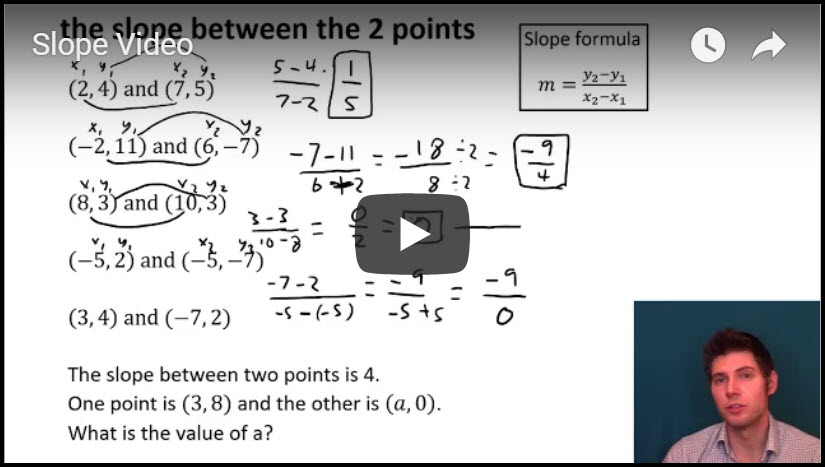
Find the slope between the two points.
\(\textbf{1)}\) \( (2,4) \) and \( (7,5) \)
The slope is \( \frac{1}{5} \)
\(\,\,\,\,\,\,\text{Slope}=\displaystyle \frac{y_2-y_1}{x_2-x_1}\)
\(\,\,\,\,\,\,\displaystyle \frac{5-4}{7-2}\)
\(\,\,\,\,\,\,\displaystyle \frac{1}{5}\)
\(\,\,\,\,\,\,\displaystyle \frac{1}{5} \)
\(\,\,\,\,\,\,\text{Slope}=\displaystyle \frac{y_2-y_1}{x_2-x_1}\)
\(\,\,\,\,\,\,\displaystyle \frac{5-4}{7-2}\)
\(\,\,\,\,\,\,\displaystyle \frac{1}{5}\)
\(\,\,\,\,\,\,\displaystyle \frac{1}{5} \)
\(\textbf{2)}\) \( (-2,11) \) and \( (6,-7) \)
The slope is \( -\frac{9}{4} \)
\(\,\,\,\,\,\,\text{Slope}=\displaystyle \frac{y_2-y_1}{x_2-x_1}\)
\(\,\,\,\,\,\,\displaystyle \frac{11-\left(-7\right)}{-2-6}\)
\(\,\,\,\,\,\,\displaystyle \frac{18}{-8}\)
\(\,\,\,\,\,\,\displaystyle -\frac{9}{4} \)
\(\,\,\,\,\,\,\text{Slope}=\displaystyle \frac{y_2-y_1}{x_2-x_1}\)
\(\,\,\,\,\,\,\displaystyle \frac{11-\left(-7\right)}{-2-6}\)
\(\,\,\,\,\,\,\displaystyle \frac{18}{-8}\)
\(\,\,\,\,\,\,\displaystyle -\frac{9}{4} \)
\(\textbf{3)}\) \( (8,3) \) and \( (10,3) \)
The slope is \( 0 \)
\(\,\,\,\,\,\,\text{Slope}=\displaystyle \frac{y_2-y_1}{x_2-x_1}\)
\(\,\,\,\,\,\,\displaystyle \frac{3-3}{10-8}\)
\(\,\,\,\,\,\,\displaystyle \frac{0}{2}\)
\(\,\,\,\,\,\,0 \)
\(\,\,\,\,\,\,\text{Slope}=\displaystyle \frac{y_2-y_1}{x_2-x_1}\)
\(\,\,\,\,\,\,\displaystyle \frac{3-3}{10-8}\)
\(\,\,\,\,\,\,\displaystyle \frac{0}{2}\)
\(\,\,\,\,\,\,0 \)
\(\textbf{4)}\) \( (-5,2) \) and \( (-5,-7) \)
The answer is Undefined slope
\(\,\,\,\,\,\,\text{Slope}=\displaystyle \frac{y_2-y_1}{x_2-x_1}\)
\(\,\,\,\,\,\,\displaystyle \frac{-7-2}{-5-\left(-5\right)}\)
\(\,\,\,\,\,\,\displaystyle \frac{-9}{0}\)
\(\,\,\,\,\,\,\text{Undefined slope} \)
\(\,\,\,\,\,\,\text{Slope}=\displaystyle \frac{y_2-y_1}{x_2-x_1}\)
\(\,\,\,\,\,\,\displaystyle \frac{-7-2}{-5-\left(-5\right)}\)
\(\,\,\,\,\,\,\displaystyle \frac{-9}{0}\)
\(\,\,\,\,\,\,\text{Undefined slope} \)
\(\textbf{5)}\) \( (3,4) \) and \( (-7,2) \)
The slope is \( \frac{1}{5} \)
\(\,\,\,\,\,\,\text{Slope}=\displaystyle \frac{y_2-y_1}{x_2-x_1}\)
\(\,\,\,\,\,\,\displaystyle \frac{4-2}{3-\left(-7\right)}\)
\(\,\,\,\,\,\,\displaystyle \frac{2}{10}\)
\(\,\,\,\,\,\,\displaystyle \frac{1}{5} \)
\(\,\,\,\,\,\,\text{Slope}=\displaystyle \frac{y_2-y_1}{x_2-x_1}\)
\(\,\,\,\,\,\,\displaystyle \frac{4-2}{3-\left(-7\right)}\)
\(\,\,\,\,\,\,\displaystyle \frac{2}{10}\)
\(\,\,\,\,\,\,\displaystyle \frac{1}{5} \)
Challenge Problems
\(\textbf{6)}\) The slope between two points is 4. One point is (3,8) and the other is (a,0). What is the value of a?
The answer is \( a=1 \)
\(\,\,\,\,\,\,\text{Slope}=\displaystyle \frac{y_2-y_1}{x_2-x_1}\)
\(\,\,\,\,\,\,4 = \displaystyle \frac{0-8}{a-3}\)
\(\,\,\,\,\,\,4 = \displaystyle \frac{-8}{a-3}\)
\(\,\,\,\,\,\,4\left(a-3\right) = -8\)
\(\,\,\,\,\,\,4a-12 = -8\)
\(\,\,\,\,\,\,4a = 4\)
\(\,\,\,\,\,\,a = 1\)
\(\,\,\,\,\,\,\text{Slope}=\displaystyle \frac{y_2-y_1}{x_2-x_1}\)
\(\,\,\,\,\,\,4 = \displaystyle \frac{0-8}{a-3}\)
\(\,\,\,\,\,\,4 = \displaystyle \frac{-8}{a-3}\)
\(\,\,\,\,\,\,4\left(a-3\right) = -8\)
\(\,\,\,\,\,\,4a-12 = -8\)
\(\,\,\,\,\,\,4a = 4\)
\(\,\,\,\,\,\,a = 1\)
\(\textbf{7)}\) Find the slope of this line
\({\begin{array}{|c|c|c|c|c|c|}
\hline
\textbf{x} & 0 & 1 & 2 & 3 & 4 \\
\hline
\textbf{y} & 8 & 6 & 4 & 2 & 0 \\
\hline
\end{array} }
\) slope \(=-2\)
\(\,\,\,\,\,\,\displaystyle\frac{y_2-y_1}{x_2-x_1}\)
\(\,\,\,\,\,\,\displaystyle\frac{6-8}{1-0}\)
\(\,\,\,\,\,\,\displaystyle\frac{-2}{1}\)
\(\,\,\,\,\,\,\)The slope \(=-2\)
\(\,\,\,\,\,\,\displaystyle\frac{y_2-y_1}{x_2-x_1}\)
\(\,\,\,\,\,\,\displaystyle\frac{6-8}{1-0}\)
\(\,\,\,\,\,\,\displaystyle\frac{-2}{1}\)
\(\,\,\,\,\,\,\)The slope \(=-2\)
True or False?
\(\textbf{8)}\) Slopes can be thought of as \(\frac{\text{Rise}}{\text{Run}}\). True
\(\textbf{9)}\) Horizontal lines have a slope of zero. True
\(\textbf{10)}\) Parallel lines have the same slope. True
\(\textbf{11)}\) \(\displaystyle\frac{y_1-y_2}{x_1-x_2}=\frac{y_2-y_1}{x_2-x_1}\) True
See Related Pages\(\)
\(\bullet\text{ Geometry Homepage}\)
\(\,\,\,\,\,\,\,\,\text{All the Best Topics…}\)
\(\bullet\text{ Graphing Linear Equations}\)
\(\,\,\,\,\,\,\,\,2x-3y=6 \) 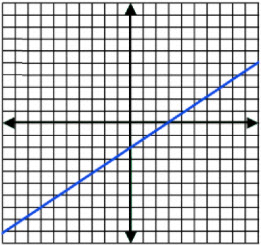
\(\bullet\text{ Net Change}\)
\(\,\,\,\,\,\,\,\,y_2-y_1\)
\(\bullet\text{ Slope Intercept Form}\)
\(\,\,\,\,\,\,\,\,y=mx+b\)
\(\bullet\text{ Point Slope Form}\)
\(\,\,\,\,\,\,\,\,y-y_1=m(x-x_1)\)
\(\bullet\text{ Parallel and Perpendicular Slope}\)
\(\,\,\,\,\,\,\,\,m_1=m+2,\,\,\,m_1=\frac{1}{m_2}\)
\(\bullet\text{ Distance Between a Point and a Line}\)
\(\,\,\,\,\,\,\,\,(3,4) \text{ and } y=\frac{3}{4}x−2\)
\(\bullet\text{ Finding x- and y- intercepts}\)
\(\,\,\,\,\,\,\,\,y=2x+4\)
In Summary
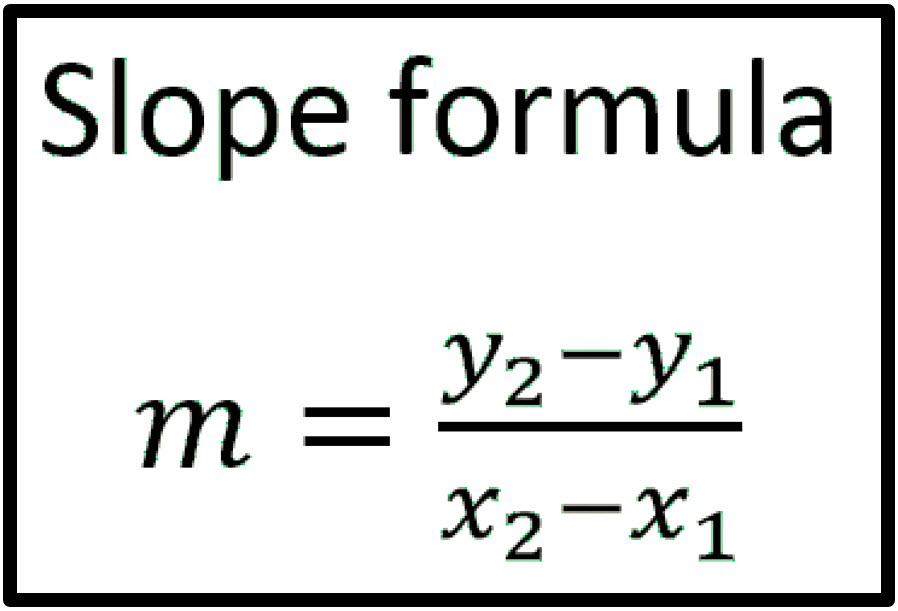
The slope formula is the way to find the slope of a line between two points. The formula is \(m = \frac{y_2-y_1}{x_2-x_1}\), where \(m\) is the slope, \((x_1, y_1)\) and \((x_2, y_2)\) are two points on the line.
The slope formula is typically covered in a high school algebra or geometry class.
A fun fact about the slope formula is that it can be used to determine whether two lines are parallel or perpendicular. If the slopes of two lines are the same, the lines are parallel. If the slopes of two lines are negative reciprocals of each other, the lines are perpendicular.
The slope formula has many real-world applications. For example, it can be used to model and analyze data in fields such as economics and engineering. It can also be used to solve practical problems such as calculating distances and determining the rate of change of a quantity over time.
The concept of the slope formula was first developed by the French mathematician René Descartes in the 17th century. He is credited with introducing the use of coordinates to represent points in space, which paved the way for the development of graphing techniques.