

Implicit differentiation is used when an equation has both \(x\) and \(y\) mixed together, making it difficult or impossible to solve directly for \(y\). The key idea is to differentiate both sides with respect to \(x\), remembering that every derivative of a \(y\) term must include \(\frac{dy}{dx}\). These problems focus on finding \(\frac{dy}{dx}\) and then sometimes evaluating the derivative at a specific point to find a slope.
Practice Problems
Find \(\frac{dy}{dx}\) by implicit differentiation
\(\textbf{1)}\) \(x^2+y^2=25\) The answer is \(\frac{dy}{dx}=\displaystyle -\frac{x}{y}\)
\(\,\,\,\,\,x^2 + y^2 = 25\)
\(\,\,\,\,\,2x + 2y \cdot \frac{dy}{dx} = 0\)
\(\,\,\,\,\,2y \cdot \frac{dy}{dx} = -2x\)
\(\,\,\,\,\,\frac{dy}{dx} = \displaystyle -\frac{x}{y}\)
\(\,\,\,\,\,\)The answer is \(\frac{dy}{dx}=\displaystyle -\frac{x}{y}\)

\(\,\,\,\,\,x^2 + y^2 = 25\)
\(\,\,\,\,\,2x + 2y \cdot \frac{dy}{dx} = 0\)
\(\,\,\,\,\,2y \cdot \frac{dy}{dx} = -2x\)
\(\,\,\,\,\,\frac{dy}{dx} = \displaystyle -\frac{x}{y}\)
\(\,\,\,\,\,\)The answer is \(\frac{dy}{dx}=\displaystyle -\frac{x}{y}\)
\(\textbf{2)}\) \(x^2y-xy=10\) The answer is \(\frac{dy}{dx}=\displaystyle\frac{y-2yx}{x(x-1)} \)
\(\,\,\,\,\,\,x^2y-xy=10\)
\(\,\,\,\,\,\,2x \cdot y+ x^2 \cdot \frac{dy}{dx} -\left[ 1 \cdot y + x \cdot \frac{dy}{dx} \right] =0\)
\(\,\,\,\,\,\,2x \cdot y+ x^2 \cdot \frac{dy}{dx} – y – x \cdot \frac{dy}{dx} =0\)
\(\,\,\,\,\,\,x \cdot \frac{dy}{dx} – x^2 \cdot \frac{dy}{dx} = 2x \cdot y – y \)
\(\,\,\,\,\,\,\frac{dy}{dx} \left(x – x^2 \right)= 2x \cdot y – y \)
\(\,\,\,\,\,\,\frac{dy}{dx} = \displaystyle \frac{ 2x \cdot y – y}{\left(x – x^2 \right)} \)
\(\,\,\,\,\,\,\text{The answer is } \frac{dy}{dx}=\displaystyle \frac{y-2yx}{x(x-1)} \)
\(\,\,\,\,\,\,x^2y-xy=10\)
\(\,\,\,\,\,\,2x \cdot y+ x^2 \cdot \frac{dy}{dx} -\left[ 1 \cdot y + x \cdot \frac{dy}{dx} \right] =0\)
\(\,\,\,\,\,\,2x \cdot y+ x^2 \cdot \frac{dy}{dx} – y – x \cdot \frac{dy}{dx} =0\)
\(\,\,\,\,\,\,x \cdot \frac{dy}{dx} – x^2 \cdot \frac{dy}{dx} = 2x \cdot y – y \)
\(\,\,\,\,\,\,\frac{dy}{dx} \left(x – x^2 \right)= 2x \cdot y – y \)
\(\,\,\,\,\,\,\frac{dy}{dx} = \displaystyle \frac{ 2x \cdot y – y}{\left(x – x^2 \right)} \)
\(\,\,\,\,\,\,\text{The answer is } \frac{dy}{dx}=\displaystyle \frac{y-2yx}{x(x-1)} \)
\(\textbf{3)}\) \(\sin x+\cos y=.5 \) The answer is \(\frac{dy}{dx}=\displaystyle\frac{\cos x}{\sin y} \)
\(\,\,\,\,\,\,\sin x+\cos y=.5\)
\(\,\,\,\,\,\,\cos x-\sin y \cdot \frac{dy}{dx}=0\)
\(\,\,\,\,\,\,-\sin y \cdot \frac{dy}{dx}=-\cos x\)
\(\,\,\,\,\,\,\frac{dy}{dx}=\displaystyle\frac{-\cos x}{-\sin y} \)
\(\,\,\,\,\,\,\)The answer is \(\frac{dy}{dx}=\displaystyle\frac{\cos x}{\sin y} \)
\(\,\,\,\,\,\,\sin x+\cos y=.5\)
\(\,\,\,\,\,\,\cos x-\sin y \cdot \frac{dy}{dx}=0\)
\(\,\,\,\,\,\,-\sin y \cdot \frac{dy}{dx}=-\cos x\)
\(\,\,\,\,\,\,\frac{dy}{dx}=\displaystyle\frac{-\cos x}{-\sin y} \)
\(\,\,\,\,\,\,\)The answer is \(\frac{dy}{dx}=\displaystyle\frac{\cos x}{\sin y} \)
\(\textbf{4)}\) \(\displaystyle \frac{1}{x}+\frac{1}{y}=10\) The answer is \(\frac{dy}{dx}=-\displaystyle\frac{y^2}{x^2} \)
\(\,\,\,\,\,\,\displaystyle \frac{1}{x}+\frac{1}{y}=10\)
\(\,\,\,\,\,\,x^{-1}+y^{-1}=10\)
\(\,\,\,\,\,\,-1x^{-2}-1y^{-2}\cdot \frac{dy}{dx}=0\)
\(\,\,\,\,\,\,-1y^{-2}\cdot \frac{dy}{dx}=1x^{-2}\)
\(\,\,\,\,\,\, \frac{dy}{dx}=\displaystyle\frac{1x^{-2}}{-1y^{-2}}\)
\(\,\,\,\,\,\, \frac{dy}{dx}=\displaystyle-\frac{y^{2}}{x^{2}}\)
\(\,\,\,\,\,\,\)The answer is \(\frac{dy}{dx}=-\displaystyle\frac{y^2}{x^2} \)
\(\,\,\,\,\,\,\displaystyle \frac{1}{x}+\frac{1}{y}=10\)
\(\,\,\,\,\,\,x^{-1}+y^{-1}=10\)
\(\,\,\,\,\,\,-1x^{-2}-1y^{-2}\cdot \frac{dy}{dx}=0\)
\(\,\,\,\,\,\,-1y^{-2}\cdot \frac{dy}{dx}=1x^{-2}\)
\(\,\,\,\,\,\, \frac{dy}{dx}=\displaystyle\frac{1x^{-2}}{-1y^{-2}}\)
\(\,\,\,\,\,\, \frac{dy}{dx}=\displaystyle-\frac{y^{2}}{x^{2}}\)
\(\,\,\,\,\,\,\)The answer is \(\frac{dy}{dx}=-\displaystyle\frac{y^2}{x^2} \)
\(\textbf{5)}\) \(x^5-y^4=20\) The answer is \(\frac{dy}{dx}=\displaystyle\frac{5x^4}{4y^3}\)
\(\,\,\,\,\,\,x^5-y^4=20\)
\(\,\,\,\,\,\,5x^4-4y^3\cdot \frac{dy}{dx}=0\)
\(\,\,\,\,\,\,-4y^3\cdot \frac{dy}{dx}=-5x^4\)
\(\,\,\,\,\,\, \frac{dy}{dx}=\displaystyle\frac{-5x^4}{-4y^3}\)
\(\,\,\,\,\,\,\)The answer is \(\frac{dy}{dx}=\displaystyle\frac{5x^4}{4y^3}\)
\(\,\,\,\,\,\,x^5-y^4=20\)
\(\,\,\,\,\,\,5x^4-4y^3\cdot \frac{dy}{dx}=0\)
\(\,\,\,\,\,\,-4y^3\cdot \frac{dy}{dx}=-5x^4\)
\(\,\,\,\,\,\, \frac{dy}{dx}=\displaystyle\frac{-5x^4}{-4y^3}\)
\(\,\,\,\,\,\,\)The answer is \(\frac{dy}{dx}=\displaystyle\frac{5x^4}{4y^3}\)
\(\textbf{6)}\) \(y-x+xy=8\) The answer is \(\frac{dy}{dx}=\displaystyle \frac{1-y}{x+1}\)
\(\,\,\,\,\,\,y-x+xy=8\)
\(\,\,\,\,\,\,\frac{dy}{dx}-1+1\cdot y + x \cdot \frac{dy}{dx} =0\)
\(\,\,\,\,\,\,\frac{dy}{dx}+ x \cdot \frac{dy}{dx} =1-y\)
\(\,\,\,\,\,\,\frac{dy}{dx}\left(1+x\right)=1-y\)
\(\,\,\,\,\,\,\frac{dy}{dx}=\displaystyle\frac{1-y}{1+x}\)
\(\,\,\,\,\,\,\)The answer is \(\frac{dy}{dx}=\displaystyle \frac{1-y}{x+1}\)
\(\,\,\,\,\,\,y-x+xy=8\)
\(\,\,\,\,\,\,\frac{dy}{dx}-1+1\cdot y + x \cdot \frac{dy}{dx} =0\)
\(\,\,\,\,\,\,\frac{dy}{dx}+ x \cdot \frac{dy}{dx} =1-y\)
\(\,\,\,\,\,\,\frac{dy}{dx}\left(1+x\right)=1-y\)
\(\,\,\,\,\,\,\frac{dy}{dx}=\displaystyle\frac{1-y}{1+x}\)
\(\,\,\,\,\,\,\)The answer is \(\frac{dy}{dx}=\displaystyle \frac{1-y}{x+1}\)
\(\textbf{7)}\) \(x^2-xy=25\) The answer is \(\frac{dy}{dx}=\displaystyle \frac{2x-y}{x}\)
\(\,\,\,\,\,x^2 – xy = 25\)
\(\,\,\,\,\,2x – \left(x \cdot \frac{dy}{dx} + y \cdot 1\right) = 0\)
\(\,\,\,\,\,2x – x \cdot \frac{dy}{dx} – y = 0\)
\(\,\,\,\,\,-x \cdot \frac{dy}{dx} = -2x + y\)
\(\,\,\,\,\,x \cdot \frac{dy}{dx} = 2x – y\)
\(\,\,\,\,\,\frac{dy}{dx} = \displaystyle \frac{2x – y}{x}\)
\(\,\,\,\,\,\)The answer is \(\frac{dy}{dx}=\displaystyle \frac{2x-y}{x}\)
\(\,\,\,\,\,x^2 – xy = 25\)
\(\,\,\,\,\,2x – \left(x \cdot \frac{dy}{dx} + y \cdot 1\right) = 0\)
\(\,\,\,\,\,2x – x \cdot \frac{dy}{dx} – y = 0\)
\(\,\,\,\,\,-x \cdot \frac{dy}{dx} = -2x + y\)
\(\,\,\,\,\,x \cdot \frac{dy}{dx} = 2x – y\)
\(\,\,\,\,\,\frac{dy}{dx} = \displaystyle \frac{2x – y}{x}\)
\(\,\,\,\,\,\)The answer is \(\frac{dy}{dx}=\displaystyle \frac{2x-y}{x}\)
\(\textbf{8)}\) \(xy+y=x+7\) The answer is \(\frac{dy}{dx}=\displaystyle \frac{1-y}{x+1}\)
\(\,\,\,\,\,xy + y = x + 7\)
\(\,\,\,\,\,\left(x \cdot \frac{dy}{dx} + y\right) + \frac{dy}{dx} = 1\)
\(\,\,\,\,\,\frac{dy}{dx}(x + 1) = 1 – y\)
\(\,\,\,\,\,\frac{dy}{dx} = \displaystyle \frac{1 – y}{x + 1}\)
\(\,\,\,\,\,\)The answer is \(\frac{dy}{dx}=\displaystyle \frac{1-y}{x+1}\)
\(\,\,\,\,\,xy + y = x + 7\)
\(\,\,\,\,\,\left(x \cdot \frac{dy}{dx} + y\right) + \frac{dy}{dx} = 1\)
\(\,\,\,\,\,\frac{dy}{dx}(x + 1) = 1 – y\)
\(\,\,\,\,\,\frac{dy}{dx} = \displaystyle \frac{1 – y}{x + 1}\)
\(\,\,\,\,\,\)The answer is \(\frac{dy}{dx}=\displaystyle \frac{1-y}{x+1}\)
\(\textbf{9)}\) \(x^3+y^3=6xy\) The answer is \(\frac{dy}{dx}=\displaystyle\frac{2y-x^2}{y^2-2x}\)
\(\,\,\,\,\,\,x^3+y^3=6xy\)
\(\,\,\,\,\,\,3x^2+3y^2\frac{dy}{dx}=6\left(x\frac{dy}{dx}+y\right)\)
\(\,\,\,\,\,\,3x^2+3y^2\frac{dy}{dx}=6x\frac{dy}{dx}+6y\)
\(\,\,\,\,\,\,3y^2\frac{dy}{dx}-6x\frac{dy}{dx}=6y-3x^2\)
\(\,\,\,\,\,\,\frac{dy}{dx}(3y^2-6x)=6y-3x^2\)
\(\,\,\,\,\,\,\frac{dy}{dx}=\displaystyle\frac{6y-3x^2}{3y^2-6x}\)
\(\,\,\,\,\,\,\frac{dy}{dx}=\displaystyle\frac{2y-x^2}{y^2-2x}\)
\(\,\,\,\,\,\)The answer is \(\frac{dy}{dx}=\displaystyle\frac{2y-x^2}{y^2-2x}\)
\(\,\,\,\,\,\,x^3+y^3=6xy\)
\(\,\,\,\,\,\,3x^2+3y^2\frac{dy}{dx}=6\left(x\frac{dy}{dx}+y\right)\)
\(\,\,\,\,\,\,3x^2+3y^2\frac{dy}{dx}=6x\frac{dy}{dx}+6y\)
\(\,\,\,\,\,\,3y^2\frac{dy}{dx}-6x\frac{dy}{dx}=6y-3x^2\)
\(\,\,\,\,\,\,\frac{dy}{dx}(3y^2-6x)=6y-3x^2\)
\(\,\,\,\,\,\,\frac{dy}{dx}=\displaystyle\frac{6y-3x^2}{3y^2-6x}\)
\(\,\,\,\,\,\,\frac{dy}{dx}=\displaystyle\frac{2y-x^2}{y^2-2x}\)
\(\,\,\,\,\,\)The answer is \(\frac{dy}{dx}=\displaystyle\frac{2y-x^2}{y^2-2x}\)
\(\textbf{10)}\) \(e^y+x^2y=7\) The answer is \(\frac{dy}{dx}=\displaystyle\frac{-2xy}{e^y+x^2}\)
\(\,\,\,\,\,\,e^y+x^2y=7\)
\(\,\,\,\,\,\,e^y\frac{dy}{dx}+2xy+x^2\frac{dy}{dx}=0\)
\(\,\,\,\,\,\,e^y\frac{dy}{dx}+x^2\frac{dy}{dx}=-2xy\)
\(\,\,\,\,\,\,\frac{dy}{dx}\left(e^y+x^2\right)=-2xy\)
\(\,\,\,\,\,\,\frac{dy}{dx}=\displaystyle\frac{-2xy}{e^y+x^2}\)
\(\,\,\,\,\,\)The answer is \(\frac{dy}{dx}=\displaystyle\frac{-2xy}{e^y+x^2}\)
\(\,\,\,\,\,\,e^y+x^2y=7\)
\(\,\,\,\,\,\,e^y\frac{dy}{dx}+2xy+x^2\frac{dy}{dx}=0\)
\(\,\,\,\,\,\,e^y\frac{dy}{dx}+x^2\frac{dy}{dx}=-2xy\)
\(\,\,\,\,\,\,\frac{dy}{dx}\left(e^y+x^2\right)=-2xy\)
\(\,\,\,\,\,\,\frac{dy}{dx}=\displaystyle\frac{-2xy}{e^y+x^2}\)
\(\,\,\,\,\,\)The answer is \(\frac{dy}{dx}=\displaystyle\frac{-2xy}{e^y+x^2}\)
\(\textbf{11)}\) \(x^2+\ln y=4\) The answer is \(\frac{dy}{dx}=-2xy\)
\(\,\,\,\,\,\,x^2+\ln y=4\)
\(\,\,\,\,\,\,2x+\frac{1}{y}\frac{dy}{dx}=0\)
\(\,\,\,\,\,\,\frac{1}{y}\frac{dy}{dx}=-2x\)
\(\,\,\,\,\,\,\frac{dy}{dx}=-2xy\)
\(\,\,\,\,\,\)The answer is \(\frac{dy}{dx}=-2xy\)
\(\,\,\,\,\,\,x^2+\ln y=4\)
\(\,\,\,\,\,\,2x+\frac{1}{y}\frac{dy}{dx}=0\)
\(\,\,\,\,\,\,\frac{1}{y}\frac{dy}{dx}=-2x\)
\(\,\,\,\,\,\,\frac{dy}{dx}=-2xy\)
\(\,\,\,\,\,\)The answer is \(\frac{dy}{dx}=-2xy\)
\(\textbf{12)}\) \(x\sin y+y\cos x=3\) The answer is \(\frac{dy}{dx}=\displaystyle\frac{y\sin x-\sin y}{x\cos y+\cos x}\)
\(\,\,\,\,\,\,x\sin y+y\cos x=3\)
\(\,\,\,\,\,\,\left(\sin y+x\cos y\frac{dy}{dx}\right)+\left(\frac{dy}{dx}\cos x-y\sin x\right)=0\)
\(\,\,\,\,\,\,x\cos y\frac{dy}{dx}+\cos x\frac{dy}{dx}=y\sin x-\sin y\)
\(\,\,\,\,\,\,\frac{dy}{dx}(x\cos y+\cos x)=y\sin x-\sin y\)
\(\,\,\,\,\,\,\frac{dy}{dx}=\displaystyle\frac{y\sin x-\sin y}{x\cos y+\cos x}\)
\(\,\,\,\,\,\)The answer is \(\frac{dy}{dx}=\displaystyle\frac{y\sin x-\sin y}{x\cos y+\cos x}\)
\(\,\,\,\,\,\,x\sin y+y\cos x=3\)
\(\,\,\,\,\,\,\left(\sin y+x\cos y\frac{dy}{dx}\right)+\left(\frac{dy}{dx}\cos x-y\sin x\right)=0\)
\(\,\,\,\,\,\,x\cos y\frac{dy}{dx}+\cos x\frac{dy}{dx}=y\sin x-\sin y\)
\(\,\,\,\,\,\,\frac{dy}{dx}(x\cos y+\cos x)=y\sin x-\sin y\)
\(\,\,\,\,\,\,\frac{dy}{dx}=\displaystyle\frac{y\sin x-\sin y}{x\cos y+\cos x}\)
\(\,\,\,\,\,\)The answer is \(\frac{dy}{dx}=\displaystyle\frac{y\sin x-\sin y}{x\cos y+\cos x}\)
Find \(\frac{dy}{dx}\) by implicit differentiation, then evaluate the derivative (slope) at the given point
\(\textbf{13)}\) \(\text{Find the slope of } x^2-y^2=5 \text{ at } \, (3,2)\) The answer is \(\frac{dy}{dx}=\frac{x}{y} \) at \( (3,2) \) with slope \( =3/2\)
\(\,\,\,\text{Step 1: Solve for }\frac{dy}{dx}\)
\(\,\,\,\,\,\,x^2-y^2=5\)
\(\,\,\,\,\,\,2x-2y \cdot \frac{dy}{dx}=0\)
\(\,\,\,\,\,\,-2y \cdot\frac{dy}{dx}=-2x\)
\(\,\,\,\,\,\,\frac{dy}{dx}=\displaystyle\frac{-2x}{-2y}\)
\(\,\,\,\,\,\,\frac{dy}{dx}=\displaystyle\frac{x}{y}\)
\(\,\,\,\text{Step 2: Plug in } (3,2) \rightarrow x=3,\, y=2\)
\(\,\,\,\,\,\,\frac{dy}{dx}=\displaystyle\frac{3}{2}\)
\(\,\,\,\)The answer is \(\frac{dy}{dx}=\frac{x}{y} \) at \( (3,2) \) with slope \( =3/2\)
\(\,\,\,\text{Step 1: Solve for }\frac{dy}{dx}\)
\(\,\,\,\,\,\,x^2-y^2=5\)
\(\,\,\,\,\,\,2x-2y \cdot \frac{dy}{dx}=0\)
\(\,\,\,\,\,\,-2y \cdot\frac{dy}{dx}=-2x\)
\(\,\,\,\,\,\,\frac{dy}{dx}=\displaystyle\frac{-2x}{-2y}\)
\(\,\,\,\,\,\,\frac{dy}{dx}=\displaystyle\frac{x}{y}\)
\(\,\,\,\text{Step 2: Plug in } (3,2) \rightarrow x=3,\, y=2\)
\(\,\,\,\,\,\,\frac{dy}{dx}=\displaystyle\frac{3}{2}\)
\(\,\,\,\)The answer is \(\frac{dy}{dx}=\frac{x}{y} \) at \( (3,2) \) with slope \( =3/2\)
\(\textbf{14)}\) \(\text{Find the slope of } x^3+y^2x=-4xy \text{ at } \, (3,-1)\) The answer is \(\frac{dy}{dx}=\frac{-3x^2-y^2-4y}{2x(y+2)} \) at \( (3, -1) \) with slope \( =-4\)
\(\,\,\,\text{Step 1: Solve for }\frac{dy}{dx}\)
\(\,\,\,\,\,\,x^3+y^2x=-4xy\)
\(\,\,\,\,\,\,3x^2+\left(2y\cdot\frac{dy}{dx}\cdot x+y^2\right)=-4\left(x\cdot\frac{dy}{dx}+y\right)\)
\(\,\,\,\,\,\,3x^2+2xy\cdot\frac{dy}{dx}+y^2=-4x\cdot\frac{dy}{dx}-4y\)
\(\,\,\,\,\,\,2xy\cdot\frac{dy}{dx}+4x\cdot\frac{dy}{dx}=-3x^2-y^2-4y\)
\(\,\,\,\,\,\,\frac{dy}{dx}\left(2xy+4x\right)=-3x^2-y^2-4y\)
\(\,\,\,\,\,\,\frac{dy}{dx}=\displaystyle\frac{-3x^2-y^2-4y}{2xy+4x}\)
\(\,\,\,\,\,\,\frac{dy}{dx}=\displaystyle\frac{-3x^2-y^2-4y}{2x(y+2)}\)
\(\,\,\,\text{Step 2: Plug in } (3,-1) \rightarrow x=3,\, y=-1\)
\(\,\,\,\,\,\,\frac{dy}{dx}=\displaystyle\frac{-3(3)^2-(-1)^2-4(-1)}{2(3)(-1+2)}\)
\(\,\,\,\,\,\,\frac{dy}{dx}=\displaystyle\frac{-27-1+4}{6}\)
\(\,\,\,\,\,\,\frac{dy}{dx}=\displaystyle\frac{-24}{6}\)
\(\,\,\,\,\,\,\frac{dy}{dx}=-4\)
\(\,\,\,\)The answer is \(\frac{dy}{dx}=\frac{-3x^2-y^2-4y}{2x(y+2)} \) at \( (3, -1) \) with slope \( =-4\)
\(\,\,\,\text{Step 1: Solve for }\frac{dy}{dx}\)
\(\,\,\,\,\,\,x^3+y^2x=-4xy\)
\(\,\,\,\,\,\,3x^2+\left(2y\cdot\frac{dy}{dx}\cdot x+y^2\right)=-4\left(x\cdot\frac{dy}{dx}+y\right)\)
\(\,\,\,\,\,\,3x^2+2xy\cdot\frac{dy}{dx}+y^2=-4x\cdot\frac{dy}{dx}-4y\)
\(\,\,\,\,\,\,2xy\cdot\frac{dy}{dx}+4x\cdot\frac{dy}{dx}=-3x^2-y^2-4y\)
\(\,\,\,\,\,\,\frac{dy}{dx}\left(2xy+4x\right)=-3x^2-y^2-4y\)
\(\,\,\,\,\,\,\frac{dy}{dx}=\displaystyle\frac{-3x^2-y^2-4y}{2xy+4x}\)
\(\,\,\,\,\,\,\frac{dy}{dx}=\displaystyle\frac{-3x^2-y^2-4y}{2x(y+2)}\)
\(\,\,\,\text{Step 2: Plug in } (3,-1) \rightarrow x=3,\, y=-1\)
\(\,\,\,\,\,\,\frac{dy}{dx}=\displaystyle\frac{-3(3)^2-(-1)^2-4(-1)}{2(3)(-1+2)}\)
\(\,\,\,\,\,\,\frac{dy}{dx}=\displaystyle\frac{-27-1+4}{6}\)
\(\,\,\,\,\,\,\frac{dy}{dx}=\displaystyle\frac{-24}{6}\)
\(\,\,\,\,\,\,\frac{dy}{dx}=-4\)
\(\,\,\,\)The answer is \(\frac{dy}{dx}=\frac{-3x^2-y^2-4y}{2x(y+2)} \) at \( (3, -1) \) with slope \( =-4\)
\(\textbf{15)}\) \(\text{Find the slope of } \cos x+\sin y=1 \text{ at } \, (0, 0)\) The answer is \(\frac{dy}{dx}=\frac{\sin x}{\cos y} \) at \( (0,0) \) with slope \( =0\)
\(\,\,\,\text{Step 1: Solve for }\frac{dy}{dx}\)
\(\,\,\,\,\,\,\cos x+\sin y=1\)
\(\,\,\,\,\,\,-\sin x+\cos y\cdot\frac{dy}{dx}=0\)
\(\,\,\,\,\,\,\cos y\cdot\frac{dy}{dx}=\sin x\)
\(\,\,\,\,\,\,\frac{dy}{dx}=\displaystyle\frac{\sin x}{\cos y}\)
\(\,\,\,\text{Step 2: Plug in } (0,0) \rightarrow x=0,\, y=0\)
\(\,\,\,\,\,\,\frac{dy}{dx}=\displaystyle\frac{\sin 0}{\cos 0}\)
\(\,\,\,\,\,\,\frac{dy}{dx}=\displaystyle\frac{0}{1}\)
\(\,\,\,\,\,\,\frac{dy}{dx}=0\)
\(\,\,\,\)The answer is \(\frac{dy}{dx}=\frac{\sin x}{\cos y} \) at \( (0,0) \) with slope \( =0\)
\(\,\,\,\text{Step 1: Solve for }\frac{dy}{dx}\)
\(\,\,\,\,\,\,\cos x+\sin y=1\)
\(\,\,\,\,\,\,-\sin x+\cos y\cdot\frac{dy}{dx}=0\)
\(\,\,\,\,\,\,\cos y\cdot\frac{dy}{dx}=\sin x\)
\(\,\,\,\,\,\,\frac{dy}{dx}=\displaystyle\frac{\sin x}{\cos y}\)
\(\,\,\,\text{Step 2: Plug in } (0,0) \rightarrow x=0,\, y=0\)
\(\,\,\,\,\,\,\frac{dy}{dx}=\displaystyle\frac{\sin 0}{\cos 0}\)
\(\,\,\,\,\,\,\frac{dy}{dx}=\displaystyle\frac{0}{1}\)
\(\,\,\,\,\,\,\frac{dy}{dx}=0\)
\(\,\,\,\)The answer is \(\frac{dy}{dx}=\frac{\sin x}{\cos y} \) at \( (0,0) \) with slope \( =0\)
\(\textbf{16)}\) \(\text{Find the slope of } \left(x^2+y^2\right)^2 = 4x^2y \text{ at } \, (1, 1)\) The slope is \(0\) at \( (1,1) \)
\(\,\,\,\text{Step 1: Differentiate implicitly}\)
\(\,\,\,\,\,\,\left(x^2+y^2\right)^2=4x^2y\)
\(\,\,\,\,\,\,2\left(x^2+y^2\right)\left(2x+2y\cdot\frac{dy}{dx}\right)=4\left(2xy+x^2\cdot\frac{dy}{dx}\right)\)
\(\,\,\,\,\,\,2\left(x^2+y^2\right)\left(2x+2y\cdot\frac{dy}{dx}\right)=8xy+4x^2\cdot\frac{dy}{dx}\)
\(\,\,\,\text{Step 2: Plug in } (1,1) \rightarrow x=1,\, y=1\)
\(\,\,\,\,\,\,2\left(1^2+1^2\right)\left(2(1)+2(1)\cdot\frac{dy}{dx}\right)=8(1)(1)+4(1)^2\cdot\frac{dy}{dx}\)
\(\,\,\,\,\,\,2(2)\left(2+2\frac{dy}{dx}\right)=8+4\frac{dy}{dx}\)
\(\,\,\,\,\,\,4\left(2+2\frac{dy}{dx}\right)=8+4\frac{dy}{dx}\)
\(\,\,\,\,\,\,8+8\frac{dy}{dx}=8+4\frac{dy}{dx}\)
\(\,\,\,\,\,\,4\frac{dy}{dx}=0\)
\(\,\,\,\,\,\,\frac{dy}{dx}=0\)
\(\,\,\,\)The slope is \(0\) at \( (1,1) \)
\(\,\,\,\text{Step 1: Differentiate implicitly}\)
\(\,\,\,\,\,\,\left(x^2+y^2\right)^2=4x^2y\)
\(\,\,\,\,\,\,2\left(x^2+y^2\right)\left(2x+2y\cdot\frac{dy}{dx}\right)=4\left(2xy+x^2\cdot\frac{dy}{dx}\right)\)
\(\,\,\,\,\,\,2\left(x^2+y^2\right)\left(2x+2y\cdot\frac{dy}{dx}\right)=8xy+4x^2\cdot\frac{dy}{dx}\)
\(\,\,\,\text{Step 2: Plug in } (1,1) \rightarrow x=1,\, y=1\)
\(\,\,\,\,\,\,2\left(1^2+1^2\right)\left(2(1)+2(1)\cdot\frac{dy}{dx}\right)=8(1)(1)+4(1)^2\cdot\frac{dy}{dx}\)
\(\,\,\,\,\,\,2(2)\left(2+2\frac{dy}{dx}\right)=8+4\frac{dy}{dx}\)
\(\,\,\,\,\,\,4\left(2+2\frac{dy}{dx}\right)=8+4\frac{dy}{dx}\)
\(\,\,\,\,\,\,8+8\frac{dy}{dx}=8+4\frac{dy}{dx}\)
\(\,\,\,\,\,\,4\frac{dy}{dx}=0\)
\(\,\,\,\,\,\,\frac{dy}{dx}=0\)
\(\,\,\,\)The slope is \(0\) at \( (1,1) \)
\(\textbf{17)}\) \(\text{Find the slope of } x^2+xy+y^2=7 \text{ at } \, (1,2)\) The slope is \(-\frac{4}{5}\) at \((1,2)\)
\(\,\,\,\text{Step 1: Solve for }\frac{dy}{dx}\)
\(\,\,\,\,\,\,x^2+xy+y^2=7\)
\(\,\,\,\,\,\,2x+\left(x\frac{dy}{dx}+y\right)+2y\frac{dy}{dx}=0\)
\(\,\,\,\,\,\,x\frac{dy}{dx}+2y\frac{dy}{dx}=-2x-y\)
\(\,\,\,\,\,\,\frac{dy}{dx}(x+2y)=-2x-y\)
\(\,\,\,\,\,\,\frac{dy}{dx}=\displaystyle\frac{-2x-y}{x+2y}\)
\(\,\,\,\text{Step 2: Plug in } (1,2) \rightarrow x=1,\, y=2\)
\(\,\,\,\,\,\,\frac{dy}{dx}=\displaystyle\frac{-2(1)-2}{1+2(2)}\)
\(\,\,\,\,\,\,\frac{dy}{dx}=\displaystyle\frac{-4}{5}\)
\(\,\,\,\)The slope is \(-\frac{4}{5}\) at \((1,2)\)
\(\,\,\,\text{Step 1: Solve for }\frac{dy}{dx}\)
\(\,\,\,\,\,\,x^2+xy+y^2=7\)
\(\,\,\,\,\,\,2x+\left(x\frac{dy}{dx}+y\right)+2y\frac{dy}{dx}=0\)
\(\,\,\,\,\,\,x\frac{dy}{dx}+2y\frac{dy}{dx}=-2x-y\)
\(\,\,\,\,\,\,\frac{dy}{dx}(x+2y)=-2x-y\)
\(\,\,\,\,\,\,\frac{dy}{dx}=\displaystyle\frac{-2x-y}{x+2y}\)
\(\,\,\,\text{Step 2: Plug in } (1,2) \rightarrow x=1,\, y=2\)
\(\,\,\,\,\,\,\frac{dy}{dx}=\displaystyle\frac{-2(1)-2}{1+2(2)}\)
\(\,\,\,\,\,\,\frac{dy}{dx}=\displaystyle\frac{-4}{5}\)
\(\,\,\,\)The slope is \(-\frac{4}{5}\) at \((1,2)\)
\(\textbf{18)}\) \(\text{Find the slope of } y^2=x^3+3x \text{ at } \, (1,2)\) The slope is \(\frac{3}{2}\) at \((1,2)\)
\(\,\,\,\text{Step 1: Solve for }\frac{dy}{dx}\)
\(\,\,\,\,\,\,y^2=x^3+3x\)
\(\,\,\,\,\,\,2y\frac{dy}{dx}=3x^2+3\)
\(\,\,\,\,\,\,\frac{dy}{dx}=\displaystyle\frac{3x^2+3}{2y}\)
\(\,\,\,\text{Step 2: Plug in } (1,2) \rightarrow x=1,\, y=2\)
\(\,\,\,\,\,\,\frac{dy}{dx}=\displaystyle\frac{3(1)^2+3}{2(2)}\)
\(\,\,\,\,\,\,\frac{dy}{dx}=\displaystyle\frac{6}{4}\)
\(\,\,\,\,\,\,\frac{dy}{dx}=\displaystyle\frac{3}{2}\)
\(\,\,\,\)The slope is \(\frac{3}{2}\) at \((1,2)\)
\(\,\,\,\text{Step 1: Solve for }\frac{dy}{dx}\)
\(\,\,\,\,\,\,y^2=x^3+3x\)
\(\,\,\,\,\,\,2y\frac{dy}{dx}=3x^2+3\)
\(\,\,\,\,\,\,\frac{dy}{dx}=\displaystyle\frac{3x^2+3}{2y}\)
\(\,\,\,\text{Step 2: Plug in } (1,2) \rightarrow x=1,\, y=2\)
\(\,\,\,\,\,\,\frac{dy}{dx}=\displaystyle\frac{3(1)^2+3}{2(2)}\)
\(\,\,\,\,\,\,\frac{dy}{dx}=\displaystyle\frac{6}{4}\)
\(\,\,\,\,\,\,\frac{dy}{dx}=\displaystyle\frac{3}{2}\)
\(\,\,\,\)The slope is \(\frac{3}{2}\) at \((1,2)\)
\(\textbf{19)}\) \(\text{Find the slope of } e^y+xy=3 \text{ at } \, (1,0)\) The slope is \(0\) at \((1,0)\)
\(\,\,\,\text{Step 1: Solve for }\frac{dy}{dx}\)
\(\,\,\,\,\,\,e^y+xy=3\)
\(\,\,\,\,\,\,e^y\frac{dy}{dx}+x\frac{dy}{dx}+y=0\)
\(\,\,\,\,\,\,\frac{dy}{dx}(e^y+x)=-y\)
\(\,\,\,\,\,\,\frac{dy}{dx}=\displaystyle\frac{-y}{e^y+x}\)
\(\,\,\,\text{Step 2: Plug in } (1,0) \rightarrow x=1,\, y=0\)
\(\,\,\,\,\,\,\frac{dy}{dx}=\displaystyle\frac{-0}{e^0+1}\)
\(\,\,\,\,\,\,\frac{dy}{dx}=0\)
\(\,\,\,\)The slope is \(0\) at \((1,0)\)
\(\,\,\,\text{Step 1: Solve for }\frac{dy}{dx}\)
\(\,\,\,\,\,\,e^y+xy=3\)
\(\,\,\,\,\,\,e^y\frac{dy}{dx}+x\frac{dy}{dx}+y=0\)
\(\,\,\,\,\,\,\frac{dy}{dx}(e^y+x)=-y\)
\(\,\,\,\,\,\,\frac{dy}{dx}=\displaystyle\frac{-y}{e^y+x}\)
\(\,\,\,\text{Step 2: Plug in } (1,0) \rightarrow x=1,\, y=0\)
\(\,\,\,\,\,\,\frac{dy}{dx}=\displaystyle\frac{-0}{e^0+1}\)
\(\,\,\,\,\,\,\frac{dy}{dx}=0\)
\(\,\,\,\)The slope is \(0\) at \((1,0)\)
\(\textbf{20)}\) \(\text{Find the slope of } \ln y+x^2=1 \text{ at } \, (0,1)\) The slope is \(0\) at \((0,1)\)
\(\,\,\,\text{Step 1: Solve for }\frac{dy}{dx}\)
\(\,\,\,\,\,\,\ln y+x^2=1\)
\(\,\,\,\,\,\,\frac{1}{y}\frac{dy}{dx}+2x=0\)
\(\,\,\,\,\,\,\frac{1}{y}\frac{dy}{dx}=-2x\)
\(\,\,\,\,\,\,\frac{dy}{dx}=-2xy\)
\(\,\,\,\text{Step 2: Plug in } (0,1) \rightarrow x=0,\, y=1\)
\(\,\,\,\,\,\,\frac{dy}{dx}=-2(0)(1)\)
\(\,\,\,\,\,\,\frac{dy}{dx}=0\)
\(\,\,\,\)The slope is \(0\) at \((0,1)\)
\(\,\,\,\text{Step 1: Solve for }\frac{dy}{dx}\)
\(\,\,\,\,\,\,\ln y+x^2=1\)
\(\,\,\,\,\,\,\frac{1}{y}\frac{dy}{dx}+2x=0\)
\(\,\,\,\,\,\,\frac{1}{y}\frac{dy}{dx}=-2x\)
\(\,\,\,\,\,\,\frac{dy}{dx}=-2xy\)
\(\,\,\,\text{Step 2: Plug in } (0,1) \rightarrow x=0,\, y=1\)
\(\,\,\,\,\,\,\frac{dy}{dx}=-2(0)(1)\)
\(\,\,\,\,\,\,\frac{dy}{dx}=0\)
\(\,\,\,\)The slope is \(0\) at \((0,1)\)
See Related Pages\(\)
\(\bullet\text{Implicit Differentiation Calculator }\)
\(\,\,\,\,\,\,\,\,\text{(Symbolab.com)}\)
\(\bullet\text{ Calculus Homepage}\)
\(\,\,\,\,\,\,\,\,\text{All the Best Topics…}\)
\(\bullet\text{ Definition of Derivative}\)
\(\,\,\,\,\,\,\,\, \displaystyle \lim_{\Delta x\to 0} \frac{f(x+ \Delta x)-f(x)}{\Delta x} \)
\(\bullet\text{ Equation of the Tangent Line}\)
\(\,\,\,\,\,\,\,\,f(x)=x^3+3x^2−x \text{ at the point } (2,18)\)
\(\bullet\text{ Derivatives- Constant Rule}\)
\(\,\,\,\,\,\,\,\,\displaystyle\frac{d}{dx}(c)=0\)
\(\bullet\text{ Derivatives- Power Rule}\)
\(\,\,\,\,\,\,\,\,\displaystyle\frac{d}{dx}(x^n)=nx^{n-1}\)
\(\bullet\text{ Derivatives- Constant Multiple Rule}\)
\(\,\,\,\,\,\,\,\,\displaystyle\frac{d}{dx}(cf(x))=cf'(x)\)
\(\bullet\text{ Derivatives- Sum and Difference Rules}\)
\(\,\,\,\,\,\,\,\,\displaystyle\frac{d}{dx}[f(x) \pm g(x)]=f'(x) \pm g'(x)\)
\(\bullet\text{ Derivatives- Sin and Cos}\)
\(\,\,\,\,\,\,\,\,\displaystyle\frac{d}{dx}sin(x)=cos(x)\)
\(\bullet\text{ Derivatives- Product Rule}\)
\(\,\,\,\,\,\,\,\,\displaystyle\frac{d}{dx}[f(x) \cdot g(x)]=f(x) \cdot g'(x)+f'(x) \cdot g(x)\)
\(\bullet\text{ Derivatives- Quotient Rule}\)
\(\,\,\,\,\,\,\,\,\displaystyle\frac{d}{dx}\left[\displaystyle\frac{f(x)}{g(x)}\right]=\displaystyle\frac{g(x) \cdot f'(x)-f(x) \cdot g'(x)}{[g(x)]^2}\)
\(\bullet\text{ Derivatives- Chain Rule}\)
\(\,\,\,\,\,\,\,\,\displaystyle\frac{d}{dx}[f(g(x))]= f'(g(x)) \cdot g'(x)\)
\(\bullet\text{ Derivatives- ln(x)}\)
\(\,\,\,\,\,\,\,\,\displaystyle\frac{d}{dx}[ln(x)]= \displaystyle \frac{1}{x}\)
\(\bullet\text{ Horizontal Tangent Line}\)
\(\,\,\,\,\,\,\,\,\)
\(\bullet\text{ Mean Value Theorem}\)
\(\,\,\,\,\,\,\,\,\)
\(\bullet\text{ Related Rates}\)
\(\,\,\,\,\,\,\,\,\)
\(\bullet\text{ Increasing and Decreasing Intervals}\)
\(\,\,\,\,\,\,\,\,\)
\(\bullet\text{ Intervals of concave up and down}\)
\(\,\,\,\,\,\,\,\,\)
\(\bullet\text{ Inflection Points}\)
\(\,\,\,\,\,\,\,\,\)
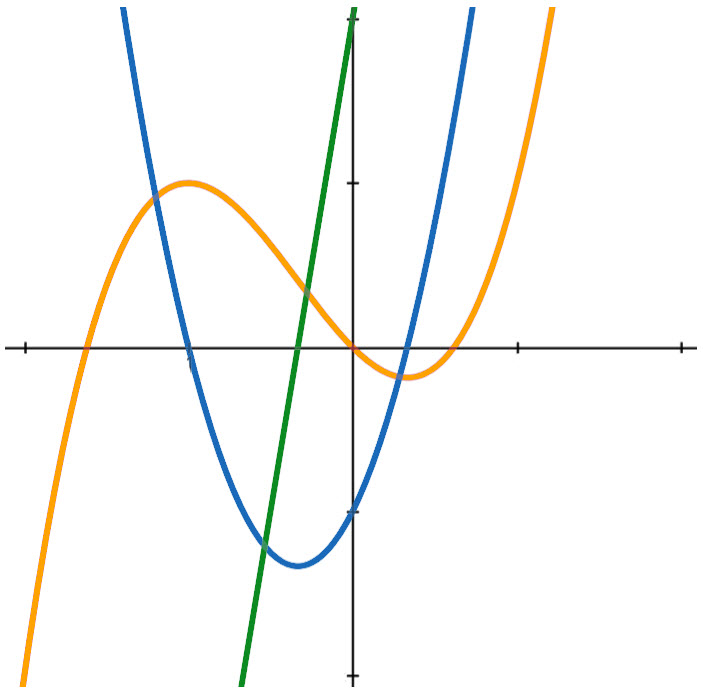
\(\bullet\text{ Graph of f(x), f'(x) and f”(x)}\)
\(\,\,\,\,\,\,\,\,\)
\(\bullet\text{ Newton’s Method}\)
\(\,\,\,\,\,\,\,\,x_{n+1}=x_n – \displaystyle \frac{f(x_n)}{f'(x_n)}\)