
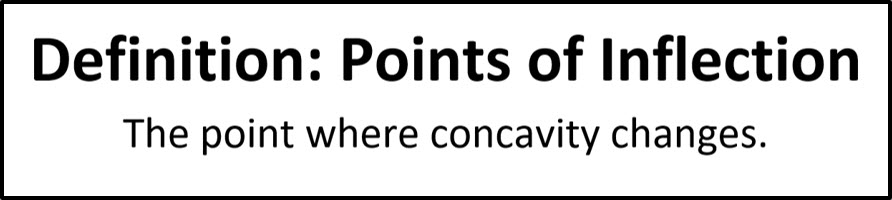
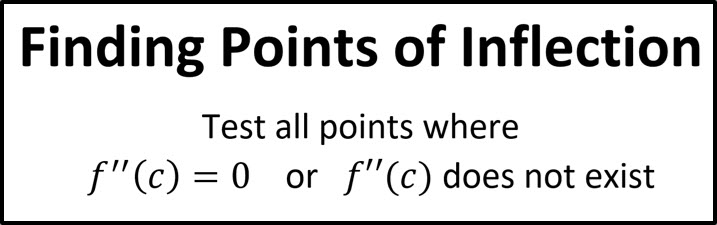
Inflection points are points on a graph where the concavity changes from concave up to concave down, or from concave down to concave up. To find possible inflection points, take the second derivative, set it equal to zero or find where it is undefined, and then check whether the sign of the second derivative changes. These problems focus on finding inflection points using derivatives, sign changes, and function values.
Notes
Practice Problems
Find the points of inflection.
\(\textbf{1)}\) \( f(x)=x^3+6x^2-10x+4 \)The inflection point is \( (-2,40) \)
\(\,\,\,\,\,\,f(x)=x^3+6x^2-10x+4\)
\(\,\,\,\,\,\,f'(x)=3x^2+12x-10\)
\(\,\,\,\,\,\,f”(x)=6x+12\)
\(\,\,\,\,\,\,6x+12=0\)
\(\,\,\,\,\,\,x=-2\)
\(\,\,\,\,\,\,f(-2)=(-2)^3+6(-2)^2-10(-2)+4\)
\(\,\,\,\,\,\,f(-2)=-8+24+20+4=40\)
\(\,\,\,\,\,\)The inflection point is \((-2,40)\)
\(\,\,\,\,\,\,f(x)=x^3+6x^2-10x+4\)
\(\,\,\,\,\,\,f'(x)=3x^2+12x-10\)
\(\,\,\,\,\,\,f”(x)=6x+12\)
\(\,\,\,\,\,\,6x+12=0\)
\(\,\,\,\,\,\,x=-2\)
\(\,\,\,\,\,\,f(-2)=(-2)^3+6(-2)^2-10(-2)+4\)
\(\,\,\,\,\,\,f(-2)=-8+24+20+4=40\)
\(\,\,\,\,\,\)The inflection point is \((-2,40)\)
\(\textbf{2)}\) \( f(x)=\frac{1}{2}x^4-3x^2 \) The inflection points are \( (-1,-2.5) \,\, \) and \( \,\, (1,-2.5) \)
\(\,\,\,\,\,\,f(x)=\frac{1}{2}x^4-3x^2\)
\(\,\,\,\,\,\,f'(x)=2x^3-6x\)
\(\,\,\,\,\,\,f”(x)=6x^2-6\)
\(\,\,\,\,\,\,6x^2-6=0\)
\(\,\,\,\,\,\,x^2=1\)
\(\,\,\,\,\,\,x=-1\text{ or }x=1\)
\(\,\,\,\,\,\,f(-1)=\frac{1}{2}(-1)^4-3(-1)^2=-2.5\)
\(\,\,\,\,\,\,f(1)=\frac{1}{2}(1)^4-3(1)^2=-2.5\)
\(\,\,\,\,\,\)The inflection points are \((-1,-2.5)\) and \((1,-2.5)\)
\(\,\,\,\,\,\,f(x)=\frac{1}{2}x^4-3x^2\)
\(\,\,\,\,\,\,f'(x)=2x^3-6x\)
\(\,\,\,\,\,\,f”(x)=6x^2-6\)
\(\,\,\,\,\,\,6x^2-6=0\)
\(\,\,\,\,\,\,x^2=1\)
\(\,\,\,\,\,\,x=-1\text{ or }x=1\)
\(\,\,\,\,\,\,f(-1)=\frac{1}{2}(-1)^4-3(-1)^2=-2.5\)
\(\,\,\,\,\,\,f(1)=\frac{1}{2}(1)^4-3(1)^2=-2.5\)
\(\,\,\,\,\,\)The inflection points are \((-1,-2.5)\) and \((1,-2.5)\)
\(\textbf{3)}\) \( f(x)=x^3(x+2) \) The inflection points are \( (-1,-1) \,\, \) and \( \,\, (0,0) \)
\(\,\,\,\,\,\,f(x)=x^3(x+2)\)
\(\,\,\,\,\,\,f(x)=x^4+2x^3\)
\(\,\,\,\,\,\,f'(x)=4x^3+6x^2\)
\(\,\,\,\,\,\,f”(x)=12x^2+12x\)
\(\,\,\,\,\,\,12x^2+12x=0\)
\(\,\,\,\,\,\,12x(x+1)=0\)
\(\,\,\,\,\,\,x=0\text{ or }x=-1\)
\(\,\,\,\,\,\,f(0)=0^3(0+2)=0\)
\(\,\,\,\,\,\,f(-1)=(-1)^3(-1+2)=-1\)
\(\,\,\,\,\,\)The inflection points are \((-1,-1)\) and \((0,0)\)
\(\,\,\,\,\,\,f(x)=x^3(x+2)\)
\(\,\,\,\,\,\,f(x)=x^4+2x^3\)
\(\,\,\,\,\,\,f'(x)=4x^3+6x^2\)
\(\,\,\,\,\,\,f”(x)=12x^2+12x\)
\(\,\,\,\,\,\,12x^2+12x=0\)
\(\,\,\,\,\,\,12x(x+1)=0\)
\(\,\,\,\,\,\,x=0\text{ or }x=-1\)
\(\,\,\,\,\,\,f(0)=0^3(0+2)=0\)
\(\,\,\,\,\,\,f(-1)=(-1)^3(-1+2)=-1\)
\(\,\,\,\,\,\)The inflection points are \((-1,-1)\) and \((0,0)\)
\(\textbf{4)}\) \( f(x)=\displaystyle\frac{x}{x^2+1} \) The inflection points are \( (0,0) \,\, \) and \( \,\, (-\sqrt{3},-\displaystyle\frac{\sqrt{3}}{4}) \,\, \) and \( \,\, (\sqrt{3},\displaystyle\frac{\sqrt{3}}{4}) \)
\(\,\,\,\,\,\,f(x)=\displaystyle\frac{x}{x^2+1}\)
\(\,\,\,\,\,\,f'(x)=\displaystyle\frac{1-x^2}{(x^2+1)^2}\)
\(\,\,\,\,\,\,f”(x)=\displaystyle\frac{2x(x^2-3)}{(x^2+1)^3}\)
\(\,\,\,\,\,\,2x(x^2-3)=0\)
\(\,\,\,\,\,\,x=0,\,-\sqrt{3},\,\sqrt{3}\)
\(\,\,\,\,\,\,f(0)=0\)
\(\,\,\,\,\,\,f(-\sqrt{3})=\displaystyle\frac{-\sqrt{3}}{3+1}=-\frac{\sqrt{3}}{4}\)
\(\,\,\,\,\,\,f(\sqrt{3})=\displaystyle\frac{\sqrt{3}}{3+1}=\frac{\sqrt{3}}{4}\)
\(\,\,\,\,\,\)The inflection points are \((0,0)\), \(\left(-\sqrt{3},-\frac{\sqrt{3}}{4}\right)\), and \(\left(\sqrt{3},\frac{\sqrt{3}}{4}\right)\)
\(\,\,\,\,\,\,f(x)=\displaystyle\frac{x}{x^2+1}\)
\(\,\,\,\,\,\,f'(x)=\displaystyle\frac{1-x^2}{(x^2+1)^2}\)
\(\,\,\,\,\,\,f”(x)=\displaystyle\frac{2x(x^2-3)}{(x^2+1)^3}\)
\(\,\,\,\,\,\,2x(x^2-3)=0\)
\(\,\,\,\,\,\,x=0,\,-\sqrt{3},\,\sqrt{3}\)
\(\,\,\,\,\,\,f(0)=0\)
\(\,\,\,\,\,\,f(-\sqrt{3})=\displaystyle\frac{-\sqrt{3}}{3+1}=-\frac{\sqrt{3}}{4}\)
\(\,\,\,\,\,\,f(\sqrt{3})=\displaystyle\frac{\sqrt{3}}{3+1}=\frac{\sqrt{3}}{4}\)
\(\,\,\,\,\,\)The inflection points are \((0,0)\), \(\left(-\sqrt{3},-\frac{\sqrt{3}}{4}\right)\), and \(\left(\sqrt{3},\frac{\sqrt{3}}{4}\right)\)
\(\textbf{5)}\) \( f(x)=\displaystyle\frac{x+4}{\sqrt{x}} \) The inflection point is \( (12,\displaystyle\frac{8\sqrt{3}}{3}) \)
\(\,\,\,\,\,\,f(x)=\displaystyle\frac{x+4}{\sqrt{x}}\)
\(\,\,\,\,\,\,f(x)=x^{1/2}+4x^{-1/2}\)
\(\,\,\,\,\,\,f'(x)=\frac{1}{2}x^{-1/2}-2x^{-3/2}\)
\(\,\,\,\,\,\,f”(x)=-\frac{1}{4}x^{-3/2}+3x^{-5/2}\)
\(\,\,\,\,\,\,f”(x)=\displaystyle\frac{-x+12}{4x^{5/2}}\)
\(\,\,\,\,\,\,-x+12=0\)
\(\,\,\,\,\,\,x=12\)
\(\,\,\,\,\,\,f(12)=\displaystyle\frac{12+4}{\sqrt{12}}\)
\(\,\,\,\,\,\,f(12)=\displaystyle\frac{16}{2\sqrt{3}}=\frac{8}{\sqrt{3}}=\frac{8\sqrt{3}}{3}\)
\(\,\,\,\,\,\)The inflection point is \(\left(12,\frac{8\sqrt{3}}{3}\right)\)
\(\,\,\,\,\,\,f(x)=\displaystyle\frac{x+4}{\sqrt{x}}\)
\(\,\,\,\,\,\,f(x)=x^{1/2}+4x^{-1/2}\)
\(\,\,\,\,\,\,f'(x)=\frac{1}{2}x^{-1/2}-2x^{-3/2}\)
\(\,\,\,\,\,\,f”(x)=-\frac{1}{4}x^{-3/2}+3x^{-5/2}\)
\(\,\,\,\,\,\,f”(x)=\displaystyle\frac{-x+12}{4x^{5/2}}\)
\(\,\,\,\,\,\,-x+12=0\)
\(\,\,\,\,\,\,x=12\)
\(\,\,\,\,\,\,f(12)=\displaystyle\frac{12+4}{\sqrt{12}}\)
\(\,\,\,\,\,\,f(12)=\displaystyle\frac{16}{2\sqrt{3}}=\frac{8}{\sqrt{3}}=\frac{8\sqrt{3}}{3}\)
\(\,\,\,\,\,\)The inflection point is \(\left(12,\frac{8\sqrt{3}}{3}\right)\)
\(\textbf{6)}\) \( f(x)=x^4-6x^2 \) The inflection points are \((-1,-5)\) and \((1,-5)\)
\(\,\,\,\,\,\,f(x)=x^4-6x^2\)
\(\,\,\,\,\,\,f'(x)=4x^3-12x\)
\(\,\,\,\,\,\,f”(x)=12x^2-12\)
\(\,\,\,\,\,\,12x^2-12=0\)
\(\,\,\,\,\,\,x^2=1\)
\(\,\,\,\,\,\,x=-1\text{ or }x=1\)
\(\,\,\,\,\,\,f(-1)=(-1)^4-6(-1)^2=-5\)
\(\,\,\,\,\,\,f(1)=1^4-6(1)^2=-5\)
\(\,\,\,\,\,\)The inflection points are \((-1,-5)\) and \((1,-5)\)
\(\,\,\,\,\,\,f(x)=x^4-6x^2\)
\(\,\,\,\,\,\,f'(x)=4x^3-12x\)
\(\,\,\,\,\,\,f”(x)=12x^2-12\)
\(\,\,\,\,\,\,12x^2-12=0\)
\(\,\,\,\,\,\,x^2=1\)
\(\,\,\,\,\,\,x=-1\text{ or }x=1\)
\(\,\,\,\,\,\,f(-1)=(-1)^4-6(-1)^2=-5\)
\(\,\,\,\,\,\,f(1)=1^4-6(1)^2=-5\)
\(\,\,\,\,\,\)The inflection points are \((-1,-5)\) and \((1,-5)\)
\(\textbf{7)}\) \( f(x)=x^3-9x \) The inflection point is \((0,0)\)
\(\,\,\,\,\,\,f(x)=x^3-9x\)
\(\,\,\,\,\,\,f'(x)=3x^2-9\)
\(\,\,\,\,\,\,f”(x)=6x\)
\(\,\,\,\,\,\,6x=0\)
\(\,\,\,\,\,\,x=0\)
\(\,\,\,\,\,\,f(0)=0^3-9(0)=0\)
\(\,\,\,\,\,\)The inflection point is \((0,0)\)
\(\,\,\,\,\,\,f(x)=x^3-9x\)
\(\,\,\,\,\,\,f'(x)=3x^2-9\)
\(\,\,\,\,\,\,f”(x)=6x\)
\(\,\,\,\,\,\,6x=0\)
\(\,\,\,\,\,\,x=0\)
\(\,\,\,\,\,\,f(0)=0^3-9(0)=0\)
\(\,\,\,\,\,\)The inflection point is \((0,0)\)
\(\textbf{8)}\) \( f(x)=x^4-8x^3 \) The inflection points are \((0,0)\) and \((4,-256)\)
\(\,\,\,\,\,\,f(x)=x^4-8x^3\)
\(\,\,\,\,\,\,f'(x)=4x^3-24x^2\)
\(\,\,\,\,\,\,f”(x)=12x^2-48x\)
\(\,\,\,\,\,\,12x^2-48x=0\)
\(\,\,\,\,\,\,12x(x-4)=0\)
\(\,\,\,\,\,\,x=0\text{ or }x=4\)
\(\,\,\,\,\,\,f(0)=0\)
\(\,\,\,\,\,\,f(4)=4^4-8(4)^3=256-512=-256\)
\(\,\,\,\,\,\)The inflection points are \((0,0)\) and \((4,-256)\)
\(\,\,\,\,\,\,f(x)=x^4-8x^3\)
\(\,\,\,\,\,\,f'(x)=4x^3-24x^2\)
\(\,\,\,\,\,\,f”(x)=12x^2-48x\)
\(\,\,\,\,\,\,12x^2-48x=0\)
\(\,\,\,\,\,\,12x(x-4)=0\)
\(\,\,\,\,\,\,x=0\text{ or }x=4\)
\(\,\,\,\,\,\,f(0)=0\)
\(\,\,\,\,\,\,f(4)=4^4-8(4)^3=256-512=-256\)
\(\,\,\,\,\,\)The inflection points are \((0,0)\) and \((4,-256)\)
\(\textbf{9)}\) \( f(x)=x^5-10x^3 \) The inflection points are \((-\sqrt{3},21\sqrt{3})\), \((0,0)\), and \((\sqrt{3},-21\sqrt{3})\)
\(\,\,\,\,\,\,f(x)=x^5-10x^3\)
\(\,\,\,\,\,\,f'(x)=5x^4-30x^2\)
\(\,\,\,\,\,\,f”(x)=20x^3-60x\)
\(\,\,\,\,\,\,20x^3-60x=0\)
\(\,\,\,\,\,\,20x(x^2-3)=0\)
\(\,\,\,\,\,\,x=0,\,-\sqrt{3},\,\sqrt{3}\)
\(\,\,\,\,\,\,f(0)=0\)
\(\,\,\,\,\,\,f(-\sqrt{3})=(-\sqrt{3})^5-10(-\sqrt{3})^3=21\sqrt{3}\)
\(\,\,\,\,\,\,f(\sqrt{3})=(\sqrt{3})^5-10(\sqrt{3})^3=-21\sqrt{3}\)
\(\,\,\,\,\,\)The inflection points are \((-\sqrt{3},21\sqrt{3})\), \((0,0)\), and \((\sqrt{3},-21\sqrt{3})\)
\(\,\,\,\,\,\,f(x)=x^5-10x^3\)
\(\,\,\,\,\,\,f'(x)=5x^4-30x^2\)
\(\,\,\,\,\,\,f”(x)=20x^3-60x\)
\(\,\,\,\,\,\,20x^3-60x=0\)
\(\,\,\,\,\,\,20x(x^2-3)=0\)
\(\,\,\,\,\,\,x=0,\,-\sqrt{3},\,\sqrt{3}\)
\(\,\,\,\,\,\,f(0)=0\)
\(\,\,\,\,\,\,f(-\sqrt{3})=(-\sqrt{3})^5-10(-\sqrt{3})^3=21\sqrt{3}\)
\(\,\,\,\,\,\,f(\sqrt{3})=(\sqrt{3})^5-10(\sqrt{3})^3=-21\sqrt{3}\)
\(\,\,\,\,\,\)The inflection points are \((-\sqrt{3},21\sqrt{3})\), \((0,0)\), and \((\sqrt{3},-21\sqrt{3})\)
\(\textbf{10)}\) \( f(x)=e^x \) There are no inflection points.
\(\,\,\,\,\,\,f(x)=e^x\)
\(\,\,\,\,\,\,f'(x)=e^x\)
\(\,\,\,\,\,\,f”(x)=e^x\)
\(\,\,\,\,\,\,e^x\text{ is always positive.}\)
\(\,\,\,\,\,\,\text{The concavity never changes.}\)
\(\,\,\,\,\,\)There are no inflection points.
\(\,\,\,\,\,\,f(x)=e^x\)
\(\,\,\,\,\,\,f'(x)=e^x\)
\(\,\,\,\,\,\,f”(x)=e^x\)
\(\,\,\,\,\,\,e^x\text{ is always positive.}\)
\(\,\,\,\,\,\,\text{The concavity never changes.}\)
\(\,\,\,\,\,\)There are no inflection points.
\(\textbf{11)}\) \( f(x)=xe^x \) The inflection point is \(\left(-2,-\frac{2}{e^2}\right)\)
\(\,\,\,\,\,\,f(x)=xe^x\)
\(\,\,\,\,\,\,f'(x)=e^x+xe^x\)
\(\,\,\,\,\,\,f'(x)=e^x(x+1)\)
\(\,\,\,\,\,\,f”(x)=e^x(x+1)+e^x\)
\(\,\,\,\,\,\,f”(x)=e^x(x+2)\)
\(\,\,\,\,\,\,e^x(x+2)=0\)
\(\,\,\,\,\,\,x=-2\)
\(\,\,\,\,\,\,f(-2)=-2e^{-2}=-\frac{2}{e^2}\)
\(\,\,\,\,\,\)The inflection point is \(\left(-2,-\frac{2}{e^2}\right)\)
\(\,\,\,\,\,\,f(x)=xe^x\)
\(\,\,\,\,\,\,f'(x)=e^x+xe^x\)
\(\,\,\,\,\,\,f'(x)=e^x(x+1)\)
\(\,\,\,\,\,\,f”(x)=e^x(x+1)+e^x\)
\(\,\,\,\,\,\,f”(x)=e^x(x+2)\)
\(\,\,\,\,\,\,e^x(x+2)=0\)
\(\,\,\,\,\,\,x=-2\)
\(\,\,\,\,\,\,f(-2)=-2e^{-2}=-\frac{2}{e^2}\)
\(\,\,\,\,\,\)The inflection point is \(\left(-2,-\frac{2}{e^2}\right)\)
\(\textbf{12)}\) \( f(x)=\ln{x} \) There are no inflection points.
\(\,\,\,\,\,\,f(x)=\ln{x}\)
\(\,\,\,\,\,\,f'(x)=\frac{1}{x}\)
\(\,\,\,\,\,\,f”(x)=-\frac{1}{x^2}\)
\(\,\,\,\,\,\,-\frac{1}{x^2}\text{ is always negative on the domain }x>0.\)
\(\,\,\,\,\,\,\text{The concavity never changes.}\)
\(\,\,\,\,\,\)There are no inflection points.
\(\,\,\,\,\,\,f(x)=\ln{x}\)
\(\,\,\,\,\,\,f'(x)=\frac{1}{x}\)
\(\,\,\,\,\,\,f”(x)=-\frac{1}{x^2}\)
\(\,\,\,\,\,\,-\frac{1}{x^2}\text{ is always negative on the domain }x>0.\)
\(\,\,\,\,\,\,\text{The concavity never changes.}\)
\(\,\,\,\,\,\)There are no inflection points.
\(\textbf{13)}\) \( f(x)=x^3-3x^2 \) The inflection point is \((1,-2)\)
\(\,\,\,\,\,\,f(x)=x^3-3x^2\)
\(\,\,\,\,\,\,f'(x)=3x^2-6x\)
\(\,\,\,\,\,\,f”(x)=6x-6\)
\(\,\,\,\,\,\,6x-6=0\)
\(\,\,\,\,\,\,x=1\)
\(\,\,\,\,\,\,f(1)=1^3-3(1)^2=-2\)
\(\,\,\,\,\,\)The inflection point is \((1,-2)\)
\(\,\,\,\,\,\,f(x)=x^3-3x^2\)
\(\,\,\,\,\,\,f'(x)=3x^2-6x\)
\(\,\,\,\,\,\,f”(x)=6x-6\)
\(\,\,\,\,\,\,6x-6=0\)
\(\,\,\,\,\,\,x=1\)
\(\,\,\,\,\,\,f(1)=1^3-3(1)^2=-2\)
\(\,\,\,\,\,\)The inflection point is \((1,-2)\)
\(\textbf{14)}\) Find the inflection point for \(f(x)=\sin{x}\) on \([0,2\pi]\). The inflection point is \((\pi,0)\)
\(\,\,\,\,\,\,f(x)=\sin{x}\)
\(\,\,\,\,\,\,f'(x)=\cos{x}\)
\(\,\,\,\,\,\,f”(x)=-\sin{x}\)
\(\,\,\,\,\,\,-\sin{x}=0\)
\(\,\,\,\,\,\,x=0,\pi,2\pi\)
\(\,\,\,\,\,\,\text{Inside the interval, the concavity changes at }x=\pi.\)
\(\,\,\,\,\,\,f(\pi)=\sin(\pi)=0\)
\(\,\,\,\,\,\)The inflection point is \((\pi,0)\)
\(\,\,\,\,\,\,f(x)=\sin{x}\)
\(\,\,\,\,\,\,f'(x)=\cos{x}\)
\(\,\,\,\,\,\,f”(x)=-\sin{x}\)
\(\,\,\,\,\,\,-\sin{x}=0\)
\(\,\,\,\,\,\,x=0,\pi,2\pi\)
\(\,\,\,\,\,\,\text{Inside the interval, the concavity changes at }x=\pi.\)
\(\,\,\,\,\,\,f(\pi)=\sin(\pi)=0\)
\(\,\,\,\,\,\)The inflection point is \((\pi,0)\)
\(\textbf{15)}\) Find the inflection points for \(f(x)=\cos{x}\) on \([0,2\pi]\). The inflection points are \(\left(\frac{\pi}{2},0\right)\) and \(\left(\frac{3\pi}{2},0\right)\)
\(\,\,\,\,\,\,f(x)=\cos{x}\)
\(\,\,\,\,\,\,f'(x)=-\sin{x}\)
\(\,\,\,\,\,\,f”(x)=-\cos{x}\)
\(\,\,\,\,\,\,-\cos{x}=0\)
\(\,\,\,\,\,\,x=\frac{\pi}{2},\frac{3\pi}{2}\)
\(\,\,\,\,\,\,f\left(\frac{\pi}{2}\right)=0\)
\(\,\,\,\,\,\,f\left(\frac{3\pi}{2}\right)=0\)
\(\,\,\,\,\,\)The inflection points are \(\left(\frac{\pi}{2},0\right)\) and \(\left(\frac{3\pi}{2},0\right)\)
\(\,\,\,\,\,\,f(x)=\cos{x}\)
\(\,\,\,\,\,\,f'(x)=-\sin{x}\)
\(\,\,\,\,\,\,f”(x)=-\cos{x}\)
\(\,\,\,\,\,\,-\cos{x}=0\)
\(\,\,\,\,\,\,x=\frac{\pi}{2},\frac{3\pi}{2}\)
\(\,\,\,\,\,\,f\left(\frac{\pi}{2}\right)=0\)
\(\,\,\,\,\,\,f\left(\frac{3\pi}{2}\right)=0\)
\(\,\,\,\,\,\)The inflection points are \(\left(\frac{\pi}{2},0\right)\) and \(\left(\frac{3\pi}{2},0\right)\)
\(\textbf{16)}\) \( f(x)=x^4+x^3 \) The inflection points are \(\left(-\frac{1}{2},-\frac{1}{16}\right)\) and \((0,0)\)
\(\,\,\,\,\,\,f(x)=x^4+x^3\)
\(\,\,\,\,\,\,f'(x)=4x^3+3x^2\)
\(\,\,\,\,\,\,f”(x)=12x^2+6x\)
\(\,\,\,\,\,\,12x^2+6x=0\)
\(\,\,\,\,\,\,6x(2x+1)=0\)
\(\,\,\,\,\,\,x=0\text{ or }x=-\frac{1}{2}\)
\(\,\,\,\,\,\,f(0)=0\)
\(\,\,\,\,\,\,f\left(-\frac{1}{2}\right)=\left(-\frac{1}{2}\right)^4+\left(-\frac{1}{2}\right)^3\)
\(\,\,\,\,\,\,f\left(-\frac{1}{2}\right)=\frac{1}{16}-\frac{1}{8}=-\frac{1}{16}\)
\(\,\,\,\,\,\)The inflection points are \(\left(-\frac{1}{2},-\frac{1}{16}\right)\) and \((0,0)\)
\(\,\,\,\,\,\,f(x)=x^4+x^3\)
\(\,\,\,\,\,\,f'(x)=4x^3+3x^2\)
\(\,\,\,\,\,\,f”(x)=12x^2+6x\)
\(\,\,\,\,\,\,12x^2+6x=0\)
\(\,\,\,\,\,\,6x(2x+1)=0\)
\(\,\,\,\,\,\,x=0\text{ or }x=-\frac{1}{2}\)
\(\,\,\,\,\,\,f(0)=0\)
\(\,\,\,\,\,\,f\left(-\frac{1}{2}\right)=\left(-\frac{1}{2}\right)^4+\left(-\frac{1}{2}\right)^3\)
\(\,\,\,\,\,\,f\left(-\frac{1}{2}\right)=\frac{1}{16}-\frac{1}{8}=-\frac{1}{16}\)
\(\,\,\,\,\,\)The inflection points are \(\left(-\frac{1}{2},-\frac{1}{16}\right)\) and \((0,0)\)
\(\textbf{17)}\) \( f(x)=\displaystyle\frac{1}{x} \) There are no inflection points.
\(\,\,\,\,\,\,f(x)=\frac{1}{x}\)
\(\,\,\,\,\,\,f'(x)=-\frac{1}{x^2}\)
\(\,\,\,\,\,\,f”(x)=\frac{2}{x^3}\)
\(\,\,\,\,\,\,f”(x)\text{ is undefined at }x=0.\)
\(\,\,\,\,\,\,x=0\text{ is not in the domain of }f(x).\)
\(\,\,\,\,\,\,\text{An inflection point must be a point on the graph.}\)
\(\,\,\,\,\,\)There are no inflection points.
\(\,\,\,\,\,\,f(x)=\frac{1}{x}\)
\(\,\,\,\,\,\,f'(x)=-\frac{1}{x^2}\)
\(\,\,\,\,\,\,f”(x)=\frac{2}{x^3}\)
\(\,\,\,\,\,\,f”(x)\text{ is undefined at }x=0.\)
\(\,\,\,\,\,\,x=0\text{ is not in the domain of }f(x).\)
\(\,\,\,\,\,\,\text{An inflection point must be a point on the graph.}\)
\(\,\,\,\,\,\)There are no inflection points.
\(\textbf{18)}\) \( f(x)=(x-1)^3+2 \) The inflection point is \((1,2)\)
\(\,\,\,\,\,\,f(x)=(x-1)^3+2\)
\(\,\,\,\,\,\,f'(x)=3(x-1)^2\)
\(\,\,\,\,\,\,f”(x)=6(x-1)\)
\(\,\,\,\,\,\,6(x-1)=0\)
\(\,\,\,\,\,\,x=1\)
\(\,\,\,\,\,\,f(1)=(1-1)^3+2=2\)
\(\,\,\,\,\,\)The inflection point is \((1,2)\)
\(\,\,\,\,\,\,f(x)=(x-1)^3+2\)
\(\,\,\,\,\,\,f'(x)=3(x-1)^2\)
\(\,\,\,\,\,\,f”(x)=6(x-1)\)
\(\,\,\,\,\,\,6(x-1)=0\)
\(\,\,\,\,\,\,x=1\)
\(\,\,\,\,\,\,f(1)=(1-1)^3+2=2\)
\(\,\,\,\,\,\)The inflection point is \((1,2)\)
\(\textbf{19)}\) \( f(x)=x^6-5x^4 \) The inflection points are \((-\sqrt{2},-12)\) and \((\sqrt{2},-12)\)
\(\,\,\,\,\,\,f(x)=x^6-5x^4\)
\(\,\,\,\,\,\,f'(x)=6x^5-20x^3\)
\(\,\,\,\,\,\,f”(x)=30x^4-60x^2\)
\(\,\,\,\,\,\,30x^4-60x^2=0\)
\(\,\,\,\,\,\,30x^2(x^2-2)=0\)
\(\,\,\,\,\,\,x=0,\,-\sqrt{2},\,\sqrt{2}\)
\(\,\,\,\,\,\,\text{The second derivative does not change sign at }x=0.\)
\(\,\,\,\,\,\,f(-\sqrt{2})=(-\sqrt{2})^6-5(-\sqrt{2})^4=8-20=-12\)
\(\,\,\,\,\,\,f(\sqrt{2})=(\sqrt{2})^6-5(\sqrt{2})^4=8-20=-12\)
\(\,\,\,\,\,\)The inflection points are \((-\sqrt{2},-12)\) and \((\sqrt{2},-12)\)
\(\,\,\,\,\,\,f(x)=x^6-5x^4\)
\(\,\,\,\,\,\,f'(x)=6x^5-20x^3\)
\(\,\,\,\,\,\,f”(x)=30x^4-60x^2\)
\(\,\,\,\,\,\,30x^4-60x^2=0\)
\(\,\,\,\,\,\,30x^2(x^2-2)=0\)
\(\,\,\,\,\,\,x=0,\,-\sqrt{2},\,\sqrt{2}\)
\(\,\,\,\,\,\,\text{The second derivative does not change sign at }x=0.\)
\(\,\,\,\,\,\,f(-\sqrt{2})=(-\sqrt{2})^6-5(-\sqrt{2})^4=8-20=-12\)
\(\,\,\,\,\,\,f(\sqrt{2})=(\sqrt{2})^6-5(\sqrt{2})^4=8-20=-12\)
\(\,\,\,\,\,\)The inflection points are \((-\sqrt{2},-12)\) and \((\sqrt{2},-12)\)
\(\textbf{20)}\) \( f(x)=\arctan{x} \) The inflection point is \((0,0)\)
\(\,\,\,\,\,\,f(x)=\arctan{x}\)
\(\,\,\,\,\,\,f'(x)=\frac{1}{1+x^2}\)
\(\,\,\,\,\,\,f”(x)=\frac{-2x}{(1+x^2)^2}\)
\(\,\,\,\,\,\,\frac{-2x}{(1+x^2)^2}=0\)
\(\,\,\,\,\,\,x=0\)
\(\,\,\,\,\,\,f(0)=\arctan(0)=0\)
\(\,\,\,\,\,\)The inflection point is \((0,0)\)
\(\,\,\,\,\,\,f(x)=\arctan{x}\)
\(\,\,\,\,\,\,f'(x)=\frac{1}{1+x^2}\)
\(\,\,\,\,\,\,f”(x)=\frac{-2x}{(1+x^2)^2}\)
\(\,\,\,\,\,\,\frac{-2x}{(1+x^2)^2}=0\)
\(\,\,\,\,\,\,x=0\)
\(\,\,\,\,\,\,f(0)=\arctan(0)=0\)
\(\,\,\,\,\,\)The inflection point is \((0,0)\)
See Related Pages\(\)
\(\bullet\text{ Calculus Homepage}\)
\(\,\,\,\,\,\,\,\,\text{All the Best Topics…}\)
\(\bullet\text{ Definition of Derivative}\)
\(\,\,\,\,\,\,\,\, \displaystyle \lim_{\Delta x\to 0} \frac{f(x+ \Delta x)-f(x)}{\Delta x} \)
\(\bullet\text{ Equation of the Tangent Line}\)
\(\,\,\,\,\,\,\,\,f(x)=x^3+3x^2−x \text{ at the point } (2,18)\)
\(\bullet\text{ Derivatives- Constant Rule}\)
\(\,\,\,\,\,\,\,\,\displaystyle\frac{d}{dx}(c)=0\)
\(\bullet\text{ Derivatives- Power Rule}\)
\(\,\,\,\,\,\,\,\,\displaystyle\frac{d}{dx}(x^n)=nx^{n-1}\)
\(\bullet\text{ Derivatives- Constant Multiple Rule}\)
\(\,\,\,\,\,\,\,\,\displaystyle\frac{d}{dx}(cf(x))=cf'(x)\)
\(\bullet\text{ Derivatives- Sum and Difference Rules}\)
\(\,\,\,\,\,\,\,\,\displaystyle\frac{d}{dx}[f(x) \pm g(x)]=f'(x) \pm g'(x)\)
\(\bullet\text{ Derivatives- Sin and Cos}\)
\(\,\,\,\,\,\,\,\,\displaystyle\frac{d}{dx}sin(x)=cos(x)\)
\(\bullet\text{ Derivatives- Product Rule}\)
\(\,\,\,\,\,\,\,\,\displaystyle\frac{d}{dx}[f(x) \cdot g(x)]=f(x) \cdot g'(x)+f'(x) \cdot g(x)\)
\(\bullet\text{ Derivatives- Quotient Rule}\)
\(\,\,\,\,\,\,\,\,\displaystyle\frac{d}{dx}\left[\displaystyle\frac{f(x)}{g(x)}\right]=\displaystyle\frac{g(x) \cdot f'(x)-f(x) \cdot g'(x)}{[g(x)]^2}\)
\(\bullet\text{ Derivatives- Chain Rule}\)
\(\,\,\,\,\,\,\,\,\displaystyle\frac{d}{dx}[f(g(x))]= f'(g(x)) \cdot g'(x)\)
\(\bullet\text{ Derivatives- ln(x)}\)
\(\,\,\,\,\,\,\,\,\displaystyle\frac{d}{dx}[ln(x)]= \displaystyle \frac{1}{x}\)
\(\bullet\text{ Implicit Differentiation}\)
\(\,\,\,\,\,\,\,\,\)
\(\bullet\text{ Horizontal Tangent Line}\)
\(\,\,\,\,\,\,\,\,\)
\(\bullet\text{ Mean Value Theorem}\)
\(\,\,\,\,\,\,\,\,\)
\(\bullet\text{ Related Rates}\)
\(\,\,\,\,\,\,\,\,\)
\(\bullet\text{ Increasing and Decreasing Intervals}\)
\(\,\,\,\,\,\,\,\,\)
\(\bullet\text{ Intervals of concave up and down}\)
\(\,\,\,\,\,\,\,\,\)
\(\bullet\text{ Inflection Points}\)
\(\,\,\,\,\,\,\,\,\)
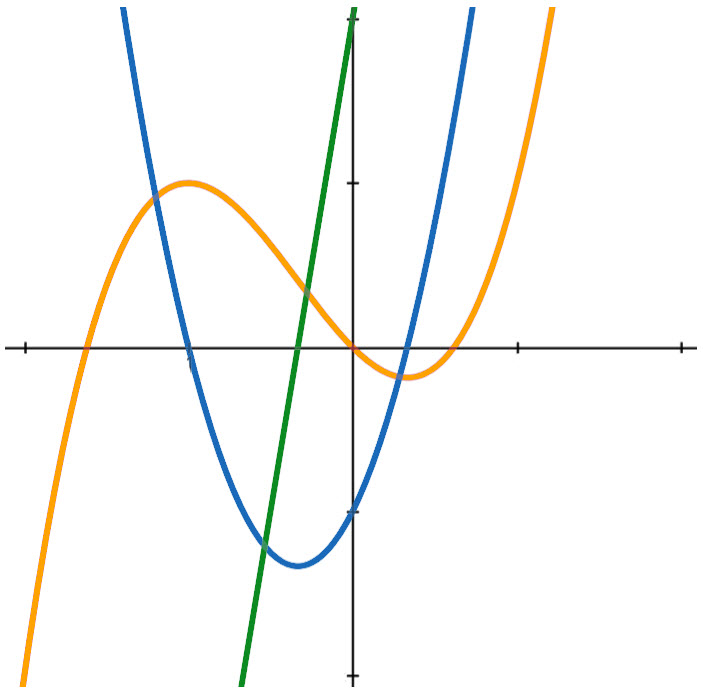
\(\bullet\text{ Graph of f(x), f'(x) and f”(x)}\)
\(\,\,\,\,\,\,\,\,\)
\(\bullet\text{ Newton’s Method}\)
\(\,\,\,\,\,\,\,\,x_{n+1}=x_n – \displaystyle \frac{f(x_n)}{f'(x_n)}\)