Lesson
Practice Problems
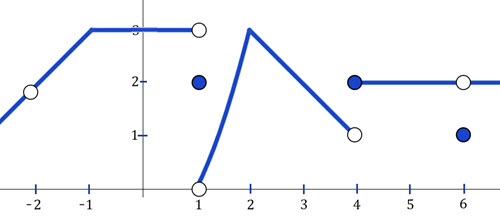
\(\textbf{1)}\)\( \displaystyle \lim_{x\to-2^{-}} f(x) \)
The answer is \(2\)
\(\textbf{2)}\)\( \displaystyle \lim_{x\to-2^{+}} f(x) \)
The answer is \(2\)
\(\textbf{3)}\)\( \displaystyle \lim_{x\to-2} f(x) \)
The answer is \(2\)
\(\textbf{4)}\) \(f(-2)\)
The answer is undefined
\(\textbf{5)}\)\( \displaystyle \lim_{x\to1^{-}} f(x) \)
The answer is \(3\)
\(\textbf{6)}\)\( \displaystyle \lim_{x\to1^{+}} f(x) \)
The answer is \(0\)
\(\textbf{7)}\) \( \displaystyle \lim_{x\to1} f(x) \)
The answer is Does Not Exist (DNE)
\(\textbf{8)}\) \(f(1)\)
The answer is \(2\)
\(\textbf{9)}\)\( \displaystyle \lim_{x\to2^{-}} f(x) \)
The answer is \(3\)
\(\textbf{10)}\)\( \displaystyle \lim_{x\to2^{+}} f(x) \)
The answer is \(3\)
\(\textbf{11)}\) \( \displaystyle \lim_{x\to2} f(x) \)
The answer is \(3\)
\(\textbf{12)}\) \(f(2)\)
The answer is \(3\)
\(\textbf{13)}\)\( \displaystyle \lim_{x\to4^{-}} f(x) \)
The answer is \(1\)
\(\textbf{14)}\)\( \displaystyle \lim_{x\to4^{+}} f(x) \)
The answer is \(2\)
\(\textbf{15)}\) \( \displaystyle \lim_{x\to4} f(x) \)
The answer is Does not exist (DNE)
\(\textbf{16)}\) \(f(4)\)
The answer is \(2\)
\(\textbf{17)}\)\( \displaystyle \lim_{x\to6^{-}} f(x) \)
The answer is \(2\)
\(\textbf{18)}\)\( \displaystyle \lim_{x\to6^{+}} f(x) \)
The answer is \(2\)
\(\textbf{19)}\) \( \displaystyle \lim_{x\to6} f(x) \)
The answer is \(2\)
\(\textbf{20)}\) \(f(6)\)
The answer is \(1\)
See Related Pages\(\)



 \(…\)
\(…\)