

Notes
Practice Problems
Fill in the below chart for each polynomial
| Positive | Negative | Imaginary | Total |
|---|---|---|---|
\(\textbf{1)}\) \(f(x)=2x^3+3x^2-5x+7\)
Positive
Negative
Imaginary
Total
2 1 0 3
0 1 2 3
| Positive | Negative | Imaginary | Total |
|---|---|---|---|
\(\textbf{2)}\) \(f(x)=-x^3+2x^2+3x+4\)
Positive
Negative
Imaginary
Total
1 2 0 3
1 0 2 3
| Positive | Negative | Imaginary | Total |
|---|---|---|---|
\(\textbf{3)}\) \(f(x)=-x^5-2x^4-3x^3+6x^2-x+2\)
Positive
Negative
Imaginary
Total
3 2 0 5
3 0 2 5
1 2 2 5
1 0 4 5
| Positive | Negative | Imaginary | Total |
|---|---|---|---|
\(\textbf{4)}\) \(f(x)=2x^5+3x^4+4x^3+5x^2+x+6\)
Positive
Negative
Imaginary
Total
0 5 0 5
0 3 2 5
0 1 4 5
| Positive | Negative | Imaginary | Total |
|---|---|---|---|
\(\textbf{5)}\) \(f(x)=x^6-2x^5+x^4-5x^3+3x^2+x+1\)
Positive
Negative
Imaginary
Total
4 2 0 6
4 0 2 6
2 2 2 6
2 0 4 6
0 2 4 6
0 0 6 6
| Positive | Negative | Imaginary | Total |
|---|---|---|---|
\(\textbf{6)}\) \(f(x)=-2x^6+x^5+3x^4-2x^3-5x^2+x+1\)
Positive
Negative
Imaginary
Total
3 3 0 6
3 1 2 6
1 3 2 6
1 1 4 6
| Positive | Negative | Imaginary | Total |
|---|---|---|---|
\(\textbf{7)}\) \(f(x)=x^5+2x^4-3x^3+2x^2-x+1\)
Positive
Negative
Imaginary
Total
4 1 0 5
2 1 2 5
0 1 4 5
| Positive | Negative | Imaginary | Total |
|---|---|---|---|
\(\textbf{8)}\) \(f(x)=-x^5-2x^4-3x^3+2x^2-x+1\)
Positive
Negative
Imaginary
Total
3 2 0 5
3 0 2 5
1 2 2 5
1 0 4 5
| Positive | Negative | Imaginary | Total |
|---|---|---|---|
\(\textbf{9)}\) \(f(x)=x^2+1\)
Positive
Negative
Imaginary
Total
0 0 2 2
| Positive | Negative | Imaginary | Total |
|---|---|---|---|
\(\textbf{10)}\) \(f(x)=6x^3-2x^2+4x+1\)
Positive
Negative
Imaginary
Total
2 1 0 3
0 1 2 3
| Positive | Negative | Imaginary | Total |
|---|---|---|---|
\(\textbf{11)}\) \(f(x)=8x^3+4x^2+2x-1\)
Positive
Negative
Imaginary
Total
1 2 0 3
1 0 2 3
| Positive | Negative | Imaginary | Total |
|---|---|---|---|
\(\textbf{12)}\) \(f(x)=-5x^4-2x^3+8x^2-4x+6\)
Positive
Negative
Imaginary
Total
3 1 0 4
1 1 2 4
| Positive | Negative | Imaginary | Total |
|---|---|---|---|
See Related Pages\(\)
\(\bullet\text{ Adding and Subtracting Polynomials}\)
\(\,\,\,\,\,\,\,\,(4d+7)−(2d−5)…\)
\(\bullet\text{ Multiplying Polynomials}\)
\(\,\,\,\,\,\,\,\,(x+2)(x^2+3x−5)…\)
\(\bullet\text{ Dividing Polynomials}\)
\(\,\,\,\,\,\,\,\,(x^3-8)÷(x-2)…\)
\(\bullet\text{ Dividing Polynomials (Synthetic Division)}\)
\(\,\,\,\,\,\,\,\,(x^3-8)÷(x-2)…\)
\(\bullet\text{ Synthetic Substitution}\)
\(\,\,\,\,\,\,\,\,f(x)=4x^4−3x^2+8x−2…\)
\(\bullet\text{ End Behavior}\)
\(\,\,\,\,\,\,\,\, \text{As } x\rightarrow \infty, \quad f(x)\rightarrow \infty \)
\(\,\,\,\,\,\,\,\, \text{As } x\rightarrow -\infty, \quad f(x)\rightarrow \infty… \)
\(\bullet\text{ Completing the Square}\)
\(\,\,\,\,\,\,\,\,x^2+10x−24=0…\)
\(\bullet\text{ Quadratic Formula and the Discriminant}\)
\(\,\,\,\,\,\,\,\,x=-b \pm \displaystyle\frac{\sqrt{b^2-4ac}}{2a}…\)
\(\bullet\text{ Complex Numbers}\)
\(\,\,\,\,\,\,\,\,i=\sqrt{-1}…\)
\(\bullet\text{ Multiplicity of Roots}\)
\(\,\,\,\,\,\,\,\,\) \(…\)
\(…\)
\(\bullet\text{ Rational Zero Theorem}\)
\(\,\,\,\,\,\,\,\, \pm 1,\pm 2,\pm 3,\pm 4,\pm 6,\pm 12…\)
\(\bullet\text{ Descartes Rule of Signs}\)
Positive
Negative
Imaginary
Total
2 1 0 3
0 1 2 3
\(\bullet\text{ Roots and Zeroes}\)
\(\,\,\,\,\,\,\,\,\text{Solve for }x. 3x^2+4x=0…\)
\(\bullet\text{ Linear Factored Form}\)
\(\,\,\,\,\,\,\,\,f(x)=(x+4)(x+1)(x−3)…\)
\(\bullet\text{ Polynomial Inequalities}\)
\(\,\,\,\,\,\,\,\,x^3-4x^2-4x+16 \gt 0…\)
In Summary
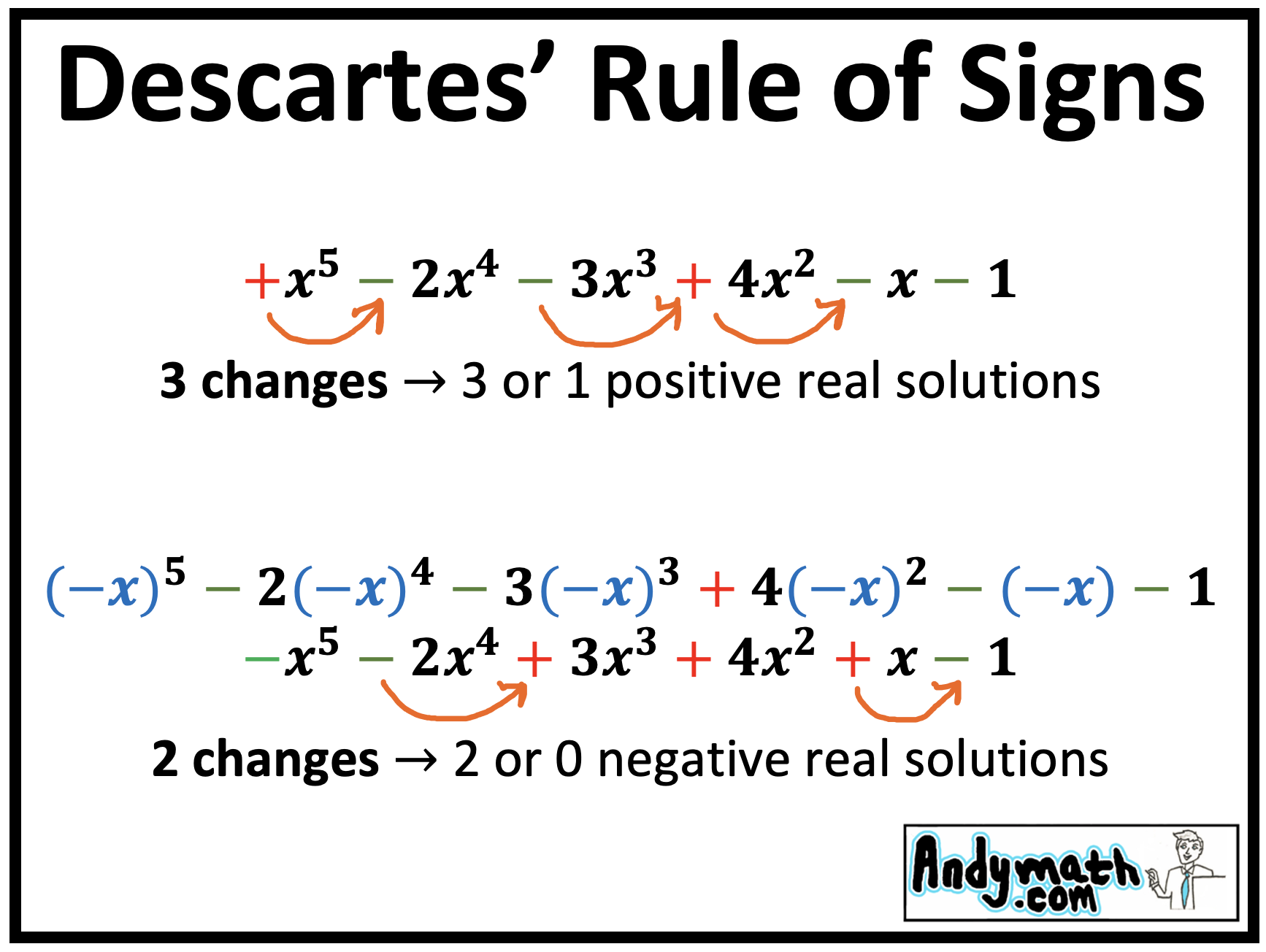
Descartes’ Rule of Signs is a fundamental theorem in algebra that provides a method for determining the possible number of positive and negative real roots of a polynomial equation.
The first part of Descartes’ Rule of Signs focuses on finding the possible number of positive roots. It states that the number of positive real roots of a polynomial equation is either equal to the number of sign changes between consecutive positive coefficients or is less than that number by an even integer (e.g., 0, 2, 4, etc.).
The second part of the rule deals with the possible number of negative roots. It suggests that the number of negative real roots of a polynomial equation is either equal to the number of sign changes between consecutive negative coefficients or is less than that number by an even integer.