

Lesson
Problems & Videos
\(\textbf{1)}\) \(\hspace{1ex} 2x(x-3) \) The answer is \( 2x^2-6x \)
\(2x(x-3)\)
\(2x\cdot x-2x\cdot3\)
\(2x^2-6x\)
\(\,\)The answer is \(2x^2-6x\)
\(2x(x-3)\)
\(2x\cdot x-2x\cdot3\)
\(2x^2-6x\)
\(\,\)The answer is \(2x^2-6x\)
\(\textbf{2)}\) \(\hspace{1ex} (x+2)(x-5) \) The answer is \( x^2-3x-10 \)
\((x+2)(x-5)\)
\(x(x-5)+2(x-5)\)
\(x^2-5x+2x-10\)
\(x^2-3x-10\)
\(\,\)The answer is \(x^2-3x-10\)
\((x+2)(x-5)\)
\(x(x-5)+2(x-5)\)
\(x^2-5x+2x-10\)
\(x^2-3x-10\)
\(\,\)The answer is \(x^2-3x-10\)
\(\textbf{3)}\) \(\hspace{1ex} (x+4)(x-4) \) The answer is \( x^2-16 \)
\((x+4)(x-4)\)
\(x(x-4)+4(x-4)\)
\(x^2-4x+4x-16\)
\(x^2-16\)
\(\,\)The answer is \(x^2-16\)
\((x+4)(x-4)\)
\(x(x-4)+4(x-4)\)
\(x^2-4x+4x-16\)
\(x^2-16\)
\(\,\)The answer is \(x^2-16\)
\(\textbf{4)}\) \(\hspace{1ex} (x+2)(x^2+3x-5) \) The answer is \( x^3+5x^2+x-10 \)
\((x+2)(x^2+3x-5)\)
\(x(x^2+3x-5)+2(x^2+3x-5)\)
\(x^3+3x^2-5x+2x^2+6x-10\)
\(x^3+5x^2+x-10\)
\(\,\)The answer is \(x^3+5x^2+x-10\)
\((x+2)(x^2+3x-5)\)
\(x(x^2+3x-5)+2(x^2+3x-5)\)
\(x^3+3x^2-5x+2x^2+6x-10\)
\(x^3+5x^2+x-10\)
\(\,\)The answer is \(x^3+5x^2+x-10\)
\(\textbf{5)}\) \(\hspace{1ex} (2x-3)(3x+4) \)
The answer is \( 6x^2-x-12 \)
\((2x-3)(3x+4)\)
\(2x(3x+4)-3(3x+4)\)
\(6x^2+8x-9x-12\)
\(6x^2-x-12\)
\(\,\)The answer is \(6x^2-x-12\)
\((2x-3)(3x+4)\)
\(2x(3x+4)-3(3x+4)\)
\(6x^2+8x-9x-12\)
\(6x^2-x-12\)
\(\,\)The answer is \(6x^2-x-12\)
\(\textbf{6)}\) \(\hspace{1ex} (t-5)^2 \)
The answer is \( t^2-10t+25 \)
\((t-5)^2\)
\((t-5)(t-5)\)
\(t^2-5t-5t+25\)
\(t^2-10t+25\)
\(\,\)The answer is \(t^2-10t+25\)
\((t-5)^2\)
\((t-5)(t-5)\)
\(t^2-5t-5t+25\)
\(t^2-10t+25\)
\(\,\)The answer is \(t^2-10t+25\)
\(\textbf{7)}\) \(\hspace{1ex} (x+5)^3 \)
The answer is \( x^3+15x^2+75x+125 \)
\((x+5)^3\)
\((x+5)(x+5)^2\)
\((x+5)(x^2+10x+25)\)
\(x(x^2+10x+25)+5(x^2+10x+25)\)
\(x^3+10x^2+25x+5x^2+50x+125\)
\(x^3+15x^2+75x+125\)
\(\,\)The answer is \(x^3+15x^2+75x+125\)
\((x+5)^3\)
\((x+5)(x+5)^2\)
\((x+5)(x^2+10x+25)\)
\(x(x^2+10x+25)+5(x^2+10x+25)\)
\(x^3+10x^2+25x+5x^2+50x+125\)
\(x^3+15x^2+75x+125\)
\(\,\)The answer is \(x^3+15x^2+75x+125\)
\(\textbf{8)}\) \(\hspace{1ex} (x+5)(2x^2-3x+2) \)
The answer is \( 2x^3+7x^2-13x+10 \)
\((x+5)(2x^2-3x+2)\)
\(x(2x^2-3x+2)+5(2x^2-3x+2)\)
\(2x^3-3x^2+2x+10x^2-15x+10\)
\(2x^3+7x^2-13x+10\)
\(\,\)The answer is \(2x^3+7x^2-13x+10\)
\((x+5)(2x^2-3x+2)\)
\(x(2x^2-3x+2)+5(2x^2-3x+2)\)
\(2x^3-3x^2+2x+10x^2-15x+10\)
\(2x^3+7x^2-13x+10\)
\(\,\)The answer is \(2x^3+7x^2-13x+10\)
\(\textbf{9)}\) \(\hspace{1ex} 4x(2x+5) \) The answer is \( 8x^2+20x \)
\(4x(2x+5)\)
\(4x\cdot2x+4x\cdot5\)
\(8x^2+20x\)
\(\,\)The answer is \(8x^2+20x\)
\(4x(2x+5)\)
\(4x\cdot2x+4x\cdot5\)
\(8x^2+20x\)
\(\,\)The answer is \(8x^2+20x\)
\(\textbf{10)}\) \(\hspace{1ex} (x+2)(x-2) \) The answer is \( x^2-4 \)
\((x+2)(x-2)\)
\(x(x-2)+2(x-2)\)
\(x^2-2x+2x-4\)
\(x^2-4\)
\(\,\)The answer is \(x^2-4\)
\((x+2)(x-2)\)
\(x(x-2)+2(x-2)\)
\(x^2-2x+2x-4\)
\(x^2-4\)
\(\,\)The answer is \(x^2-4\)
\(\textbf{11)}\) \(\hspace{1ex} (x+1)(x+3) \) The answer is \( x^2+4x+3 \)
\((x+1)(x+3)\)
\(x(x+3)+1(x+3)\)
\(x^2+3x+x+3\)
\(x^2+4x+3\)
\(\,\)The answer is \(x^2+4x+3\)
\((x+1)(x+3)\)
\(x(x+3)+1(x+3)\)
\(x^2+3x+x+3\)
\(x^2+4x+3\)
\(\,\)The answer is \(x^2+4x+3\)
\(\textbf{12)}\) \(\hspace{1ex} (x+3)(2x^2+4x-4) \) The answer is \( 2x^3+10x^2+8x-12 \)
\((x+3)(2x^2+4x-4)\)
\(x(2x^2+4x-4)+3(2x^2+4x-4)\)
\(2x^3+4x^2-4x+6x^2+12x-12\)
\(2x^3+10x^2+8x-12\)
\(\,\)The answer is \(2x^3+10x^2+8x-12\)
\((x+3)(2x^2+4x-4)\)
\(x(2x^2+4x-4)+3(2x^2+4x-4)\)
\(2x^3+4x^2-4x+6x^2+12x-12\)
\(2x^3+10x^2+8x-12\)
\(\,\)The answer is \(2x^3+10x^2+8x-12\)
\(\textbf{13)}\) \(\hspace{1ex} (3x + 2)(2x – 5) \) The answer is \( 6x^2 – 11x – 10 \)
\((3x+2)(2x-5)\)
\(3x(2x-5)+2(2x-5)\)
\(6x^2-15x+4x-10\)
\(6x^2-11x-10\)
\(\,\)The answer is \(6x^2-11x-10\)
\((3x+2)(2x-5)\)
\(3x(2x-5)+2(2x-5)\)
\(6x^2-15x+4x-10\)
\(6x^2-11x-10\)
\(\,\)The answer is \(6x^2-11x-10\)
\(\textbf{14)}\) \(\hspace{1ex} (x – 3)(x + 4) \) The answer is \( x^2 + x – 12 \)
\((x-3)(x+4)\)
\(x(x+4)-3(x+4)\)
\(x^2+4x-3x-12\)
\(x^2+x-12\)
\(\,\)The answer is \(x^2+x-12\)
\((x-3)(x+4)\)
\(x(x+4)-3(x+4)\)
\(x^2+4x-3x-12\)
\(x^2+x-12\)
\(\,\)The answer is \(x^2+x-12\)
\(\textbf{15)}\) \(\hspace{1ex} (2x + 1)(3x – 2) \) The answer is \( 6x^2 – x – 2 \)
\((2x+1)(3x-2)\)
\(2x(3x-2)+1(3x-2)\)
\(6x^2-4x+3x-2\)
\(6x^2-x-2\)
\(\,\)The answer is \(6x^2-x-2\)
\((2x+1)(3x-2)\)
\(2x(3x-2)+1(3x-2)\)
\(6x^2-4x+3x-2\)
\(6x^2-x-2\)
\(\,\)The answer is \(6x^2-x-2\)
\(\textbf{16)}\) \(\hspace{1ex} (4x – 1)(x + 7) \) The answer is \( 4x^2 + 27x – 7 \)
\((4x-1)(x+7)\)
\(4x(x+7)-1(x+7)\)
\(4x^2+28x-x-7\)
\(4x^2+27x-7\)
\(\,\)The answer is \(4x^2+27x-7\)
\((4x-1)(x+7)\)
\(4x(x+7)-1(x+7)\)
\(4x^2+28x-x-7\)
\(4x^2+27x-7\)
\(\,\)The answer is \(4x^2+27x-7\)
\(\textbf{17)}\) \(\hspace{1ex} (2x + 5)(x – 3) \) The answer is \( 2x^2 – x – 15 \)
\((2x+5)(x-3)\)
\(2x(x-3)+5(x-3)\)
\(2x^2-6x+5x-15\)
\(2x^2-x-15\)
\(\,\)The answer is \(2x^2-x-15\)
\((2x+5)(x-3)\)
\(2x(x-3)+5(x-3)\)
\(2x^2-6x+5x-15\)
\(2x^2-x-15\)
\(\,\)The answer is \(2x^2-x-15\)
\(\textbf{18)}\) \(\hspace{1ex} (x + 4)(3x + 1) \) The answer is \( 3x^2 + 13x + 4 \)
\((x+4)(3x+1)\)
\(x(3x+1)+4(3x+1)\)
\(3x^2+x+12x+4\)
\(3x^2+13x+4\)
\(\,\)The answer is \(3x^2+13x+4\)
\((x+4)(3x+1)\)
\(x(3x+1)+4(3x+1)\)
\(3x^2+x+12x+4\)
\(3x^2+13x+4\)
\(\,\)The answer is \(3x^2+13x+4\)
\(\textbf{19)}\) \(\hspace{1ex} (2x – 3)(x + 6) \) The answer is \( 2x^2 + 9x – 18 \)
\((2x-3)(x+6)\)
\(2x(x+6)-3(x+6)\)
\(2x^2+12x-3x-18\)
\(2x^2+9x-18\)
\(\,\)The answer is \(2x^2+9x-18\)
\((2x-3)(x+6)\)
\(2x(x+6)-3(x+6)\)
\(2x^2+12x-3x-18\)
\(2x^2+9x-18\)
\(\,\)The answer is \(2x^2+9x-18\)
\(\textbf{20)}\) \(\hspace{1ex} (x + 2)(2x^2 – 3x + 5) \) The answer is \( 2x^3 + x^2 – x + 10 \)
\((x+2)(2x^2-3x+5)\)
\(x(2x^2-3x+5)+2(2x^2-3x+5)\)
\(2x^3-3x^2+5x+4x^2-6x+10\)
\(2x^3+x^2-x+10\)
\(\,\)The answer is \(2x^3+x^2-x+10\)
\((x+2)(2x^2-3x+5)\)
\(x(2x^2-3x+5)+2(2x^2-3x+5)\)
\(2x^3-3x^2+5x+4x^2-6x+10\)
\(2x^3+x^2-x+10\)
\(\,\)The answer is \(2x^3+x^2-x+10\)
See Related Pages\(\)
\(\bullet\text{ Polynomial Multiplication Calculator }\)
\(\,\,\,\,\,\,\,\,\text{(Symbolab.com)}\)
\(\bullet\text{ Multiply Monomials}\)
\(\,\,\,\,\,\,\,\,(7m^2 k^5 )(8m^3 k^4 )…\)
\(\bullet\text{ Dividing Monomials}\)
\(\,\,\,\,\,\,\,\,\displaystyle \frac{12x^4 y^3 z}{3x^2 z^4 x}…\)
\(\bullet\text{ Adding and Subtracting Polynomials}\)
\(\,\,\,\,\,\,\,\,(4d+7)−(2d−5)…\)
\(\bullet\text{ Multiplying Polynomials}\)
\(\,\,\,\,\,\,\,\,(x+2)(x^2+3x−5)…\)
\(\bullet\text{ Dividing Polynomials}\)
\(\,\,\,\,\,\,\,\,(x^3-8)÷(x-2)…\)
\(\bullet\text{ Dividing Polynomials (Synthetic Division)}\)
\(\,\,\,\,\,\,\,\,(x^3-8)÷(x-2)…\)
\(\bullet\text{ Synthetic Substitution}\)
\(\,\,\,\,\,\,\,\,f(x)=4x^4−3x^2+8x−2…\)
\(\bullet\text{ End Behavior}\)
\(\,\,\,\,\,\,\,\, \text{As } x\rightarrow \infty, \quad f(x)\rightarrow \infty \)
\(\,\,\,\,\,\,\,\, \text{As } x\rightarrow -\infty, \quad f(x)\rightarrow \infty… \)
\(\bullet\text{ Completing the Square}\)
\(\,\,\,\,\,\,\,\,x^2+10x−24=0…\)
\(\bullet\text{ Quadratic Formula and the Discriminant}\)
\(\,\,\,\,\,\,\,\,x=-b \pm \displaystyle\frac{\sqrt{b^2-4ac}}{2a}…\)
\(\bullet\text{ Complex Numbers}\)
\(\,\,\,\,\,\,\,\,i=\sqrt{-1}…\)
\(\bullet\text{ Multiplicity of Roots}\)
\(\,\,\,\,\,\,\,\,\)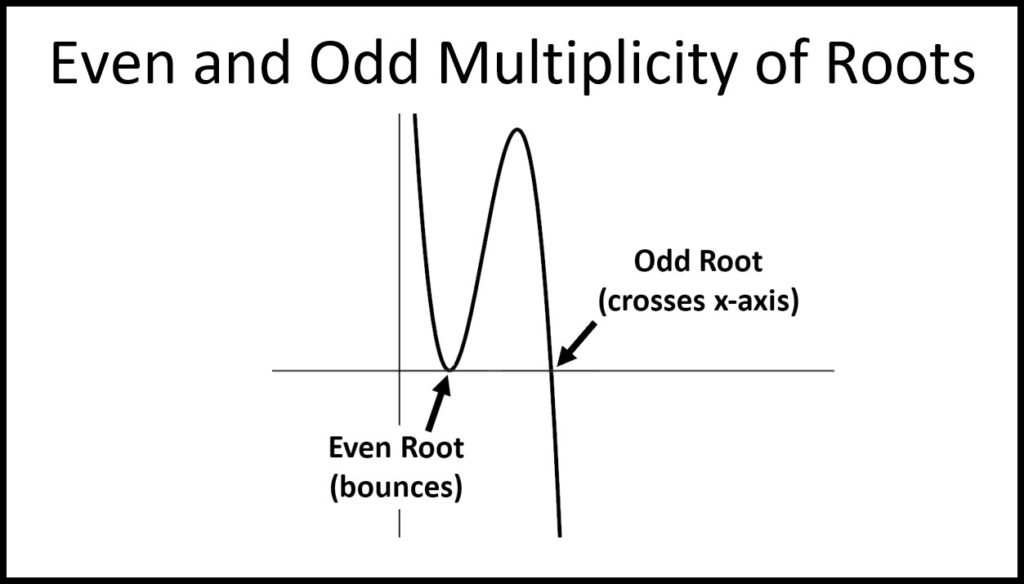 \(…\)
\(…\)
\(\bullet\text{ Rational Zero Theorem}\)
\(\,\,\,\,\,\,\,\, \pm 1,\pm 2,\pm 3,\pm 4,\pm 6,\pm 12…\)
\(\bullet\text{ Descartes Rule of Signs}\)
\(\,\)
\(\bullet\text{ Roots and Zeroes}\)
\(\,\,\,\,\,\,\,\,\text{Solve for }x. 3x^2+4x=0…\)
\(\bullet\text{ Linear Factored Form}\)
\(\,\,\,\,\,\,\,\,f(x)=(x+4)(x+1)(x−3)…\)
\(\bullet\text{ Polynomial Inequalities}\)
\(\,\,\,\,\,\,\,\,x^3-4x^2-4x+16 \gt 0…\)