
Synthetic substitution is a shortcut for evaluating polynomial functions. Instead of plugging a value into every power of \(x\), we use the coefficients and repeat a multiply-add pattern. This is especially useful when polynomials have many terms or missing powers. It also connects nicely to synthetic division and the remainder theorem.
Use synthetic substitution to find the value of each polynomial function
\(\textbf{1)}\) Find \( f(3) \) for \( f(x)=4x^4-3x^2+8x-2 \)The answer is \( f(3)=319 \)
\(\begin{array}{r|rrrrr} 3 & 4 & 0 & -3 & 8 & -2 \\ & & 12 & 36 & 99 & 321 \\ \hline & 4 & 12 & 33 & 107 & 319 \end{array}\)\(\text{Use synthetic substitution with }x=3\text{ and coefficients }4,0,-3,8,-2.\)\(\text{The final number is the value of the function.}\)\(f(3)=319\)
\(\begin{array}{r|rrrrr} 3 & 4 & 0 & -3 & 8 & -2 \\ & & 12 & 36 & 99 & 321 \\ \hline & 4 & 12 & 33 & 107 & 319 \end{array}\)\(\text{Use synthetic substitution with }x=3\text{ and coefficients }4,0,-3,8,-2.\)\(\text{The final number is the value of the function.}\)\(f(3)=319\)
\(\textbf{2)}\) Find \( f(3) \) for \( f(x)=x^5-3x^4-4x^3-2x^2+4x+2 \)The answer is \( f(3)=-112 \)
\(\begin{array}{r|rrrrrr} 3 & 1 & -3 & -4 & -2 & 4 & 2 \\ & & 3 & 0 & -12 & -42 & -114 \\ \hline & 1 & 0 & -4 & -14 & -38 & -112 \end{array}\)\(\text{Use synthetic substitution with }x=3\text{ and coefficients }1,-3,-4,-2,4,2.\)\(\text{The final number is the value of the function.}\)\(f(3)=-112\)
\(\begin{array}{r|rrrrrr} 3 & 1 & -3 & -4 & -2 & 4 & 2 \\ & & 3 & 0 & -12 & -42 & -114 \\ \hline & 1 & 0 & -4 & -14 & -38 & -112 \end{array}\)\(\text{Use synthetic substitution with }x=3\text{ and coefficients }1,-3,-4,-2,4,2.\)\(\text{The final number is the value of the function.}\)\(f(3)=-112\)
\(\textbf{3)}\) Find \( f(3) \) for \( f(x)=4x^4+2x^2-x-3\) \(\text{The answer is }f(3)=336\)
\(\begin{array}{r|rrrrr} 3 & 4 & 0 & 2 & -1 & -3 \\ & & 12 & 36 & 114 & 339 \\ \hline & 4 & 12 & 38 & 113 & 336 \end{array}\)\(\text{Use synthetic substitution with }x=3\text{ and coefficients }4,0,2,-1,-3.\)\(\text{The final number is the value of the function.}\)\(f(3)=336\)
\(\begin{array}{r|rrrrr} 3 & 4 & 0 & 2 & -1 & -3 \\ & & 12 & 36 & 114 & 339 \\ \hline & 4 & 12 & 38 & 113 & 336 \end{array}\)\(\text{Use synthetic substitution with }x=3\text{ and coefficients }4,0,2,-1,-3.\)\(\text{The final number is the value of the function.}\)\(f(3)=336\)
\(\textbf{4)}\) Find \( f(1) \) for \( f(x)=2x^4 – 3x^3 + x^2 + 2x – 5\) \(\text{The answer is }f(1)=-3\)
\(\begin{array}{r|rrrrr} 1 & 2 & -3 & 1 & 2 & -5 \\ & & 2 & -1 & 0 & 2 \\ \hline & 2 & -1 & 0 & 2 & -3 \end{array}\)\(\text{Use synthetic substitution with }x=1\text{ and coefficients }2,-3,1,2,-5.\)\(\text{The final number is the value of the function.}\)\(f(1)=-3\)
\(\begin{array}{r|rrrrr} 1 & 2 & -3 & 1 & 2 & -5 \\ & & 2 & -1 & 0 & 2 \\ \hline & 2 & -1 & 0 & 2 & -3 \end{array}\)\(\text{Use synthetic substitution with }x=1\text{ and coefficients }2,-3,1,2,-5.\)\(\text{The final number is the value of the function.}\)\(f(1)=-3\)
\(\textbf{5)}\) Find \( f(-2) \) for \( f(x)=x^4 + 3x^3 – 2x + 4\) \(\text{The answer is }f(-2)=0\)
\(\begin{array}{r|rrrrr} -2 & 1 & 3 & 0 & -2 & 4 \\ & & -2 & -2 & 4 & -4 \\ \hline & 1 & 1 & -2 & 2 & 0 \end{array}\)\(\text{Use synthetic substitution with }x=-2\text{ and coefficients }1,3,0,-2,4.\)\(\text{The final number is the value of the function.}\)\(f(-2)=0\)
\(\begin{array}{r|rrrrr} -2 & 1 & 3 & 0 & -2 & 4 \\ & & -2 & -2 & 4 & -4 \\ \hline & 1 & 1 & -2 & 2 & 0 \end{array}\)\(\text{Use synthetic substitution with }x=-2\text{ and coefficients }1,3,0,-2,4.\)\(\text{The final number is the value of the function.}\)\(f(-2)=0\)
\(\textbf{6)}\) Find \( f(2) \) for \( f(x)=3x^4 – 5x^2 + 6x – 1\) \(\text{The answer is }f(2)=39\)
\(\begin{array}{r|rrrrr} 2 & 3 & 0 & -5 & 6 & -1 \\ & & 6 & 12 & 14 & 40 \\ \hline & 3 & 6 & 7 & 20 & 39 \end{array}\)\(\text{Use synthetic substitution with }x=2\text{ and coefficients }3,0,-5,6,-1.\)\(\text{The final number is the value of the function.}\)\(f(2)=39\)
\(\begin{array}{r|rrrrr} 2 & 3 & 0 & -5 & 6 & -1 \\ & & 6 & 12 & 14 & 40 \\ \hline & 3 & 6 & 7 & 20 & 39 \end{array}\)\(\text{Use synthetic substitution with }x=2\text{ and coefficients }3,0,-5,6,-1.\)\(\text{The final number is the value of the function.}\)\(f(2)=39\)
\(\textbf{7)}\) Find \( f(-3) \) for \( f(x)=x^4 + 2x^3 – 5x – 8\) \(\text{The answer is }f(-3)=34\)
\(\begin{array}{r|rrrrr} -3 & 1 & 2 & 0 & -5 & -8 \\ & & -3 & 3 & -9 & 42 \\ \hline & 1 & -1 & 3 & -14 & 34 \end{array}\)\(\text{Use synthetic substitution with }x=-3\text{ and coefficients }1,2,0,-5,-8.\)\(\text{The final number is the value of the function.}\)\(f(-3)=34\)
\(\begin{array}{r|rrrrr} -3 & 1 & 2 & 0 & -5 & -8 \\ & & -3 & 3 & -9 & 42 \\ \hline & 1 & -1 & 3 & -14 & 34 \end{array}\)\(\text{Use synthetic substitution with }x=-3\text{ and coefficients }1,2,0,-5,-8.\)\(\text{The final number is the value of the function.}\)\(f(-3)=34\)
\(\textbf{8)}\) Find \( f(4) \) for \( f(x)=5x^4 – 2x^3 + 3x – 9\) \(\text{The answer is }f(4)=1155\)
\(\begin{array}{r|rrrrr} 4 & 5 & -2 & 0 & 3 & -9 \\ & & 20 & 72 & 288 & 1164 \\ \hline & 5 & 18 & 72 & 291 & 1155 \end{array}\)\(\text{Use synthetic substitution with }x=4\text{ and coefficients }5,-2,0,3,-9.\)\(\text{The final number is the value of the function.}\)\(f(4)=1155\)
\(\begin{array}{r|rrrrr} 4 & 5 & -2 & 0 & 3 & -9 \\ & & 20 & 72 & 288 & 1164 \\ \hline & 5 & 18 & 72 & 291 & 1155 \end{array}\)\(\text{Use synthetic substitution with }x=4\text{ and coefficients }5,-2,0,3,-9.\)\(\text{The final number is the value of the function.}\)\(f(4)=1155\)
\(\textbf{9)}\) Find \( f(-1) \) for \( f(x)=2x^4 – 3x^3 + 4x^2 – 2x + 1\) \(\text{The answer is }f(-1)=12\)
\(\begin{array}{r|rrrrr} -1 & 2 & -3 & 4 & -2 & 1 \\ & & -2 & 5 & -9 & 11 \\ \hline & 2 & -5 & 9 & -11 & 12 \end{array}\)\(\text{Use synthetic substitution with }x=-1\text{ and coefficients }2,-3,4,-2,1.\)\(\text{The final number is the value of the function.}\)\(f(-1)=12\)
\(\begin{array}{r|rrrrr} -1 & 2 & -3 & 4 & -2 & 1 \\ & & -2 & 5 & -9 & 11 \\ \hline & 2 & -5 & 9 & -11 & 12 \end{array}\)\(\text{Use synthetic substitution with }x=-1\text{ and coefficients }2,-3,4,-2,1.\)\(\text{The final number is the value of the function.}\)\(f(-1)=12\)
\(\textbf{10)}\) Find \( f(5) \) for \( f(x)=3x^4 – 2x^2 + x – 7\) \(\text{The answer is }f(5)=1823\)
\(\begin{array}{r|rrrrr} 5 & 3 & 0 & -2 & 1 & -7 \\ & & 15 & 75 & 365 & 1830 \\ \hline & 3 & 15 & 73 & 366 & 1823 \end{array}\)\(\text{Use synthetic substitution with }x=5\text{ and coefficients }3,0,-2,1,-7.\)\(\text{The final number is the value of the function.}\)\(f(5)=1823\)
\(\begin{array}{r|rrrrr} 5 & 3 & 0 & -2 & 1 & -7 \\ & & 15 & 75 & 365 & 1830 \\ \hline & 3 & 15 & 73 & 366 & 1823 \end{array}\)\(\text{Use synthetic substitution with }x=5\text{ and coefficients }3,0,-2,1,-7.\)\(\text{The final number is the value of the function.}\)\(f(5)=1823\)
\(\textbf{11)}\) Find \( f(-2) \) for \( f(x)=2x^4 – x^3 + 5x – 6\) \(\text{The answer is }f(-2)=24\)
\(\begin{array}{r|rrrrr} -2 & 2 & -1 & 0 & 5 & -6 \\ & & -4 & 10 & -20 & 30 \\ \hline & 2 & -5 & 10 & -15 & 24 \end{array}\)\(\text{Use synthetic substitution with }x=-2\text{ and coefficients }2,-1,0,5,-6.\)\(\text{The final number is the value of the function.}\)\(f(-2)=24\)
\(\begin{array}{r|rrrrr} -2 & 2 & -1 & 0 & 5 & -6 \\ & & -4 & 10 & -20 & 30 \\ \hline & 2 & -5 & 10 & -15 & 24 \end{array}\)\(\text{Use synthetic substitution with }x=-2\text{ and coefficients }2,-1,0,5,-6.\)\(\text{The final number is the value of the function.}\)\(f(-2)=24\)
\(\textbf{12)}\) Find \( f(2) \) for \( f(x)=x^3 – 4x^2 + 6x – 3\) \(\text{The answer is }f(2)=1\)
\(\begin{array}{r|rrrr} 2 & 1 & -4 & 6 & -3 \\ & & 2 & -4 & 4 \\ \hline & 1 & -2 & 2 & 1 \end{array}\)\(\text{Use synthetic substitution with }x=2\text{ and coefficients }1,-4,6,-3.\)\(\text{The final number is the value of the function.}\)\(f(2)=1\)
\(\begin{array}{r|rrrr} 2 & 1 & -4 & 6 & -3 \\ & & 2 & -4 & 4 \\ \hline & 1 & -2 & 2 & 1 \end{array}\)\(\text{Use synthetic substitution with }x=2\text{ and coefficients }1,-4,6,-3.\)\(\text{The final number is the value of the function.}\)\(f(2)=1\)
\(\textbf{13)}\) Find \( f(-1) \) for \( f(x)=3x^4 – 2x^2 + 7\) \(\text{The answer is }f(-1)=8\)
\(\begin{array}{r|rrrrr} -1 & 3 & 0 & -2 & 0 & 7 \\ & & -3 & 3 & -1 & 1 \\ \hline & 3 & -3 & 1 & -1 & 8 \end{array}\)\(\text{Use synthetic substitution with }x=-1\text{ and coefficients }3,0,-2,0,7.\)\(\text{The final number is the value of the function.}\)\(f(-1)=8\)
\(\begin{array}{r|rrrrr} -1 & 3 & 0 & -2 & 0 & 7 \\ & & -3 & 3 & -1 & 1 \\ \hline & 3 & -3 & 1 & -1 & 8 \end{array}\)\(\text{Use synthetic substitution with }x=-1\text{ and coefficients }3,0,-2,0,7.\)\(\text{The final number is the value of the function.}\)\(f(-1)=8\)
\(\textbf{14)}\) Find \( f(4) \) for \( f(x)=x^4 – 5x^2 + 4\) \(\text{The answer is }f(4)=180\)
\(\begin{array}{r|rrrrr} 4 & 1 & 0 & -5 & 0 & 4 \\ & & 4 & 16 & 44 & 176 \\ \hline & 1 & 4 & 11 & 44 & 180 \end{array}\)\(\text{Use synthetic substitution with }x=4\text{ and coefficients }1,0,-5,0,4.\)\(\text{The final number is the value of the function.}\)\(f(4)=180\)
\(\begin{array}{r|rrrrr} 4 & 1 & 0 & -5 & 0 & 4 \\ & & 4 & 16 & 44 & 176 \\ \hline & 1 & 4 & 11 & 44 & 180 \end{array}\)\(\text{Use synthetic substitution with }x=4\text{ and coefficients }1,0,-5,0,4.\)\(\text{The final number is the value of the function.}\)\(f(4)=180\)
\(\textbf{15)}\) Find \( f(-3) \) for \( f(x)=2x^4 + 5x^3 – x^2 – 9\) \(\text{The answer is }f(-3)=9\)
\(\begin{array}{r|rrrrr} -3 & 2 & 5 & -1 & 0 & -9 \\ & & -6 & 3 & -6 & 18 \\ \hline & 2 & -1 & 2 & -6 & 9 \end{array}\)\(\text{Use synthetic substitution with }x=-3\text{ and coefficients }2,5,-1,0,-9.\)\(\text{The final number is the value of the function.}\)\(f(-3)=9\)
\(\begin{array}{r|rrrrr} -3 & 2 & 5 & -1 & 0 & -9 \\ & & -6 & 3 & -6 & 18 \\ \hline & 2 & -1 & 2 & -6 & 9 \end{array}\)\(\text{Use synthetic substitution with }x=-3\text{ and coefficients }2,5,-1,0,-9.\)\(\text{The final number is the value of the function.}\)\(f(-3)=9\)
\(\textbf{16)}\) Find \( f(1) \) for \( f(x)=4x^4 – 6x^3 + 3x – 10\) \(\text{The answer is }f(1)=-9\)
\(\begin{array}{r|rrrrr} 1 & 4 & -6 & 0 & 3 & -10 \\ & & 4 & -2 & -2 & 1 \\ \hline & 4 & -2 & -2 & 1 & -9 \end{array}\)\(\text{Use synthetic substitution with }x=1\text{ and coefficients }4,-6,0,3,-10.\)\(\text{The final number is the value of the function.}\)\(f(1)=-9\)
\(\begin{array}{r|rrrrr} 1 & 4 & -6 & 0 & 3 & -10 \\ & & 4 & -2 & -2 & 1 \\ \hline & 4 & -2 & -2 & 1 & -9 \end{array}\)\(\text{Use synthetic substitution with }x=1\text{ and coefficients }4,-6,0,3,-10.\)\(\text{The final number is the value of the function.}\)\(f(1)=-9\)
\(\textbf{17)}\) Find \( f(3) \) for \( f(x)=x^5 + 2x^4 – 7x^3 + 6x – 4\) \(\text{The answer is }f(3)=230\)
\(\begin{array}{r|rrrrrr} 3 & 1 & 2 & -7 & 0 & 6 & -4 \\ & & 3 & 15 & 24 & 72 & 234 \\ \hline & 1 & 5 & 8 & 24 & 78 & 230 \end{array}\)\(\text{Use synthetic substitution with }x=3\text{ and coefficients }1,2,-7,0,6,-4.\)\(\text{The final number is the value of the function.}\)\(f(3)=230\)
\(\begin{array}{r|rrrrrr} 3 & 1 & 2 & -7 & 0 & 6 & -4 \\ & & 3 & 15 & 24 & 72 & 234 \\ \hline & 1 & 5 & 8 & 24 & 78 & 230 \end{array}\)\(\text{Use synthetic substitution with }x=3\text{ and coefficients }1,2,-7,0,6,-4.\)\(\text{The final number is the value of the function.}\)\(f(3)=230\)
\(\textbf{18)}\) Find \( f(-2) \) for \( f(x)=5x^4 + 3x^2 – 4x + 1\) \(\text{The answer is }f(-2)=101\)
\(\begin{array}{r|rrrrr} -2 & 5 & 0 & 3 & -4 & 1 \\ & & -10 & 20 & -46 & 100 \\ \hline & 5 & -10 & 23 & -50 & 101 \end{array}\)\(\text{Use synthetic substitution with }x=-2\text{ and coefficients }5,0,3,-4,1.\)\(\text{The final number is the value of the function.}\)\(f(-2)=101\)
\(\begin{array}{r|rrrrr} -2 & 5 & 0 & 3 & -4 & 1 \\ & & -10 & 20 & -46 & 100 \\ \hline & 5 & -10 & 23 & -50 & 101 \end{array}\)\(\text{Use synthetic substitution with }x=-2\text{ and coefficients }5,0,3,-4,1.\)\(\text{The final number is the value of the function.}\)\(f(-2)=101\)
\(\textbf{19)}\) Find \( f(0) \) for \( f(x)=7x^4 – 2x^3 + 5x^2 – x + 8\) \(\text{The answer is }f(0)=8\)
\(\begin{array}{r|rrrrr} 0 & 7 & -2 & 5 & -1 & 8 \\ & & 0 & 0 & 0 & 0 \\ \hline & 7 & -2 & 5 & -1 & 8 \end{array}\)\(\text{Use synthetic substitution with }x=0\text{ and coefficients }7,-2,5,-1,8.\)\(\text{The final number is the value of the function.}\)\(f(0)=8\)
\(\begin{array}{r|rrrrr} 0 & 7 & -2 & 5 & -1 & 8 \\ & & 0 & 0 & 0 & 0 \\ \hline & 7 & -2 & 5 & -1 & 8 \end{array}\)\(\text{Use synthetic substitution with }x=0\text{ and coefficients }7,-2,5,-1,8.\)\(\text{The final number is the value of the function.}\)\(f(0)=8\)
\(\textbf{20)}\) Find \( f(-4) \) for \( f(x)=x^4 – x^3 – 6x^2 + 2x + 8\) \(\text{The answer is }f(-4)=224\)
\(\begin{array}{r|rrrrr} -4 & 1 & -1 & -6 & 2 & 8 \\ & & -4 & 20 & -56 & 216 \\ \hline & 1 & -5 & 14 & -54 & 224 \end{array}\)\(\text{Use synthetic substitution with }x=-4\text{ and coefficients }1,-1,-6,2,8.\)\(\text{The final number is the value of the function.}\)\(f(-4)=224\)
\(\begin{array}{r|rrrrr} -4 & 1 & -1 & -6 & 2 & 8 \\ & & -4 & 20 & -56 & 216 \\ \hline & 1 & -5 & 14 & -54 & 224 \end{array}\)\(\text{Use synthetic substitution with }x=-4\text{ and coefficients }1,-1,-6,2,8.\)\(\text{The final number is the value of the function.}\)\(f(-4)=224\)
See Related Pages\(\)
\(\bullet\text{ Multiply Monomials}\)
\(\,\,\,\,\,\,\,\,(7m^2 k^5 )(8m^3 k^4 )…\)
\(\bullet\text{ Dividing Monomials}\)
\(\,\,\,\,\,\,\,\,\displaystyle \frac{12x^4 y^3 z}{3x^2 z^4 x}…\)
\(\bullet\text{ Adding and Subtracting Polynomials}\)
\(\,\,\,\,\,\,\,\,(4d+7)−(2d−5)…\)
\(\bullet\text{ Multiplying Polynomials}\)
\(\,\,\,\,\,\,\,\,(x+2)(x^2+3x−5)…\)
\(\bullet\text{ Dividing Polynomials}\)
\(\,\,\,\,\,\,\,\,(x^3-8)÷(x-2)…\)
\(\bullet\text{ Dividing Polynomials (Synthetic Division)}\)
\(\,\,\,\,\,\,\,\,(x^3-8)÷(x-2)…\)
\(\bullet\text{ Synthetic Substitution}\)
\(\,\,\,\,\,\,\,\,f(x)=4x^4−3x^2+8x−2…\)
\(\bullet\text{ End Behavior}\)
\(\,\,\,\,\,\,\,\, \text{As } x\rightarrow \infty, \quad f(x)\rightarrow \infty \)
\(\,\,\,\,\,\,\,\, \text{As } x\rightarrow -\infty, \quad f(x)\rightarrow \infty… \)
\(\bullet\text{ Completing the Square}\)
\(\,\,\,\,\,\,\,\,x^2+10x−24=0…\)
\(\bullet\text{ Quadratic Formula and the Discriminant}\)
\(\,\,\,\,\,\,\,\,x=-b \pm \displaystyle\frac{\sqrt{b^2-4ac}}{2a}…\)
\(\bullet\text{ Complex Numbers}\)
\(\,\,\,\,\,\,\,\,i=\sqrt{-1}…\)
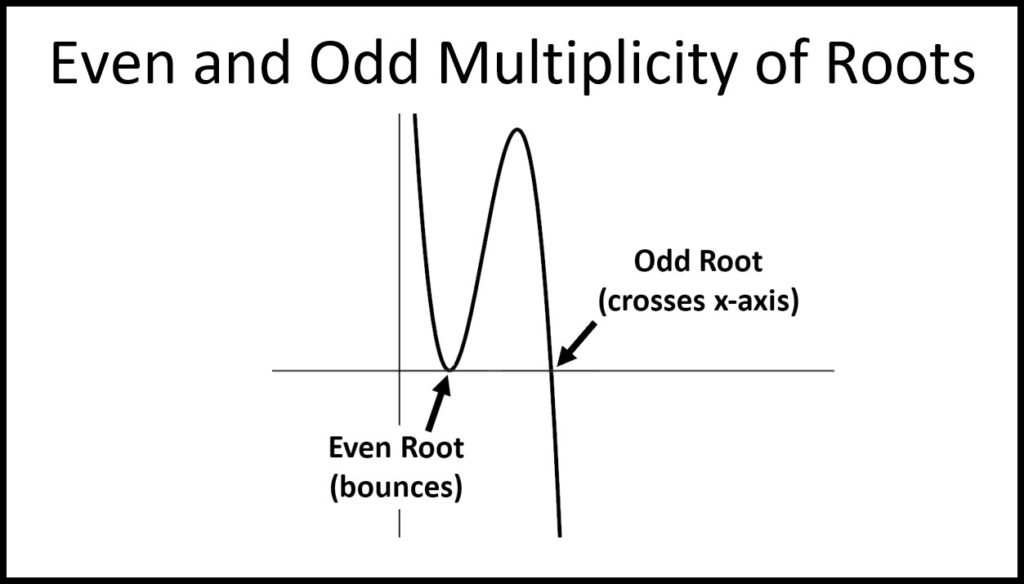
\(\bullet\text{ Multiplicity of Roots}\)
\(\,\,\,\,\,\,\,\,\) \(…\)
\(…\)
\(\bullet\text{ Rational Zero Theorem}\)
\(\,\,\,\,\,\,\,\, \pm 1,\pm 2,\pm 3,\pm 4,\pm 6,\pm 12…\)
\(\bullet\text{ Descartes Rule of Signs}\)
\(\,\)
\(\bullet\text{ Roots and Zeroes}\)
\(\,\,\,\,\,\,\,\,\text{Solve for }x. 3x^2+4x=0…\)
\(\bullet\text{ Linear Factored Form}\)
\(\,\,\,\,\,\,\,\,f(x)=(x+4)(x+1)(x−3)…\)
\(\bullet\text{ Polynomial Inequalities}\)
\(\,\,\,\,\,\,\,\,x^3-4x^2-4x+16 \gt 0…\)
\(\bullet\text{ Andymath Homepage}\)