

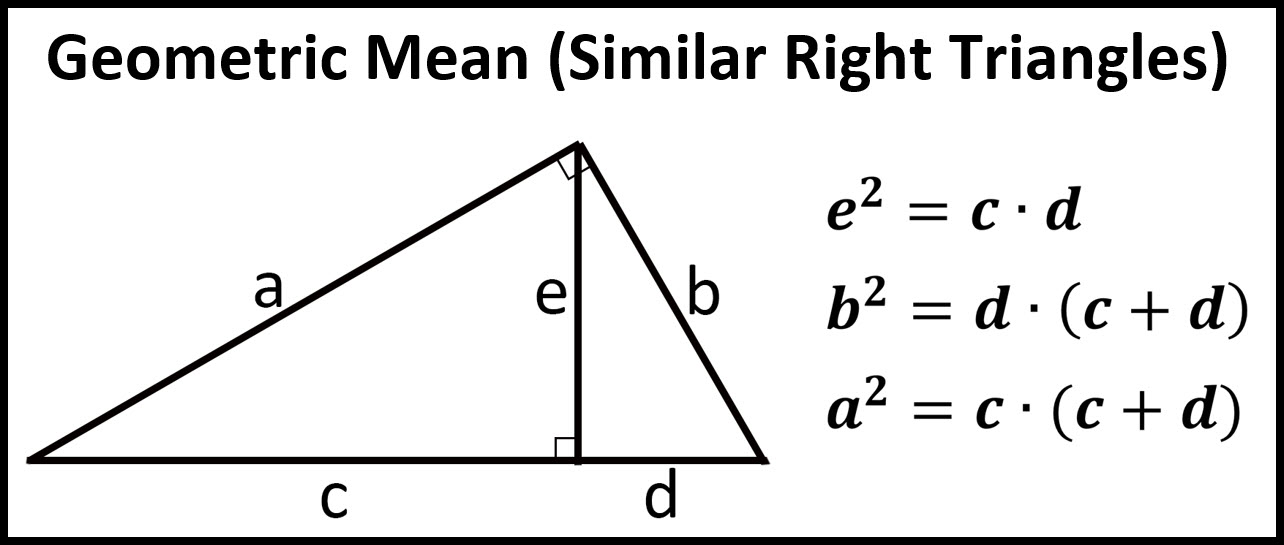
Similar right triangles are formed when an altitude is drawn from the right angle of a right triangle to the hypotenuse. These relationships create geometric mean formulas that can be used to solve for missing side lengths. This page focuses on using similar right triangle proportions and geometric mean relationships to solve for variables in right triangle diagrams.
Notes
Practice Problems
Solve for the variables.
\(\textbf{1)}\) Solve for x
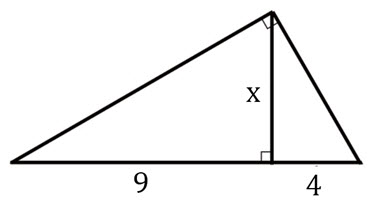 \(\text{The answer is } x=6 \)
\(\,\,\,\,\,\,e^2=c \cdot d\)
\(\,\,\,\,\,\,x^2=9 \cdot 4\)
\(\,\,\,\,\,\,x^2=36\)
\(\,\,\,\,\,\,x=6\)
\(\,\,\,\,\,\, \text{The answer is } x=6 \)
\(\,\,\,\,\,\,e^2=c \cdot d\)
\(\,\,\,\,\,\,x^2=9 \cdot 4\)
\(\,\,\,\,\,\,x^2=36\)
\(\,\,\,\,\,\,x=6\)
\(\,\,\,\,\,\, \text{The answer is } x=6 \)
\(\textbf{2)}\) Solve for y
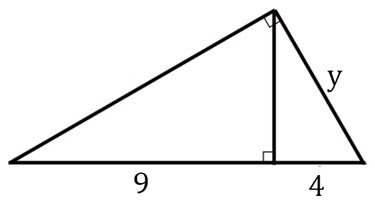
The answer is \( y=2\sqrt{13} \)
\(\,\,\,\,\,\,b^2=d \cdot (c+d)\)
\(\,\,\,\,\,\,y^2=4 \cdot (4+9)\)
\(\,\,\,\,\,\,y^2=4 \cdot 13\)
\(\,\,\,\,\,\,y^2=52\)
\(\,\,\,\,\,\,\sqrt{y^2}=\sqrt{52}\)
\(\,\,\,\,\,\,y=2\sqrt{13}\)
\(\,\,\,\,\,\,b^2=d \cdot (c+d)\)
\(\,\,\,\,\,\,y^2=4 \cdot (4+9)\)
\(\,\,\,\,\,\,y^2=4 \cdot 13\)
\(\,\,\,\,\,\,y^2=52\)
\(\,\,\,\,\,\,\sqrt{y^2}=\sqrt{52}\)
\(\,\,\,\,\,\,y=2\sqrt{13}\)
\(\textbf{3)}\) Solve for z
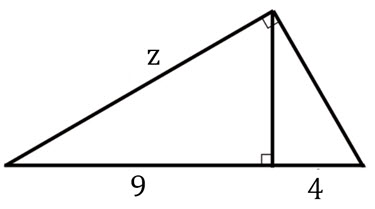
The answer is \( z=3\sqrt{13} \)
\(\,\,\,\,\,\,a^2=c \cdot (c+d)\)
\(\,\,\,\,\,\,z^2=9 \cdot (9+4)\)
\(\,\,\,\,\,\,z^2=9 \cdot 13\)
\(\,\,\,\,\,\,z^2=117\)
\(\,\,\,\,\,\,\sqrt{y^2}=\sqrt{117}\)
\(\,\,\,\,\,\,z=3\sqrt{13}\)
\(\,\,\,\,\,\,a^2=c \cdot (c+d)\)
\(\,\,\,\,\,\,z^2=9 \cdot (9+4)\)
\(\,\,\,\,\,\,z^2=9 \cdot 13\)
\(\,\,\,\,\,\,z^2=117\)
\(\,\,\,\,\,\,\sqrt{y^2}=\sqrt{117}\)
\(\,\,\,\,\,\,z=3\sqrt{13}\)
\(\textbf{4)}\) Solve for x
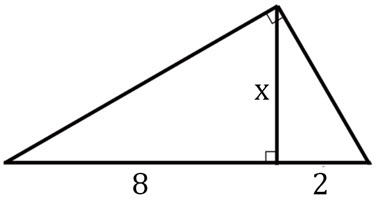
The answer is \( x=4 \)
\(\,\,\,\,\,\,e^2=c \cdot d\)
\(\,\,\,\,\,\,x^2=8 \cdot 2\)
\(\,\,\,\,\,\,x^2=16\)
\(\,\,\,\,\,\,x=4\)
\(\,\,\,\,\,\, \text{The answer is } x=4 \)
\(\,\,\,\,\,\,e^2=c \cdot d\)
\(\,\,\,\,\,\,x^2=8 \cdot 2\)
\(\,\,\,\,\,\,x^2=16\)
\(\,\,\,\,\,\,x=4\)
\(\,\,\,\,\,\, \text{The answer is } x=4 \)
\(\textbf{5)}\) Solve for y
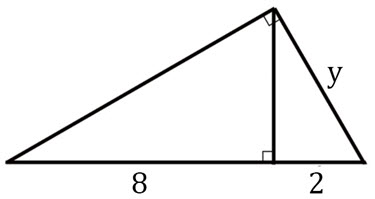
The answer is \( y=2\sqrt{5} \)
\(\,\,\,\,\,\,b^2=d \cdot (c+d)\)
\(\,\,\,\,\,\,y^2=2 \cdot (2+8)\)
\(\,\,\,\,\,\,y^2=2 \cdot 10\)
\(\,\,\,\,\,\,y^2=20\)
\(\,\,\,\,\,\,\sqrt{y^2}=\sqrt{20}\)
\(\,\,\,\,\,\,y=2\sqrt{5}\)
\(\,\,\,\,\,\,b^2=d \cdot (c+d)\)
\(\,\,\,\,\,\,y^2=2 \cdot (2+8)\)
\(\,\,\,\,\,\,y^2=2 \cdot 10\)
\(\,\,\,\,\,\,y^2=20\)
\(\,\,\,\,\,\,\sqrt{y^2}=\sqrt{20}\)
\(\,\,\,\,\,\,y=2\sqrt{5}\)
\(\textbf{6)}\) Solve for z
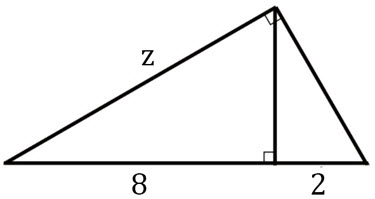
The answer is \( z=4\sqrt{5} \)
\(\,\,\,\,\,\,a^2=c \cdot (c+d)\)
\(\,\,\,\,\,\,z^2=8 \cdot (8+2)\)
\(\,\,\,\,\,\,z^2=8 \cdot 10\)
\(\,\,\,\,\,\,z^2=80\)
\(\,\,\,\,\,\,\sqrt{y^2}=\sqrt{80}\)
\(\,\,\,\,\,\,z=4\sqrt{5}\)
\(\,\,\,\,\,\,a^2=c \cdot (c+d)\)
\(\,\,\,\,\,\,z^2=8 \cdot (8+2)\)
\(\,\,\,\,\,\,z^2=8 \cdot 10\)
\(\,\,\,\,\,\,z^2=80\)
\(\,\,\,\,\,\,\sqrt{y^2}=\sqrt{80}\)
\(\,\,\,\,\,\,z=4\sqrt{5}\)
\(\textbf{7)}\) Solve for x
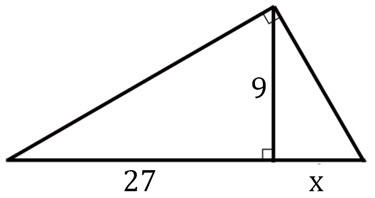
The answer is \( x=3 \)
\(\,\,\,\,\,\,e^2=c \cdot d\)
\(\,\,\,\,\,\,9^2=27 \cdot x\)
\(\,\,\,\,\,\,81=27 \cdot x\)
\(\,\,\,\,\,\,3=x\)
\(\,\,\,\,\,\,e^2=c \cdot d\)
\(\,\,\,\,\,\,9^2=27 \cdot x\)
\(\,\,\,\,\,\,81=27 \cdot x\)
\(\,\,\,\,\,\,3=x\)
\(\textbf{8)}\) Solve for z
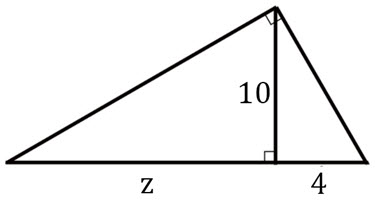
The answer is \( z=25 \)
\(\,\,\,\,\,\,e^2=c \cdot d\)
\(\,\,\,\,\,\,10^2=z \cdot 4\)
\(\,\,\,\,\,\,100=4z\)
\(\,\,\,\,\,\,25=z \cdot x\)
\(\,\,\,\,\,\,e^2=c \cdot d\)
\(\,\,\,\,\,\,10^2=z \cdot 4\)
\(\,\,\,\,\,\,100=4z\)
\(\,\,\,\,\,\,25=z \cdot x\)
\(\textbf{9)}\) Solve for x, y, and z
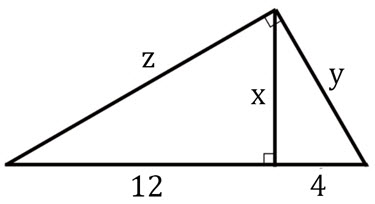
The answer is \( x=4\sqrt{3} \) The answer is \( y=8 \) The answer is \( z=8\sqrt{3} \)
\(\textbf{10)}\) Solve for x
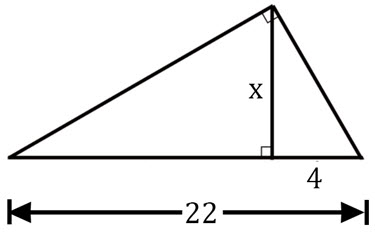
The answer is \( x=6\sqrt{2} \)
\(\,\,\,\,\,\,e^2=c \cdot d\)
\(\,\,\,\,\,\,x^2=\left(22-4\right) \cdot 4\)
\(\,\,\,\,\,\,x^2=18 \cdot 4\)
\(\,\,\,\,\,\,x^2=72\)
\(\,\,\,\,\,\,x=\sqrt{72}\)
\(\,\,\,\,\,\, \text{The answer is } x=6\sqrt{2} \)
\(\,\,\,\,\,\,e^2=c \cdot d\)
\(\,\,\,\,\,\,x^2=\left(22-4\right) \cdot 4\)
\(\,\,\,\,\,\,x^2=18 \cdot 4\)
\(\,\,\,\,\,\,x^2=72\)
\(\,\,\,\,\,\,x=\sqrt{72}\)
\(\,\,\,\,\,\, \text{The answer is } x=6\sqrt{2} \)
\(\textbf{11)}\) Solve for y
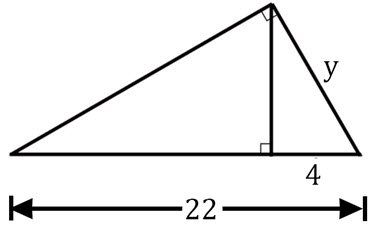
The answer is \( y=2\sqrt{22} \)
\(\,\,\,\,\,\,b^2=d \cdot (c+d)\)
\(\,\,\,\,\,\,y^2=4 \cdot (22)\)
\(\,\,\,\,\,\,y^2=88\)
\(\,\,\,\,\,\,\sqrt{y^2}=\sqrt{88}\)
\(\,\,\,\,\,\,y=2\sqrt{22}\)
\(\,\,\,\,\,\,b^2=d \cdot (c+d)\)
\(\,\,\,\,\,\,y^2=4 \cdot (22)\)
\(\,\,\,\,\,\,y^2=88\)
\(\,\,\,\,\,\,\sqrt{y^2}=\sqrt{88}\)
\(\,\,\,\,\,\,y=2\sqrt{22}\)
\(\textbf{12)}\) Solve for z
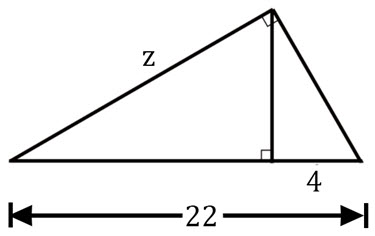
The answer is \( z=6\sqrt{11} \)
\(\,\,\,\,\,\,a^2=c \cdot (c+d)\)
\(\,\,\,\,\,\,z^2=\left(22-4\right) \cdot (22)\)
\(\,\,\,\,\,\,z^2=18 \cdot 22\)
\(\,\,\,\,\,\,z^2=396\)
\(\,\,\,\,\,\,\sqrt{z^2}=\sqrt{396}\)
\(\,\,\,\,\,\,z=6\sqrt{11}\)
\(\,\,\,\,\,\,a^2=c \cdot (c+d)\)
\(\,\,\,\,\,\,z^2=\left(22-4\right) \cdot (22)\)
\(\,\,\,\,\,\,z^2=18 \cdot 22\)
\(\,\,\,\,\,\,z^2=396\)
\(\,\,\,\,\,\,\sqrt{z^2}=\sqrt{396}\)
\(\,\,\,\,\,\,z=6\sqrt{11}\)
\(\textbf{13)}\) Solve for x
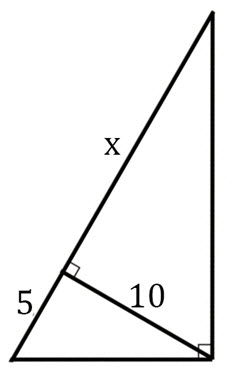
The answer is \( x=20 \)
\(\,\,\,\,\,\,e^2=c \cdot d\)
\(\,\,\,\,\,\,10^2=x \cdot 5\)
\(\,\,\,\,\,\,100=5x\)
\(\,\,\,\,\,\, \text{The answer is } x=20 \)
\(\,\,\,\,\,\,e^2=c \cdot d\)
\(\,\,\,\,\,\,10^2=x \cdot 5\)
\(\,\,\,\,\,\,100=5x\)
\(\,\,\,\,\,\, \text{The answer is } x=20 \)
\(\textbf{14)}\) Solve for z
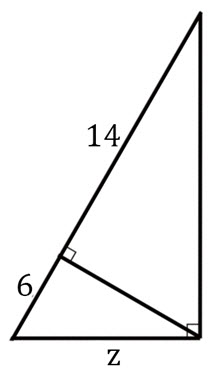
The answer is \( z=2\sqrt{30} \)
\(\,\,\,\,\,\,b^2=d \cdot (c+d)\)
\(\,\,\,\,\,\,z^2=6 \cdot (6+14)\)
\(\,\,\,\,\,\,z^2=6 \cdot 20\)
\(\,\,\,\,\,\,z^2=120\)
\(\,\,\,\,\,\,\sqrt{z^2}=\sqrt{120}\)
\(\,\,\,\,\,\,z=2\sqrt{30}\)
\(\,\,\,\,\,\,b^2=d \cdot (c+d)\)
\(\,\,\,\,\,\,z^2=6 \cdot (6+14)\)
\(\,\,\,\,\,\,z^2=6 \cdot 20\)
\(\,\,\,\,\,\,z^2=120\)
\(\,\,\,\,\,\,\sqrt{z^2}=\sqrt{120}\)
\(\,\,\,\,\,\,z=2\sqrt{30}\)
Challenge Problems
\(\textbf{15)}\) Solve for w, z, and x
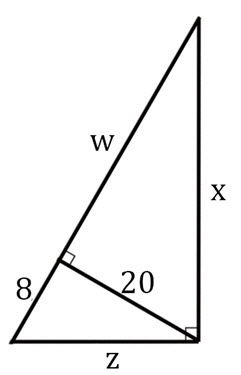
The answer is \( w=50 \) The answer is \( z=4\sqrt{29} \) The answer is \( x=10\sqrt{29} \)
\(\textbf{16)}\) Solve for x and z
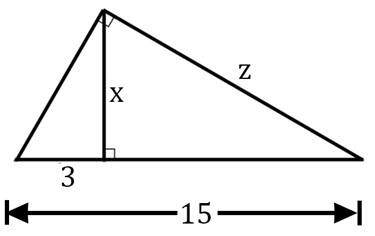
The answer is \( x=6 \) The answer is \( z=6\sqrt{5} \)
\(\textbf{17)}\) Solve for x
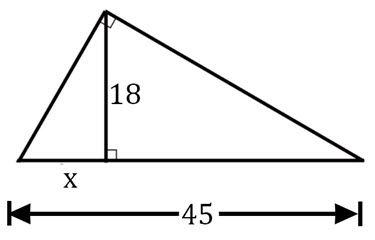
The answer is \( x=9 \text{ or } x=36 \)
\(\,\,\,\,\,\,e^2=c \cdot d\)
\(\,\,\,\,\,\,18^2=x \cdot \left(45-x\right)\)
\(\,\,\,\,\,\,324=45x-x^2\)
\(\,\,\,\,\,\,x^2-45x+324=0\)
\(\,\,\,\,\,\,\left(x-9\right) \left(x-36\right)=0\)
\(\,\,\,\,\,\, \text{The answer is } x=9 \text{ or } x=36 \)
\(\,\,\,\,\,\,e^2=c \cdot d\)
\(\,\,\,\,\,\,18^2=x \cdot \left(45-x\right)\)
\(\,\,\,\,\,\,324=45x-x^2\)
\(\,\,\,\,\,\,x^2-45x+324=0\)
\(\,\,\,\,\,\,\left(x-9\right) \left(x-36\right)=0\)
\(\,\,\,\,\,\, \text{The answer is } x=9 \text{ or } x=36 \)
\(\textbf{18)}\) Write the triangle similarity statement for all 3 triangles below.
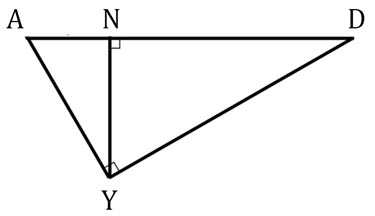
The answer is \( \bigtriangleup ANY \sim \bigtriangleup YND \sim \bigtriangleup AYD \)
(Other answers may be correct as long as the angles line up correctly)
(Other answers may be correct as long as the angles line up correctly)
See Related Pages\(\)
\(\bullet\text{ Geometry Homepage}\)
\(\,\,\,\,\,\,\,\,\text{All the Best Topics…}\)
\(\bullet\text{ SideSplitter Theorem}\)
\(\,\,\,\,\,\,\,\,\)
\(\bullet\text{ Geometric Mean}\)
\(\,\,\,\,\,\,\,\,\)