Lesson
VIDEO
Notes
Practice Problems
For problems 1-5, Jill is playing 5 games of tennis. Jill has a 65% chance of winning any one of the games.
\(\textbf{1)}\) What is the probability that Jill wins all the games? Show Answer
\(P(5)= {}_{5}C_{5} (.65)^5(.35)^0 \approx 0.1160\)
\(\textbf{2)}\) What is the probability that Jill wins none of the games? Show Answer
\(P(0)= {}_{5}C_{0} (.65)^0(.35)^5 \approx 0.005252\)
\(\textbf{3)}\) What is the probability that Jill wins exactly 3 of the games? Show Answer
\(P(3)= {}_{5}C_{3} (.65)^3(.35)^2 \approx 0.3364\)
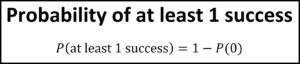
\(\textbf{4)}\) What is the probability that Jill wins at least 1 game? Show Answer
\(1-P(0) \approx 1-.005252 \approx .9947\)
\(\textbf{5)}\) Construct a table showing the probability of all scenarios. Show Table
\(P(0)\)
\({}_{5}C_{0} (.65)^0(.35)^5\)
\(\approx 0.005252\)
\(P(1)\)
\({}_{5}C_{1} (.65)^1(.35)^4\)
\(\approx 0.04877\)
\(P(2)\)
\({}_{5}C_{2} (.65)^2(.35)^3\)
\(\approx 0.1811\)
\(P(3)\)
\({}_{5}C_{3} (.65)^3(.35)^2\)
\(\approx 0.3364\)
\(P(4)\)
\({}_{5}C_{4} (.65)^4(.35)^1\)
\(\approx 0.3124\)
\(P(5)\)
\({}_{5}C_{5} (.65)^5(.35)^0\)
\(\approx 0.1160\)
\(\textbf{6)}\) What is the expected number of games Jill will win? Show Answer
\((5)(.65)=3.25 \) games
For problems 7-12, you roll a six-sided die 8 times. You consider rolling a “5” to be a success.
\(\textbf{7)}\) What is the probability of getting zero \(5\)s? Show Answer
\(P(0)= {}_{8}C_{0} \left( \frac{1}{6} \right)^0 \left( \frac{5}{6} \right)^8 \approx 0.2326\)
\(\textbf{8)}\) What is probability of getting exactly two \(5\)s? Show Answer
\(P(2)= {}_{8}C_{2} \left( \frac{1}{6} \right)^2 \left( \frac{5}{6} \right)^6 \approx 0.2605\)
\(\textbf{9)}\) What is the probability of getting at least one \(5\)? Show Answer
\(1-P(0) \approx 1-.2326 \approx .7674\)
\(\textbf{10)}\) What is the probability of getting all 5s? Show Answer
\(P(8)= {}_{8}C_{8} \left( \frac{1}{6} \right)^8 \left( \frac{5}{6} \right)^0 \approx 0.0000005954\)
\(\textbf{11)}\) Construct a table showing the probability of all scenarios. Show Table
\(P(0)\)
\({}_{8}C_{0} \left( \frac{1}{6} \right)^0 \left( \frac{5}{6} \right)^8\)
\(\approx 0.2326\)
\(P(1)\)
\({}_{8}C_{1} \left( \frac{1}{6} \right)^1 \left( \frac{5}{6} \right)^7\)
\(\approx 0.3721\)
\(P(2)\)
\({}_{8}C_{2} \left( \frac{1}{6} \right)^2 \left( \frac{5}{6} \right)^6\)
\(\approx 0.2605\)
\(P(3)\)
\({}_{8}C_{3} \left( \frac{1}{6} \right)^3 \left( \frac{5}{6} \right)^5\)
\(\approx 0.1042\)
\(P(4)\)
\({}_{8}C_{4} \left( \frac{1}{6} \right)^4 \left( \frac{5}{6} \right)^4\)
\(\approx 0.02605\)
\(P(5)\)
\({}_{8}C_{5} \left( \frac{1}{6} \right)^5 \left( \frac{5}{6} \right)^3\)
\(\approx 0.004168\)
\(P(6)\)
\({}_{8}C_{6} \left( \frac{1}{6} \right)^6 \left( \frac{5}{6} \right)^2\)
\(\approx 0.0004168\)
\(P(7)\)
\({}_{8}C_{7} \left( \frac{1}{6} \right)^7 \left( \frac{5}{6} \right)^1\)
\(\approx .00002382\)
\(P(8)\)
\({}_{8}C_{8} \left( \frac{1}{6} \right)^8 \left( \frac{5}{6} \right)^0\)
\(\approx .0000005954\)
\(\textbf{12)}\) How many times do you expect to roll a 5? Show Answer
\((\frac{1}{6})(8)=\frac{4}{3} \approx 1.33 \) times
For problems 13-17, you flip a fair coin 10 times.
\(\textbf{13)}\) What is the probability of getting all heads? Show Answer
\(P(10)= {}_{10}C_{10} (.5)^{10}(.5)^{0} \approx 0.0009766\)
\(\textbf{14)}\) What is the probability of getting exactly 3 heads? Show Answer
\(P(3)= {}_{10}C_{3} (.5)^{3}(.5)^{7} \approx 0.1172\)
\(\textbf{15)}\) What is the probability of getting at least 1 head? Show Answer
\(1-P(0) \approx 1-0.0009766 \approx 0.9990\)
\(\textbf{16)}\) Construct a table showing the probability of all scenarios. Show Table
\(P(0)\)
\({}_{10}C_{0} (.5)^{0}(.5)^{10}\)
\(\approx 0.0009766\)
\(P(1)\)
\({}_{10}C_{1} (.5)^{1}(.5)^{9}\)
\(\approx 0.009766\)
\(P(2)\)
\({}_{10}C_{2} (.5)^{2}(.5)^{8}\)
\(\approx 0.04395\)
\(P(3)\)
\({}_{10}C_{3} (.5)^{3}(.5)^{7}\)
\(\approx 0.1172\)
\(P(4)\)
\({}_{10}C_{4} (.5)^{4}(.5)^{6}\)
\(\approx 0.2051\)
\(P(5)\)
\({}_{10}C_{5} (.5)^{5}(.5)^{5}\)
\(\approx 0.2461\)
\(P(6)\)
\({}_{10}C_{6} (.5)^{6}(.5)^{4}\)
\(\approx 0.2051\)
\(P(7)\)
\({}_{10}C_{7} (.5)^{7}(.5)^{3}\)
\(\approx 0.1172\)
\(P(8)\)
\({}_{10}C_{8} (.5)^{8}(.5)^{2}\)
\(\approx 0.04395\)
\(P(9)\)
\({}_{10}C_{9} (.5)^{9}(.5)^{1}\)
\(\approx 0.009766\)
\(P(10)\)
\({}_{10}C_{10} (.5)^{10}(.5)^{0}\)
\(\approx 0.0009765\)
\(\textbf{17)}\) How many times do you expect to flip a heads? Show Answer
\((.5)(10)=5\) times
See Related Pages\(\)
In Summary
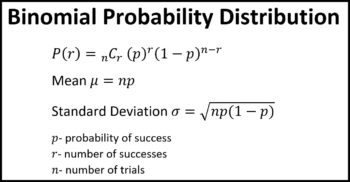
The binomial distribution is a probability distribution that describes the outcome of a sequence of independent and identically distributed binary events. This type of distribution is commonly used to model the behavior of a random variable that can take on only two values, such as success or failure, heads or tails, or yes or no.
The binomial distribution is defined by two parameters: the probability of success, p, and the number of trials, n. The probability of success, p, represents the likelihood that a single binary event will result in a successful outcome, and the number of trials, n, represents the total number of independent binary events that are being considered.
The binomial distribution can be used to calculate the probability of a specific number of successes in a sequence of n binary events. It can also be used to calculate the probability of a range of possible outcomes.