

Printable PDF and Answer Key 
Lesson
Practice Problems
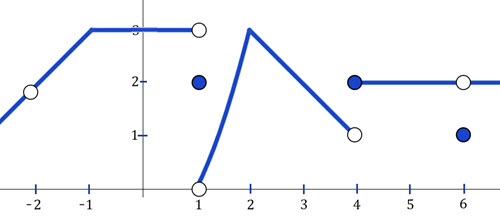
\(\textbf{1)}\)\( \displaystyle \lim_{x\to-2^{-}} f(x) \)
\(\textbf{2)}\)\( \displaystyle \lim_{x\to-2^{+}} f(x) \)
\(\textbf{3)}\)\( \displaystyle \lim_{x\to-2} f(x) \)
\(\textbf{4)}\) \(f(-2)\)
\(\textbf{5)}\)\( \displaystyle \lim_{x\to1^{-}} f(x) \)
\(\textbf{6)}\)\( \displaystyle \lim_{x\to1^{+}} f(x) \)
\(\textbf{7)}\) \( \displaystyle \lim_{x\to1} f(x) \)
\(\textbf{8)}\) \(f(1)\)
\(\textbf{9)}\)\( \displaystyle \lim_{x\to2^{-}} f(x) \)
\(\textbf{10)}\)\( \displaystyle \lim_{x\to2^{+}} f(x) \)
\(\textbf{11)}\) \( \displaystyle \lim_{x\to2} f(x) \)
\(\textbf{12)}\) \(f(2)\)
\(\textbf{13)}\)\( \displaystyle \lim_{x\to4^{-}} f(x) \)
\(\textbf{14)}\)\( \displaystyle \lim_{x\to4^{+}} f(x) \)
\(\textbf{15)}\) \( \displaystyle \lim_{x\to4} f(x) \)
\(\textbf{16)}\) \(f(4)\)
\(\textbf{17)}\)\( \displaystyle \lim_{x\to6^{-}} f(x) \)
\(\textbf{18)}\)\( \displaystyle \lim_{x\to6^{+}} f(x) \)
\(\textbf{19)}\) \( \displaystyle \lim_{x\to6} f(x) \)
\(\textbf{20)}\) \(f(6)\)
See Related Pages\(\)
\(\bullet\text{ Calculus Homepage}\)
\(\,\,\,\,\,\,\,\,\text{All the Best Topics…}\)
\(\bullet\text{ Continuity on Graphs}\)
\(\,\,\,\,\,\,\,\,\)\(…\)
\(\bullet\text{ Piecewise Functions- Limits and Continuity}\)
\(\,\,\,\,\,\,\,\,\) \(…\)
\(…\)
\(\bullet\text{ Infinite Limits}\)
\(\,\,\,\,\,\,\,\,\displaystyle \lim_{x\to 4^{+}} \frac{5}{x-4}\)
\(\bullet\text{ Limits at Infinity}\)
\(\,\,\,\,\,\,\,\,\displaystyle\lim_{x\to \infty}\frac{5x^2+2x-10}{3x^2+4x-5}\)
\(\bullet\text{ Trig Limits}\)
\(\,\,\,\,\,\,\,\,\displaystyle \lim_{\theta\to0} \frac{\sin \theta}{\theta}=1\)
In Summary
Limits are an important concept in calculus that allow us to understand how functions behave as they approach a certain point on a graph. Essentially, a limit tells us what a function’s value would be if it could reach that point, even if it doesn’t reach it.
To define limits on a graph, we need to consider a function’s behavior as it approaches a certain x-value from both the left and the right. If the function’s values on the left and right both approach the same y-value as x gets closer and closer to the limit, then we say the limit exists and is equal to that y-value. If the function’s values on the left and right do not approach the same y-value, then the limit does not exist.
Limits on graphs are typically introduced in a calculus course, usually at the beginning of the first semester. Limits are the foundation of calculus. Derivatives and Integrals both use limits. The modern definition of a limit was developed by Sir Isaac Newton and Gottfried Leibniz, two of the most influential figures in math.
It is important to note that continuity of a functions is defined using limits. A function is continuous at a point if the limit of the function as it approaches that point from both sides exists and is equal to the value of the function at that point.