

Practice Questions
\(\textbf{1)}\)
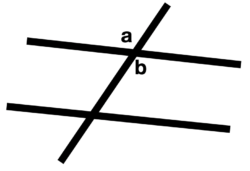
Vertical Angles
\(\textbf{2)}\)
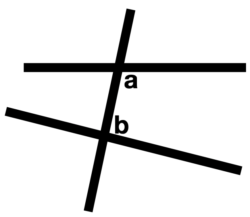
Same Side Interior Angles (or Consecutive Interior Angles)
\(\textbf{3)}\)
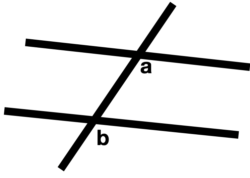
Corresponding Angles
\(\textbf{4)}\)
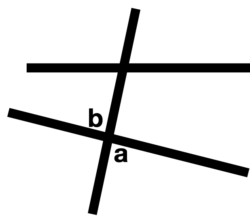
Vertical Angles
\(\textbf{5)}\)
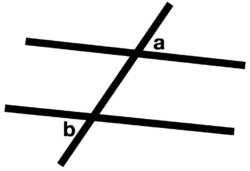
Alternate Exterior Angles
\(\textbf{6)}\)
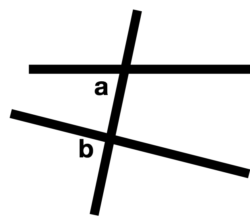
Corresponding Angles
\(\textbf{7)}\)
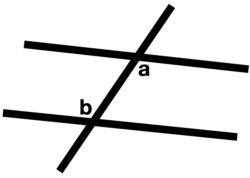
Alternate Interior
\(\textbf{8)}\)
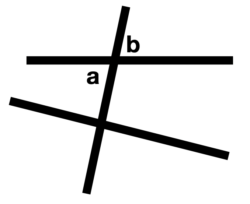
Vertical Angles
\(\textbf{9)}\)
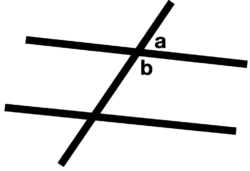
Linear Pair
\(\textbf{10)}\)
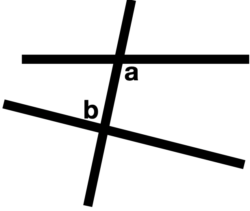
Alternate Interior Angles
\(\textbf{11)}\)
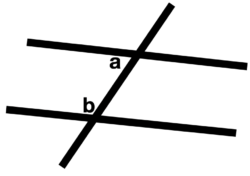
Same Side Interior Angles (or Consecutive Interior Angles)
\(\textbf{12)}\)
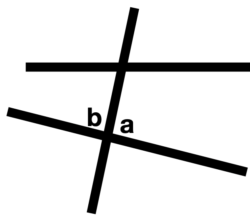
Linear Pair
\(\textbf{13)}\)
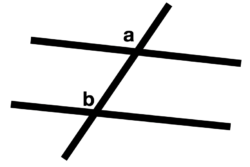
Corresponding Angles
\(\textbf{14)}\)
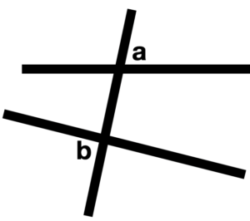
Alternate Exterior Angles
See Related Pages\(\)
\(\bullet\text{ Geometry Homepage}\)
\(\,\,\,\,\,\,\,\,\text{All the Best Topics…}\)
\(\bullet\text{ Angle Addition Postulate}\)
\(\,\,\,\,\,\,\,\,\)
\(\bullet\text{ Complimentary and Supplementary Angles}\)
\(\,\,\,\,\,\,\,\,\)
In Summary
Corresponding angles, same-side interior, alternate interior and alternate exterior angles are created when a line called a transversal cuts through two other lines. These are typically introduced in geometry courses. They are useful tools for analyzing the properties of shapes and their relationships with each other. These concepts are often used to solve problems involving angles, lines, and shapes, and they are also useful for understanding more advanced topics in geometry, such as transformation, symmetry, and similarity.
Common mistakes in this topic is related to identifying whether the two lines being cut by the transversal are parallel or not. Students may accidentally assign relationships between angles that would only be true if the two lines were parallel, and in many cases that information is unknown.