

Notes
Practice Problems & Videos
\(\textbf{1)}\) “If a figure has 3 sides, then it is a triangle.”
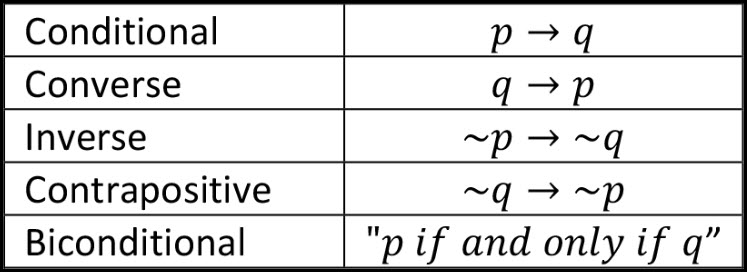
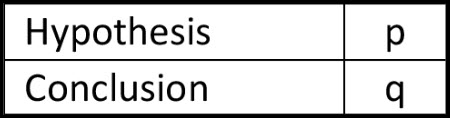
State the hypothesis. The hypothesis is “A figure has 3 sides.” 
\(\textbf{2)}\) “If a figure has 3 sides, then it is a triangle.”
State the conclusion. The conclusion is “A figure is a triangle.”
\(\textbf{3)}\) “If a figure has 3 sides, then it is a triangle.”
State the converse. The converse is “If a figure is a triangle, then it has 3 sides.”
\(\textbf{4)}\) “If a figure has 3 sides, then it is a triangle.”
State the inverse. The inverse is “If a figure does not have 3 sides, then it is not a triangle.”
\(\textbf{5)}\) “If a figure has 3 sides, then it is a triangle.”
State the contrapositive. The contrapositive is “If a figure is not a triangle, then it does not have 3 sides.”
\(\textbf{6)}\) “If a figure has 3 sides, then it is a triangle.”
State the biconditional. The biconditional is “A figure has 3 sides, if and only if, it is a triangle.”
Challenge Problems
\(\textbf{7)}\) Create a Venn diagram for “All circles are ellipses.” One example below
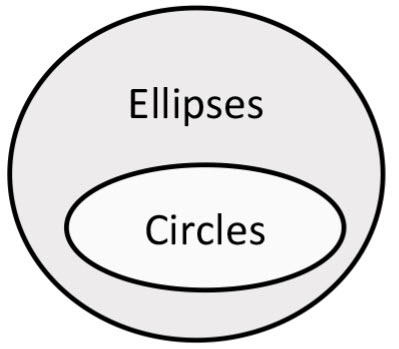
\(\textbf{8)}\) Create a Venn diagram for “If you don’t have an ellipse, then you don’t have a circle.” Note it is the same answer as number 7. They are equivalent statements.
\(\textbf{9)}\) Write 2 conditional statements based on the Venn diagram below.
“If a square, then a rectangle.” or “All squares are rectangles”
and
“If not a rectangle, not a square.” or “All non-rectangles are non-squares”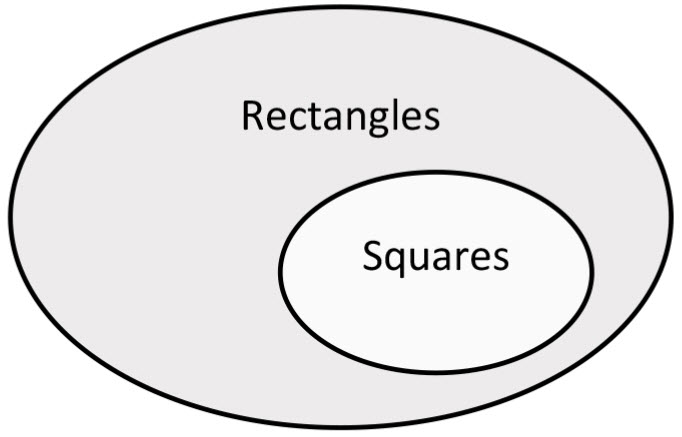
and
“If not a rectangle, not a square.” or “All non-rectangles are non-squares”
See Related Pages\(\)
\(\bullet\text{ Geometry Homepage}\)
\(\,\,\,\,\,\,\,\,\text{All the Best Topics…}\)
\(\bullet\text{ Law of Syllogism}\)
\(\,\,\,\,\,\,\,\,\text{If p then q,}\)
\(\,\,\,\,\,\,\,\,\text{If q then r,}\)
\(\,\,\,\,\,\,\,\,\,\,\,\,\,\,\,\,\text{If p then r…}\)
\(\bullet\text{ Law of Detachment}\)
\(\,\,\,\,\,\,\,\,\text{If p then q,}\)
\(\,\,\,\,\,\,\,\,\text{p is true,}\)
\(\,\,\,\,\,\,\,\,\,\,\,\,\,\,\,\,\text{q is true…}\)
In Summary
A conditional statement is a statement in the form “If P, then Q,” where P and Q are called the hypothesis and conclusion, respectively. The statement “If it is raining, then the ground is wet” is an example of a conditional statement.
The converse of a conditional statement is formed by flipping the order in which the hypothesis and conclusion appear. For example, the converse of the statement “If it is raining, then the ground is wet” is “If the ground is wet, then it is raining.”
The inverse of a conditional statement is formed by negating both the hypothesis and conclusion. For example, the inverse of the statement “If it is raining, then the ground is wet” is “If it is not raining, then the ground is not wet”
The contrapositive of a conditional statement is formed by negating both the hypothesis and conclusion and flipping the order in which they appear. For example, the contrapositive of the statement “If it is raining, then the ground is wet” is “If the ground is not wet, then it is not raining.”
A biconditional statement is a statement in the form “If and only if P, then Q,” which is equivalent to the statement “P if and only if Q.” This means that P and Q are either both true or both false. For example, the statement “If and only if it is raining, the ground is wet” is a biconditional statement.
In geometry class, students learn about conditional statements and their related concepts (inverse, converse, contrapositive, and biconditional) in order to make logical deductions about geometric figures and their properties. These concepts are often used to prove theorems and solve problems.