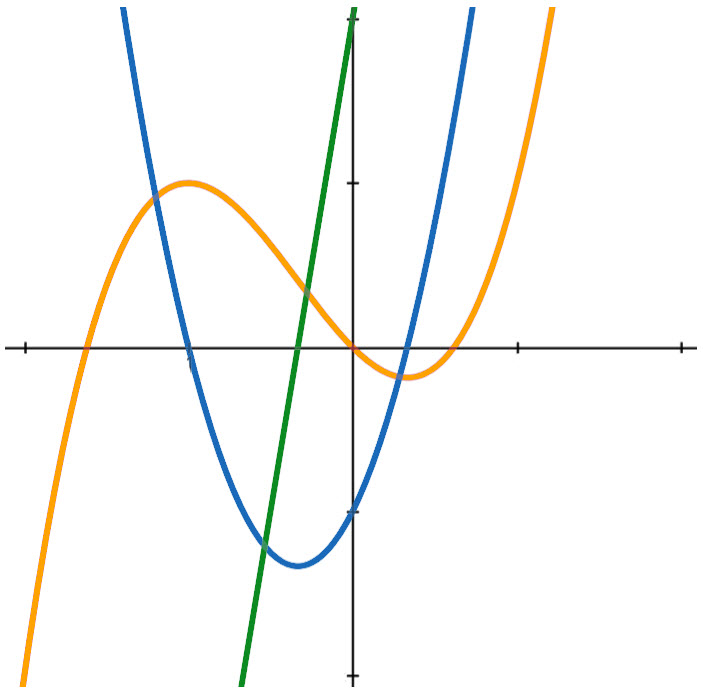
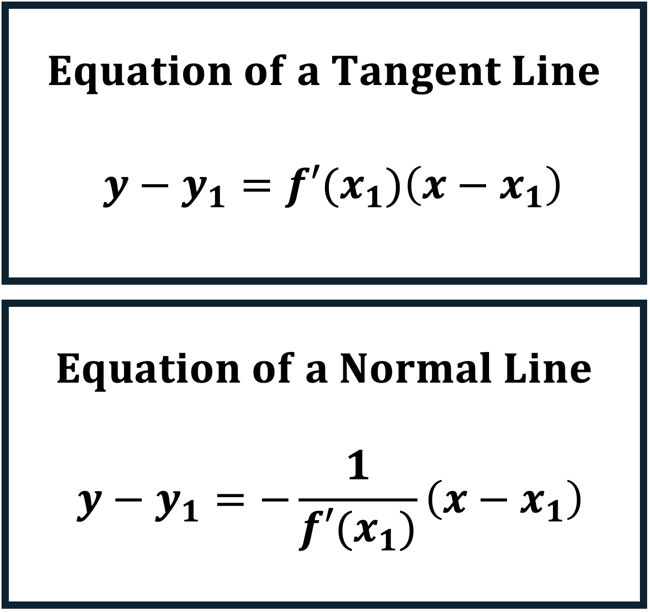
The normal line to a curve is the line that is perpendicular to the tangent line at a specific point. To find it, first find the derivative to get the tangent slope, then use the negative reciprocal to get the normal slope. These problems include polynomial, exponential, logarithmic, trigonometric, radical, and quotient-style functions.
Notes
Practice Questions
\(\small{\textbf{1)}}\) Find the equation of the normal line to the curve \(f(x) = x^3 – 4x + 1\) at the point \((2, 1)\).
The equation of the normal line is \(y = -\frac{1}{8}x + \frac{5}{4}\)
\(\,\,\,\,\,f(x) = x^3 – 4x + 1\)
\(\,\,\,\,\,f'(x) = 3x^2 – 4\)
\(\,\,\,\,\,f'(2) = 3(2)^2 – 4 = 8\)
\(\,\,\,\,\,\text{Slope of normal line: } m = -\frac{1}{f'(2)} = -\frac{1}{8}\)
\(\,\,\,\,\,f(2) = (2)^3 – 4(2) + 1 = 1\)
\(\,\,\,\,\,\text{Point-slope form: } y – 1 = -\frac{1}{8}(x – 2)\)
\(\,\,\,\,\,\text{Simplified: } y = -\frac{1}{8}x + \frac{5}{4}\)
\(\small{\textbf{2)}}\) Find the equation of the normal line to the curve \(f(x) = e^x\) at the point \((0, 1)\).
The equation of the normal line is \(y = -x + 1\)
\(\,\,\,\,\,f(x) = e^x\)
\(\,\,\,\,\,f'(x) = e^x\)
\(\,\,\,\,\,f'(0) = e^0 = 1\)
\(\,\,\,\,\,\text{Slope of normal line: } m = -\frac{1}{f'(0)} = -1\)
\(\,\,\,\,\,f(0) = e^0 = 1\)
\(\,\,\,\,\,\text{Point-slope form: } y – 1 = -1(x – 0)\)
\(\,\,\,\,\,\text{Simplified: } y = -x + 1\)
\(\small{\textbf{3)}}\) Find the equation of the normal line to the curve \(f(x) = \ln(x)\) at the point \((1, 0)\).
The equation of the normal line is \(y = -x +1\)
\(\,\,\,\,\,f(x) = \ln(x)\)
\(\,\,\,\,\,f'(x) = \frac{1}{x}\)
\(\,\,\,\,\,f'(1) = \frac{1}{1} = 1\)
\(\,\,\,\,\,\text{Slope of normal line: } m = -\frac{1}{f'(1)} = -1\)
\(\,\,\,\,\,f(1) = \ln(1) = 0\)
\(\,\,\,\,\,\text{Point-slope form: } y – 0 = -1(x – 1)\)
\(\,\,\,\,\,\text{Simplified: } y = -x +1\)
\(\small{\textbf{4)}}\) Find the equation of the normal line to the curve \(f(x) = \sin(x)\) at the point \(\left(\frac{\pi}{2}, 1\right)\).
The equation of the normal line is \(x= \frac{\pi}{2}\)
\(\,\,\,\,\,f(x) = \sin(x)\)
\(\,\,\,\,\,f'(x) = \cos(x)\)
\(\,\,\,\,\,f’\left(\frac{\pi}{2}\right) = \cos\left(\frac{\pi}{2}\right) = 0\)
\(\,\,\,\,\,\text{Slope of tangent line: } m = 0\)
\(\,\,\,\,\,\text{Slope of normal line: } m = \text{undefined (since } -\frac{1}{0} \text{ is undefined)}\)
\(\,\,\,\,\,\text{The normal line is vertical and passes through } x = \frac{\pi}{2}\)
\(\,\,\,\,\,\text{Equation: } x = \frac{\pi}{2}\)
\(\small{\textbf{5)}}\) Find the equation of the normal line to the curve \(f(x) = \frac{1}{x}\) at the point \((1, 1)\).
The equation of the normal line is \(y = x \)
\(\,\,\,\,\,f(x) = \frac{1}{x}\)
\(\,\,\,\,\,f'(x) = -\frac{1}{x^2}\)
\(\,\,\,\,\,f'(1) = -\frac{1}{1^2} = -1\)
\(\,\,\,\,\,\text{Slope of normal line: } m = -\frac{1}{f'(1)} = 1\)
\(\,\,\,\,\,f(1) = \frac{1}{1} = 1\)
\(\,\,\,\,\,\text{Point-slope form: } y – 1 = 1(x – 1)\)
\(\,\,\,\,\,\text{Simplified: } y = x \)
\(\small{\textbf{6)}}\) Find the equation of the normal line to the curve \(f(x)=\sqrt{x}\) at the point \((4,2)\).
The equation of the normal line is \(y=-4x+18\)
\(\,\,\,\,\,f(x)=\sqrt{x}\)
\(\,\,\,\,\,f(x)=x^{1/2}\)
\(\,\,\,\,\,f'(x)=\frac{1}{2}x^{-1/2}\)
\(\,\,\,\,\,f'(x)=\frac{1}{2\sqrt{x}}\)
\(\,\,\,\,\,f'(4)=\frac{1}{2\sqrt{4}}=\frac{1}{4}\)
\(\,\,\,\,\,\text{Slope of normal line: } m=-\frac{1}{f'(4)}=-4\)
\(\,\,\,\,\,\text{Point-slope form: } y-2=-4(x-4)\)
\(\,\,\,\,\,\text{Simplified: } y=-4x+18\)
\(\small{\textbf{7)}}\) Find the equation of the normal line to the curve \(f(x)=x^2+\frac{1}{x}\) at the point \((1,2)\).
The equation of the normal line is \(y=-x+3\)
\(\,\,\,\,\,f(x)=x^2+\frac{1}{x}\)
\(\,\,\,\,\,f(x)=x^2+x^{-1}\)
\(\,\,\,\,\,f'(x)=2x-x^{-2}\)
\(\,\,\,\,\,f'(x)=2x-\frac{1}{x^2}\)
\(\,\,\,\,\,f'(1)=2(1)-\frac{1}{1^2}=1\)
\(\,\,\,\,\,\text{Slope of normal line: } m=-\frac{1}{f'(1)}=-1\)
\(\,\,\,\,\,\text{Point-slope form: } y-2=-1(x-1)\)
\(\,\,\,\,\,\text{Simplified: } y=-x+3\)
\(\small{\textbf{8)}}\) Find the equation of the normal line to the curve \(f(x)=e^{2x}\) at the point \((0,1)\).
The equation of the normal line is \(y=-\frac{1}{2}x+1\)
\(\,\,\,\,\,f(x)=e^{2x}\)
\(\,\,\,\,\,f'(x)=2e^{2x}\)
\(\,\,\,\,\,f'(0)=2e^{2(0)}=2\)
\(\,\,\,\,\,\text{Slope of normal line: } m=-\frac{1}{f'(0)}=-\frac{1}{2}\)
\(\,\,\,\,\,f(0)=e^{2(0)}=1\)
\(\,\,\,\,\,\text{Point-slope form: } y-1=-\frac{1}{2}(x-0)\)
\(\,\,\,\,\,\text{Simplified: } y=-\frac{1}{2}x+1\)
\(\small{\textbf{9)}}\) Find the equation of the normal line to the curve \(f(x)=\tan(x)\) at the point \((0,0)\).
The equation of the normal line is \(y=-x\)
\(\,\,\,\,\,f(x)=\tan(x)\)
\(\,\,\,\,\,f'(x)=\sec^2(x)\)
\(\,\,\,\,\,f'(0)=\sec^2(0)=1\)
\(\,\,\,\,\,\text{Slope of normal line: } m=-\frac{1}{f'(0)}=-1\)
\(\,\,\,\,\,f(0)=\tan(0)=0\)
\(\,\,\,\,\,\text{Point-slope form: } y-0=-1(x-0)\)
\(\,\,\,\,\,\text{Simplified: } y=-x\)
\(\small{\textbf{10)}}\) Find the equation of the normal line to the curve \(f(x)=\sqrt{x^2+3}\) at the point \((1,2)\).
The equation of the normal line is \(y=-2x+4\)
\(\,\,\,\,\,f(x)=\sqrt{x^2+3}\)
\(\,\,\,\,\,f(x)=(x^2+3)^{1/2}\)
\(\,\,\,\,\,f'(x)=\frac{1}{2}(x^2+3)^{-1/2}(2x)\)
\(\,\,\,\,\,f'(x)=\frac{x}{\sqrt{x^2+3}}\)
\(\,\,\,\,\,f'(1)=\frac{1}{\sqrt{1^2+3}}=\frac{1}{2}\)
\(\,\,\,\,\,\text{Slope of normal line: } m=-\frac{1}{f'(1)}=-2\)
\(\,\,\,\,\,\text{Point-slope form: } y-2=-2(x-1)\)
\(\,\,\,\,\,\text{Simplified: } y=-2x+4\)
\(\small{\textbf{11)}}\) Find the equation of the normal line to the curve \(f(x)=x^2+3x\) at the point \((1,4)\).
The equation of the normal line is \(y=-\frac{1}{5}x+\frac{21}{5}\)
\(\,\,\,\,\,f(x)=x^2+3x\)
\(\,\,\,\,\,f'(x)=2x+3\)
\(\,\,\,\,\,f'(1)=2(1)+3=5\)
\(\,\,\,\,\,\text{Slope of normal line: } m=-\frac{1}{f'(1)}=-\frac{1}{5}\)
\(\,\,\,\,\,\text{Point-slope form: } y-4=-\frac{1}{5}(x-1)\)
\(\,\,\,\,\,\text{Simplified: } y=-\frac{1}{5}x+\frac{21}{5}\)
\(\small{\textbf{12)}}\) Find the equation of the normal line to the curve \(f(x)=x^4\) at the point \((1,1)\).
The equation of the normal line is \(y=-\frac{1}{4}x+\frac{5}{4}\)
\(\,\,\,\,\,f(x)=x^4\)
\(\,\,\,\,\,f'(x)=4x^3\)
\(\,\,\,\,\,f'(1)=4(1)^3=4\)
\(\,\,\,\,\,\text{Slope of normal line: } m=-\frac{1}{f'(1)}=-\frac{1}{4}\)
\(\,\,\,\,\,\text{Point-slope form: } y-1=-\frac{1}{4}(x-1)\)
\(\,\,\,\,\,\text{Simplified: } y=-\frac{1}{4}x+\frac{5}{4}\)
\(\small{\textbf{13)}}\) Find the equation of the normal line to the curve \(f(x)=\cos(x)\) at the point \((0,1)\).
The equation of the normal line is \(x=0\)
\(\,\,\,\,\,f(x)=\cos(x)\)
\(\,\,\,\,\,f'(x)=-\sin(x)\)
\(\,\,\,\,\,f'(0)=-\sin(0)=0\)
\(\,\,\,\,\,\text{Slope of tangent line: } m=0\)
\(\,\,\,\,\,\text{Slope of normal line: } m=\text{undefined}\)
\(\,\,\,\,\,\text{The normal line is vertical and passes through }x=0\)
\(\,\,\,\,\,\text{Equation: } x=0\)
\(\small{\textbf{14)}}\) Find the equation of the normal line to the curve \(f(x)=\ln(x+1)\) at the point \((0,0)\).
The equation of the normal line is \(y=-x\)
\(\,\,\,\,\,f(x)=\ln(x+1)\)
\(\,\,\,\,\,f'(x)=\frac{1}{x+1}\)
\(\,\,\,\,\,f'(0)=\frac{1}{0+1}=1\)
\(\,\,\,\,\,\text{Slope of normal line: } m=-\frac{1}{f'(0)}=-1\)
\(\,\,\,\,\,\text{Point-slope form: } y-0=-1(x-0)\)
\(\,\,\,\,\,\text{Simplified: } y=-x\)
\(\small{\textbf{15)}}\) Find the equation of the normal line to the curve \(f(x)=x^3+x\) at the point \((1,2)\).
The equation of the normal line is \(y=-\frac{1}{4}x+\frac{9}{4}\)
\(\,\,\,\,\,f(x)=x^3+x\)
\(\,\,\,\,\,f'(x)=3x^2+1\)
\(\,\,\,\,\,f'(1)=3(1)^2+1=4\)
\(\,\,\,\,\,\text{Slope of normal line: } m=-\frac{1}{f'(1)}=-\frac{1}{4}\)
\(\,\,\,\,\,\text{Point-slope form: } y-2=-\frac{1}{4}(x-1)\)
\(\,\,\,\,\,\text{Simplified: } y=-\frac{1}{4}x+\frac{9}{4}\)
\(\small{\textbf{16)}}\) Find the equation of the normal line to the curve \(f(x)=e^{-x}\) at the point \((0,1)\).
The equation of the normal line is \(y=x+1\)
\(\,\,\,\,\,f(x)=e^{-x}\)
\(\,\,\,\,\,f'(x)=-e^{-x}\)
\(\,\,\,\,\,f'(0)=-e^0=-1\)
\(\,\,\,\,\,\text{Slope of normal line: } m=-\frac{1}{f'(0)}=1\)
\(\,\,\,\,\,\text{Point-slope form: } y-1=1(x-0)\)
\(\,\,\,\,\,\text{Simplified: } y=x+1\)
\(\small{\textbf{17)}}\) Find the equation of the normal line to the curve \(f(x)=\frac{x+1}{x}\) at the point \((1,2)\).
The equation of the normal line is \(y=x+1\)
\(\,\,\,\,\,f(x)=\frac{x+1}{x}\)
\(\,\,\,\,\,f(x)=1+\frac{1}{x}\)
\(\,\,\,\,\,f'(x)=-\frac{1}{x^2}\)
\(\,\,\,\,\,f'(1)=-\frac{1}{1^2}=-1\)
\(\,\,\,\,\,\text{Slope of normal line: } m=-\frac{1}{f'(1)}=1\)
\(\,\,\,\,\,\text{Point-slope form: } y-2=1(x-1)\)
\(\,\,\,\,\,\text{Simplified: } y=x+1\)
\(\small{\textbf{18)}}\) Find the equation of the normal line to the curve \(f(x)=\sqrt{x+5}\) at the point \((4,3)\).
The equation of the normal line is \(y=-6x+27\)
\(\,\,\,\,\,f(x)=\sqrt{x+5}\)
\(\,\,\,\,\,f(x)=(x+5)^{1/2}\)
\(\,\,\,\,\,f'(x)=\frac{1}{2}(x+5)^{-1/2}\)
\(\,\,\,\,\,f'(x)=\frac{1}{2\sqrt{x+5}}\)
\(\,\,\,\,\,f'(4)=\frac{1}{2\sqrt{9}}=\frac{1}{6}\)
\(\,\,\,\,\,\text{Slope of normal line: } m=-\frac{1}{f'(4)}=-6\)
\(\,\,\,\,\,\text{Point-slope form: } y-3=-6(x-4)\)
\(\,\,\,\,\,\text{Simplified: } y=-6x+27\)
\(\small{\textbf{19)}}\) Find the equation of the normal line to the curve \(f(x)=\sin(2x)\) at the point \((0,0)\).
The equation of the normal line is \(y=-\frac{1}{2}x\)
\(\,\,\,\,\,f(x)=\sin(2x)\)
\(\,\,\,\,\,f'(x)=2\cos(2x)\)
\(\,\,\,\,\,f'(0)=2\cos(0)=2\)
\(\,\,\,\,\,\text{Slope of normal line: } m=-\frac{1}{f'(0)}=-\frac{1}{2}\)
\(\,\,\,\,\,\text{Point-slope form: } y-0=-\frac{1}{2}(x-0)\)
\(\,\,\,\,\,\text{Simplified: } y=-\frac{1}{2}x\)
\(\small{\textbf{20)}}\) Find the equation of the normal line to the curve \(f(x)=x^2-4x+6\) at the point \((3,3)\).
The equation of the normal line is \(y=-\frac{1}{2}x+\frac{9}{2}\)
\(\,\,\,\,\,f(x)=x^2-4x+6\)
\(\,\,\,\,\,f'(x)=2x-4\)
\(\,\,\,\,\,f'(3)=2(3)-4=2\)
\(\,\,\,\,\,\text{Slope of normal line: } m=-\frac{1}{f'(3)}=-\frac{1}{2}\)
\(\,\,\,\,\,\text{Point-slope form: } y-3=-\frac{1}{2}(x-3)\)
\(\,\,\,\,\,\text{Simplified: } y=-\frac{1}{2}x+\frac{9}{2}\)
See Related Pages\(\)