

Lesson
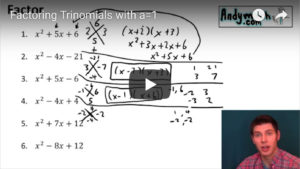
Questions
For problems 1-9, factor the trinomial.
\(\textbf{1)}\) \( x^2+5x+6 \) The answer is \( (x+2)(x+3) \)

\(\textbf{2)}\) \( x^2-4x-21 \) The answer is \( (x-7)(x+3) \)
\(\textbf{3)}\) \( x^2+5x-6 \) The answer is \( (x+6)(x-1) \)
\(\textbf{4)}\) \( x^2-4x+4 \) The answer is \( (x-2)(x-2) \) or \( (x-2)^2 \)
\(\textbf{5)}\) \( x^2+7x+12 \) The answer is \( (x+3)(x+4) \)
\(\textbf{6)}\) \( x^2-8x+12 \) The answer is \( (x-6)(x-2) \)
\(\textbf{7)}\) \(x^2-6x+8\) The answer is \((x-4)(x-2)\)
\(\textbf{8)}\) \(x^2-8x-20\) The answer is \((x-10)(x+2)\)
\(\textbf{9)}\) \(x^2+2x+1\) The answer is \((x+1)(x+1)\) or \( (x+1)^2\)
\(\textbf{10)}\) \(x^2-3x-28\) The answer is \((x+4)(x-7)\)
\(\textbf{11)}\) \(x^2-14x+40\) The answer is \((x-10)(x-4)\)
\(\textbf{12)}\) \(x^2+7x-30\) The answer is \((x+10)(x-3)\)
\(\textbf{13)}\) \(x^2-11x+24\) The answer is \((x-8)(x-3)\)
\(\textbf{14)}\) \(x^2+16x+28\) The answer is \((x+2)(x+14)\)
\(\textbf{15)}\) \(x^2+12x-28\) The answer is \((x-2)(x+14)\)
\(\textbf{16)}\) \(x^2-17x+72\) The answer is \((x-8)(x-9)\)
\(\textbf{17)}\) \(x^2+x-90\) The answer is \((x+10)(x-9)\)
\(\textbf{18)}\) \(x^2+2x-48\) The answer is \((x+8)(x-6)\)
\(\textbf{19)}\) \(x^2+x-42\) The answer is \((x-6)(x+7)\)
\(\textbf{20)}\) \(x^2+2x-15\) The answer is \((x-3)(x+5)\)
\(\textbf{21)}\) \(x^2-6x+8\) The answer is \((x-4)(x-2)\)
\(\textbf{22)}\) \(x^2+5x-14\) The answer is \((x+7)(x-2)\)
\(\textbf{23)}\) \(x^2-8x+15\) The answer is \((x-5)(x-3)\)
\(\textbf{24)}\) \(x^2+4x-60\) The answer is \((x+10)(x-6)\)
\(\textbf{25)}\) \(x^2-2x-15\) The answer is \((x-5)(x+3)\)
\(\textbf{26)}\) \(x^2+3x-28\) The answer is \((x+7)(x-4)\)
\(\textbf{27)}\) \(x^2-10x+21\) The answer is \((x-7)(x-3)\)
\(\textbf{28)}\) \(x^2+6x-16\) The answer is \((x+8)(x-2)\)
\(\textbf{29)}\) \(x^2-9x+20\) The answer is \((x-5)(x-4)\)
\(\textbf{30)}\) \(x^2+8x+15\) The answer is \((x+5)(x+3)\)
Challenge Questions
\(\textbf{31)}\) \( x^2-9 \)
The answer is \( (x+3)(x-3) \)
\(\textbf{32)}\) \( x^4+5x^2+6 \) The answer is \( (x^2+2)(x^2+3) \)
\(\textbf{33)}\) \(x^4-5x^2+4\) The answer is \((x-1)(x+1)(x-2)(x+2)\)
\(\textbf{34)}\) What is the sum of the solutions of \( x^2+5x=6? \) The answer is \(-5 \)
\(\textbf{35)}\) Solve for x. \(\,\, \displaystyle 4= \frac{x^2-9}{3-x} \) The answer is \(x=-7 \)
Printable PDFs
Printable PDF
Printable PDF Answer Key
See Related Pages\(\)
\(\bullet\text{ Factoring Calculator }\)
\(\,\,\,\,\,\,\,\,\text{(Symbolab.com)}\)
\(\bullet\text{ Factoring out a GCF}\)
\(\,\,\,\,\,\,\,\,3xyz^2+x^2y^2z+9x^3y=xy(3z^2+xyz+9x^2)…\)
\(\bullet\text{ Perfect Square Trinomials}\)
\(\,\,\,\,\,\,\,\,x^2-6x+9=(x-3)^2…\)
\(\bullet\text{ Factoring Trinomials with a} \ne 1\)
\(\,\,\,\,\,\,\,\,3x^2+11x+6=(3x+2)(x+3)…\)
\(\bullet\text{ Factoring with u-substitution}\)
\(\,\,\,\,\,\,\,\,x^4+5x^2+6=u^2+5u+6…\)
\(\bullet\text{ Difference of Two Squares}\)
\(\,\,\,\,\,\,\,\,x^2-16=(x+4)(x-4)…\)
\(\bullet\text{ Sum/Difference of Two Cubes}\)
\(\,\,\,\,\,\,\,\,x^3-8=(x-2)(x^2+2x+4)…\)
\(\bullet\text{ Factor by Grouping}\)
\(\,\,\,\,\,\,\,\,8x^3-4x^2-6x+3=(4x^2-3)(2x-1)…\)
\(\bullet\text{ Solving Quadratic Equations by Factoring}\)
\(\,\,\,\,\,\,\,\,x^2+10x−24=0…\)
In Summary
Factoring trinomials with a coefficient of 1 can be a simple process as long as integer solutions exist. A trinomial is a polynomial with three terms, and the general form of a trinomial with a coefficient of 1 is \(x^2 + bx + c\). To factor this trinomial, we need two integers that add together to give us “b” and multiply together to give us “c.”
It’s always a good idea to check your work by multiplying the factors to make sure you get the original trinomial.
Factoring trinomials is typically covered in an algebra or pre-calculus class.
Factoring is the inverse operation of “FOIL.” Factoring starts with a trinomial and ends in 2 binomials. The FOIL method would take those two binomials and multiply them out to create the trinomial.
Topics related to Factoring Trinomials
Factoring Polynomials: Factoring trinomials is a specific type of factoring polynomials. In general, factoring polynomials involves expressing a polynomial as the product of two or more polynomials with simpler forms.
The distributive property: The distributive property is a fundamental property of numbers that is used extensively in algebra. This property is used in the process of factoring some trinomials.
Quadratic equations: Factoring trinomials is often the method of choice used to solve quadratic equations, which are equations of the form \(ax^2 + bx + c = 0\).
Overall, factoring trinomials is a fundamental concept in algebra that is related to many other mathematical concepts and techniques.