

Notes
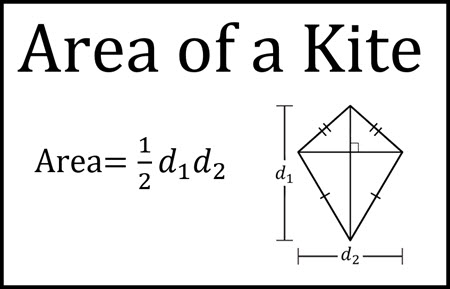
| Properties of Kites | |||
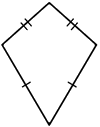 |
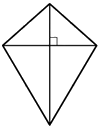 |
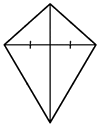 |
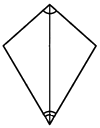 |
| Two pairs adjacent sides congruent | Diagonals are perpendicular | One diagonal bisects the other diagonal | One diagonal bisects angles |
Practice Questions
\(\textbf{1)}\) Find the Area
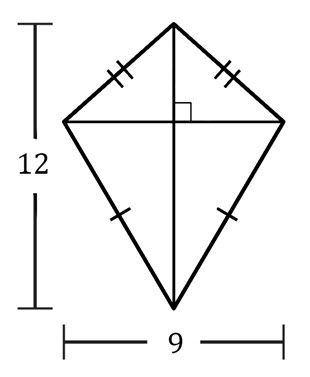 The area is \(54\)
\(\,\,\,\,\,\,\text{Area}=\frac{1}{2}d_1d_2\)
\(\,\,\,\,\,\,\text{Area}=\frac{1}{2}(9)(12)\)
\(\,\,\,\,\,\,\)The area is \(54\)
\(\,\,\,\,\,\,\text{Area}=\frac{1}{2}d_1d_2\)
\(\,\,\,\,\,\,\text{Area}=\frac{1}{2}(9)(12)\)
\(\,\,\,\,\,\,\)The area is \(54\)
\(\textbf{2)}\) Find the Area
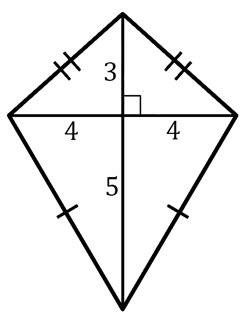 The area is \(32\)
\(\,\,\,\,\,\,\text{Area}=\frac{1}{2}d_1d_2\)
\(\,\,\,\,\,\,\text{Area}=\frac{1}{2}(3+5)(4+4)\)
\(\,\,\,\,\,\,\text{Area}=\frac{1}{2}(8)(8)\)
\(\,\,\,\,\,\,\)The area is \(32\)
\(\,\,\,\,\,\,\text{Area}=\frac{1}{2}d_1d_2\)
\(\,\,\,\,\,\,\text{Area}=\frac{1}{2}(3+5)(4+4)\)
\(\,\,\,\,\,\,\text{Area}=\frac{1}{2}(8)(8)\)
\(\,\,\,\,\,\,\)The area is \(32\)
\(\textbf{3)}\) Find the perimeter of the following kite
The perimeter is \(10+2\sqrt{41}\)
\(\textbf{4)}\) Solve for x
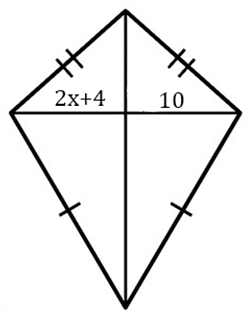 The answer is \(x=3\)
True or False?
\(\textbf{5)}\) A kite is a parallelogram. The answer is False
\(\textbf{6)}\) A kite has congruent diagonals. The answer is False
\(\textbf{7)}\) A kite is a quadrilateral. The answer is True
\(\textbf{8)}\) The perimeter of a kite is equal to the sum of the diagonals. The answer is False