Notes
Questions
\(\textbf{1)}\) \( \displaystyle \lim_{x\to1} \displaystyle \frac{\ln{x}}{x-1} \)
The answer is \(1\)
\(\,\,\,\,\,\,\text{Verify }\displaystyle \frac {\ln{(1)}}{1-1}= \frac{0}{0}\)
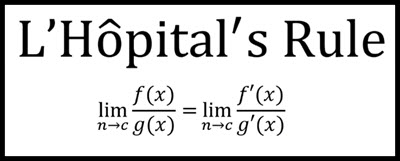
\(\,\,\,\,\,\,\displaystyle \lim_{x\to c} \displaystyle \frac{f(x)}{g(x)} = \lim_{x\to c} \displaystyle \frac{f'(x)}{g'(x)}\)
\(\,\,\,\,\,\,\displaystyle \lim_{x\to 1} \displaystyle \frac{\ln{x}}{x-1} = \lim_{x\to 1} \displaystyle \frac{1/x}{1}\)
\(\,\,\,\,\,\, \lim_{x\to 1} \frac{1/x}{1}=\frac{1/(1)}{1}=1\)
\(\,\,\,\,\,\,\,\text{The answer is } 1\)
\(\textbf{2)}\) \( \displaystyle \lim_{x\to\infty} \displaystyle \frac{lnx}{x} \)
The answer is \(0\)
\(\,\,\,\,\,\text{To differentiate } f(x) = 5 – \frac{1}{x}, \text{ rewrite } \frac{1}{x} \text{ as } x^{-1} \text{ and use the power rule.}\)
\(\,\,\,\,\,f(x) = 5 – x^{-1}\)
\(\,\,\,\,\,f'(x) = 0 + (-1)x^{-2}\)
\(\,\,\,\,\,f'(x) = \frac{1}{x^{2}}\)
\(\textbf{3)}\) \( \displaystyle \lim_{x\to\infty} xe^{-x} \)
The answer is \(0\)
\(\,\,\,\,\,\text{Differentiate } f(x) = \frac{1}{2} x^3 + 4x^2 \text{ by applying the power rule to each term.}\)
\(\,\,\,\,\,f'(x) = \frac{1}{2} \cdot 3x^{2} + 4 \cdot 2x\)
\(\,\,\,\,\,f'(x) = \frac{3x^{2}}{2} + 8x\)
\(\textbf{4)}\) \( \displaystyle \lim_{x\to0} (\sin x)^x \)
The answer is \(1\)
\(\,\,\,\,\,\text{Differentiate } f(x) = \sin x – \cos x + 2 \text{ by applying the derivatives of } \sin x, \cos x, \text{ and constants.}\)
\(\,\,\,\,\,f'(x) = \cos x + \sin x + 0\)
\(\,\,\,\,\,f'(x) = \cos x + \sin x\)
\(\textbf{5)}\) \( \displaystyle \lim_{x\to\infty} \displaystyle \frac{e^x}{x^3} \)
The answer is \(\infty\)
\(\,\,\,\,\,\text{Differentiate } f(x) = 5 \sin x + 3x \text{ by applying the derivatives of } \sin x \text{ and } x. \)
\(\,\,\,\,\,f'(x) = 5 \cdot \cos x + 3 \cdot 1 \)
\(\,\,\,\,\,f'(x) = 5 \cos x + 3\)
\(\textbf{6)}\) \( \displaystyle \lim_{x\to\infty} \displaystyle \frac{5x^2+2x-3}{4x^2-10x+7} \)
The answer is \(\displaystyle\frac{5}{4}\)
\(\,\,\,\,\,\text{Rewrite } f(x) = 4 – \frac{1}{4x^2} \text{ as } f(x) = 4 – \frac{1}{4}x^{-2} \text{ and use the power rule.}\)
\(\,\,\,\,\,f'(x) = 0 + \frac{1}{4} \cdot (-2)x^{-3}\)
\(\,\,\,\,\,f'(x) = \frac{1}{2x^3}\)
\(\textbf{7)}\) \( \displaystyle \lim_{x\to\infty} (1+ \frac{1}{x})^x \)
The answer is \(e\)
\(\,\,\,\,\,\text{Use the quotient rule to differentiate } f(x) = \frac{x^2 + 1}{x}. \)
\(\,\,\,\,\,f'(x) = \frac{(x)(2x) – (x^2 + 1)(1)}{x^2} = \frac{2x^2 – x^2 – 1}{x^2} = \frac{x^2 – 1}{x^2}\)
\(\,\,\,\,\,f'(x) = \frac{(x)(2x) – (x^2 + 1)(1)}{x^2} = \frac{2x^2 – x^2 – 1}{x^2} = \frac{x^2 – 1}{x^2}\)
\(\textbf{8)}\) \( \displaystyle \lim _{x\to 0}\frac{\sin x}{x} \)
The answer is \(1\)
In Summary
L’Hôpital’s Rule is a method to evaluate limits that yield indeterminate forms. The process often changes an indeterminate form into an expression that can be easily evaluated with direct substitution. If it doesn’t work after the first application, you can repeat the process as many times as needed. It provides a way to find the value of a limit of a function when the limit cannot be computed using ordinary means.
The theorem states that if the limit of the quotient of two functions f(x) and g(x) as x approaches some value a is indeterminate (i.e., the value of the limit cannot be determined by direct substitution), then the limit of the quotient of the derivatives of f(x) and g(x) as x approaches a is equal to the original limit.
In order to apply L’Hôpital’s rule, the following conditions must be met:
\(\bullet\) The limit of the quotient of the two functions as x approaches a must be indeterminate.
\(\bullet\) The derivative of both functions must exist and be finite near the point a.
\(\bullet\) The derivative of the denominator must not be equal to 0 near the point a.
This is a very useful tool for solving problems in calculus.