One-sided limits describe what a function approaches from only the left side or only the right side of a value. They are especially helpful for piecewise functions, absolute value expressions, and functions with different behavior on each side of a point. These problems include left-hand limits, right-hand limits, two-sided limits, piecewise functions, absolute value limits, and infinite one-sided limits.
Practice Problems
\(\textbf{1)}\) Find \( \displaystyle \lim_{x\to 2^{-}} f(x) \)
where \(f(x) = \begin{cases}
5x+3 & \text{if } x \lt 2 \\
4x & \text{if } x \geq 2
\end{cases}\)
The limit is \( 13 \)
\(\,\,\,\,\,\text{Since }x\to2^{-}\text{, use the rule for }x<2.[/latex]
[latex]\,\,\,\,\,f(x)=5x+3\)
\(\,\,\,\,\,\displaystyle \lim_{x\to2^{-}}f(x)=5(2)+3\)
\(\,\,\,\,\,\displaystyle \lim_{x\to2^{-}}f(x)=13\)
\(\,\,\,\,\,\)The limit is \(13\)

\(\textbf{2)}\) Find \( \displaystyle \lim_{x\to 2^{+}} f(x) \)
where \(f(x) = \begin{cases}
5x+3 & \text{if } x \lt 2 \\
4x & \text{if } x \geq 2
\end{cases}\)
The limit is \( 8 \)
\(\,\,\,\,\,\text{Since }x\to2^{+}\text{, use the rule for }x\geq2.\)
\(\,\,\,\,\,f(x)=4x\)
\(\,\,\,\,\,\displaystyle \lim_{x\to2^{+}}f(x)=4(2)\)
\(\,\,\,\,\,\displaystyle \lim_{x\to2^{+}}f(x)=8\)
\(\,\,\,\,\,\)The limit is \(8\)
\(\textbf{3)}\) \( \displaystyle \lim_{x\to 2^{+}} \frac{|x-2|}{x-2} \)
The answer is \( 1 \)
\(\,\,\,\,\,\text{For }x>2,\text{ }x-2\text{ is positive.}\)
\(\,\,\,\,\,|x-2|=x-2\)
\(\,\,\,\,\,\displaystyle\frac{|x-2|}{x-2}=\frac{x-2}{x-2}\)
\(\,\,\,\,\,\displaystyle\frac{|x-2|}{x-2}=1\)
\(\,\,\,\,\,\)The answer is \(1\)
\(\textbf{4)}\) \( \displaystyle \lim_{x\to 2^{-}} \frac{|x-2|}{x-2} \)
The answer is \( -1 \)
\(\,\,\,\,\,\text{For }x<2,\text{ }x-2\text{ is negative.}[/latex]
[latex]\,\,\,\,\,|x-2|=-(x-2)\)
\(\,\,\,\,\,\displaystyle\frac{|x-2|}{x-2}=\frac{-(x-2)}{x-2}\)
\(\,\,\,\,\,\displaystyle\frac{|x-2|}{x-2}=-1\)
\(\,\,\,\,\,\)The answer is \(-1\)
\(\textbf{5)}\) \( \displaystyle \lim_{x\to 2} \frac{|x-2|}{x-2} \)
The Limit Does Not Exist
\(\,\,\,\,\,\displaystyle \lim_{x\to2^{-}}\frac{|x-2|}{x-2}=-1\)
\(\,\,\,\,\,\displaystyle \lim_{x\to2^{+}}\frac{|x-2|}{x-2}=1\)
\(\,\,\,\,\,-1\neq1\)
\(\,\,\,\,\,\text{Since the one-sided limits are not equal, the two-sided limit does not exist.}\)
\(\,\,\,\,\,\)The Limit Does Not Exist
\(\textbf{6)}\) \( \displaystyle \lim_{x\to 1^{+}} \frac{3|x-1|}{x-1} \)
The answer is \( 3 \)
\(\,\,\,\,\,\text{For }x>1,\text{ }x-1\text{ is positive.}\)
\(\,\,\,\,\,|x-1|=x-1\)
\(\,\,\,\,\,\displaystyle\frac{3|x-1|}{x-1}=\frac{3(x-1)}{x-1}\)
\(\,\,\,\,\,\displaystyle\frac{3|x-1|}{x-1}=3\)
\(\,\,\,\,\,\)The answer is \(3\)
\(\textbf{7)}\) \( \displaystyle \lim_{x\to 1^{-}} \frac{3|x-1|}{x-1} \)
The answer is \( -3 \)
\(\,\,\,\,\,\text{For }x<1,\text{ }x-1\text{ is negative.}[/latex]
[latex]\,\,\,\,\,|x-1|=-(x-1)\)
\(\,\,\,\,\,\displaystyle\frac{3|x-1|}{x-1}=\frac{3[-(x-1)]}{x-1}\)
\(\,\,\,\,\,\displaystyle\frac{3|x-1|}{x-1}=-3\)
\(\,\,\,\,\,\)The answer is \(-3\)
\(\textbf{8)}\) \( \displaystyle \lim_{x\to 1} \frac{3|x-1|}{x-1} \)
The Limit Does Not Exist
\(\,\,\,\,\,\displaystyle \lim_{x\to1^{-}}\frac{3|x-1|}{x-1}=-3\)
\(\,\,\,\,\,\displaystyle \lim_{x\to1^{+}}\frac{3|x-1|}{x-1}=3\)
\(\,\,\,\,\,-3\neq3\)
\(\,\,\,\,\,\text{Since the one-sided limits are not equal, the two-sided limit does not exist.}\)
\(\,\,\,\,\,\)The Limit Does Not Exist
\(\textbf{9)}\) Find \( \displaystyle \lim_{x\to 4^{-}} f(x) \)
where \(f(x) = \begin{cases}
-x+5 & \text{if } x\leq 4 \\
x-3 & \text{if } 4\lt x \lt 6 \\
x & \text{if }x\geq 6
\end{cases}\)
The limit is \( 1 \)
\(\,\,\,\,\,\text{Since }x\to4^{-}\text{, use the rule for }x\leq4.\)
\(\,\,\,\,\,f(x)=-x+5\)
\(\,\,\,\,\,\displaystyle \lim_{x\to4^{-}}f(x)=-(4)+5\)
\(\,\,\,\,\,\displaystyle \lim_{x\to4^{-}}f(x)=1\)
\(\,\,\,\,\,\)The limit is \(1\)
\(\textbf{10)}\) Find \( \displaystyle \lim_{x\to 4^{+}} f(x) \)
where \(f(x) = \begin{cases}
-x+5 & \text{if } x\leq 4 \\
x-3 & \text{if } 4\lt x \lt 6 \\
x & \text{if }x\geq 6
\end{cases}\)
The limit is \( 1 \)
\(\,\,\,\,\,\text{Since }x\to4^{+}\text{, use the rule for }4
[latex]\,\,\,\,\,f(x)=x-3\)
\(\,\,\,\,\,\displaystyle \lim_{x\to4^{+}}f(x)=4-3\)
\(\,\,\,\,\,\displaystyle \lim_{x\to4^{+}}f(x)=1\)
\(\,\,\,\,\,\)The limit is \(1\)
\(\textbf{11)}\) Find \( \displaystyle \lim_{x\to 6^{-}} f(x) \)
where \(f(x) = \begin{cases}
-x+5 & \text{if } x\leq 4 \\
x-3 & \text{if } 4\lt x \lt 6 \\
x & \text{if }x\geq 6
\end{cases}\)
The limit is \( 3 \)
\(\,\,\,\,\,\text{Since }x\to6^{-}\text{, use the rule for }4
[latex]\,\,\,\,\,f(x)=x-3\)
\(\,\,\,\,\,\displaystyle \lim_{x\to6^{-}}f(x)=6-3\)
\(\,\,\,\,\,\displaystyle \lim_{x\to6^{-}}f(x)=3\)
\(\,\,\,\,\,\)The limit is \(3\)
\(\textbf{12)}\) Find \( \displaystyle \lim_{x\to 6^{+}} f(x) \)
where \(f(x) = \begin{cases}
-x+5 & \text{if } x\leq 4 \\
x-3 & \text{if } 4\lt x \lt 6 \\
x & \text{if }x\geq 6
\end{cases}\)
The limit is \( 6 \)
\(\,\,\,\,\,\text{Since }x\to6^{+}\text{, use the rule for }x\geq6.\)
\(\,\,\,\,\,f(x)=x\)
\(\,\,\,\,\,\displaystyle \lim_{x\to6^{+}}f(x)=6\)
\(\,\,\,\,\,\)The limit is \(6\)
\(\textbf{13)}\) Find \( \displaystyle \lim_{x\to 7^{-}} f(x) \)
where \(f(x) = \begin{cases}
-x+5 & \text{if } x\leq 4 \\
x-3 & \text{if } 4\lt x \lt 6 \\
x & \text{if }x\geq 6
\end{cases}\)
The limit is \( 7 \)
\(\,\,\,\,\,\text{Since values just to the left of }7\text{ are still greater than }6,\text{ use }x\geq6.\)
\(\,\,\,\,\,f(x)=x\)
\(\,\,\,\,\,\displaystyle \lim_{x\to7^{-}}f(x)=7\)
\(\,\,\,\,\,\)The limit is \(7\)
\(\textbf{14)}\) Find \( \displaystyle \lim_{x\to 7^{+}} f(x) \)
where \(f(x) = \begin{cases}
-x+5 & \text{if } x\leq 4 \\
x-3 & \text{if } 4\lt x \lt 6 \\
x & \text{if }x\geq 6
\end{cases}\)
The limit is \( 7 \)
\(\,\,\,\,\,\text{Since values just to the right of }7\text{ are greater than }6,\text{ use }x\geq6.\)
\(\,\,\,\,\,f(x)=x\)
\(\,\,\,\,\,\displaystyle \lim_{x\to7^{+}}f(x)=7\)
\(\,\,\,\,\,\)The limit is \(7\)
\(\textbf{15)}\) \( \displaystyle \lim_{x\to 1^{-}} \frac{x^2+3x-4}{\left(x-1\right)^4} \)
The answer is \(-\infty\)
\(\,\,\,\,\,x^2+3x-4=(x+4)(x-1)\)
\(\,\,\,\,\,\displaystyle\frac{x^2+3x-4}{(x-1)^4}=\frac{(x+4)(x-1)}{(x-1)^4}\)
\(\,\,\,\,\,\displaystyle\frac{x^2+3x-4}{(x-1)^4}=\frac{x+4}{(x-1)^3}\)
\(\,\,\,\,\,\text{As }x\to1^{-},\text{ }x+4\to5\text{ and }(x-1)^3\to0^{-}.\)
\(\,\,\,\,\,\text{A positive number divided by a very small negative number approaches }-\infty.\)
\(\,\,\,\,\,\)The answer is \(-\infty\)
\(\textbf{16)}\) \( \displaystyle \lim_{x\to 1^{+}} \frac{x^2+3x-4}{\left(x-1\right)^4} \)
The answer is \(\infty\)
\(\,\,\,\,\,x^2+3x-4=(x+4)(x-1)\)
\(\,\,\,\,\,\displaystyle\frac{x^2+3x-4}{(x-1)^4}=\frac{(x+4)(x-1)}{(x-1)^4}\)
\(\,\,\,\,\,\displaystyle\frac{x^2+3x-4}{(x-1)^4}=\frac{x+4}{(x-1)^3}\)
\(\,\,\,\,\,\text{As }x\to1^{+},\text{ }x+4\to5\text{ and }(x-1)^3\to0^{+}.\)
\(\,\,\,\,\,\text{A positive number divided by a very small positive number approaches }\infty.\)
\(\,\,\,\,\,\)The answer is \(\infty\)
\(\textbf{17)}\) \( \displaystyle \lim_{x\to 1} \frac{x^2+3x-4}{\left(x-1\right)^4} \)
The limit does not exist
\(\,\,\,\,\,\displaystyle \lim_{x\to1^{-}}\frac{x^2+3x-4}{(x-1)^4}=-\infty\)
\(\,\,\,\,\,\displaystyle \lim_{x\to1^{+}}\frac{x^2+3x-4}{(x-1)^4}=\infty\)
\(\,\,\,\,\,\text{The left and right limits do not match.}\)
\(\,\,\,\,\,\text{Therefore, the two-sided limit does not exist.}\)
\(\,\,\,\,\,\)The limit does not exist
\(\textbf{18)}\) Find \( \displaystyle \lim_{x\to -2^{-}} f(x) \)
where \(f(x)=\begin{cases}
x^2+1 & \text{if }x \lt -2\\
3x-1 & \text{if }x\geq -2
\end{cases}\)
The limit is \(5\)
\(\,\,\,\,\,\text{Since }x\to-2^{-}\text{, use the rule for }x<-2.[/latex]
[latex]\,\,\,\,\,f(x)=x^2+1\)
\(\,\,\,\,\,\displaystyle \lim_{x\to-2^{-}}f(x)=(-2)^2+1\)
\(\,\,\,\,\,\displaystyle \lim_{x\to-2^{-}}f(x)=5\)
\(\,\,\,\,\,\)The limit is \(5\)
\(\textbf{19)}\) Find \( \displaystyle \lim_{x\to -2^{+}} f(x) \)
where \(f(x)=\begin{cases}
x^2+1 & \text{if }x \lt -2\\
3x-1 & \text{if }x\geq -2
\end{cases}\)
The limit is \(-7\)
\(\,\,\,\,\,\text{Since }x\to-2^{+}\text{, use the rule for }x\geq-2.\)
\(\,\,\,\,\,f(x)=3x-1\)
\(\,\,\,\,\,\displaystyle \lim_{x\to-2^{+}}f(x)=3(-2)-1\)
\(\,\,\,\,\,\displaystyle \lim_{x\to-2^{+}}f(x)=-7\)
\(\,\,\,\,\,\)The limit is \(-7\)
\(\textbf{20)}\) Find \( \displaystyle \lim_{x\to -2} f(x) \)
where \(f(x)=\begin{cases}
x^2+1 & \text{if }x \lt -2\\
3x-1 & \text{if }x\geq -2
\end{cases}\)
The limit does not exist
\(\,\,\,\,\,\displaystyle \lim_{x\to-2^{-}}f(x)=(-2)^2+1=5\)
\(\,\,\,\,\,\displaystyle \lim_{x\to-2^{+}}f(x)=3(-2)-1=-7\)
\(\,\,\,\,\,5\neq-7\)
\(\,\,\,\,\,\text{Since the one-sided limits are not equal, the two-sided limit does not exist.}\)
\(\,\,\,\,\,\)The limit does not exist
See Related Pages\(\)


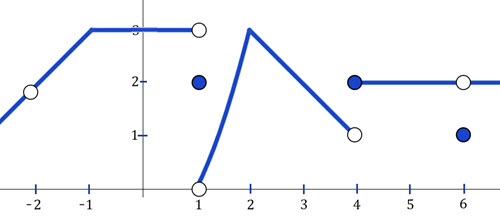 \(…\)
\(…\)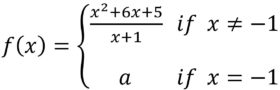 \(…\)
\(…\)