

Partial derivatives are used to find how a multivariable function changes with respect to one variable at a time. When taking a partial derivative with respect to \(x\), all other variables are treated as constants. These problems focus on finding first-order partial derivatives such as \(f_x\), \(f_y\), and \(f_z\) for functions with two or more variables.
Practice Problems
Find the first order partial derivatives for each.
\(\textbf{1)}\) \(f(x,y)=x^2+y^2+3\)
\(\,\,\,\,\, f_x(x,y)=\frac{\partial}{\partial x}\left(x^2+y^2+3\right) \,\,\,\left(\text{Differentiate with respect to x}\right)\)
\(\,\,\,\,\, f_x(x,y)=2x+0+0 \,\,\,\left(\text{Treat y as a constant}\right)\)
\(\,\,\,\,\, f_x(x,y)=2x \,\,\,\left(\text{Simplify}\right)\)
\(\,\,\,\,\, f_y(x,y)=\frac{\partial}{\partial y}\left(x^2+y^2+3\right) \,\,\,\left(\text{Differentiate with respect to y}\right)\)
\(\,\,\,\,\, f_y(x,y)=0+2y+0 \,\,\,\left(\text{Treat x as a constant}\right)\)
\(\,\,\,\,\, f_y(x,y)=2y \,\,\,\left(\text{Simplify}\right)\)
\(f_x(x,y)=2x \)
\(f_y(x,y)=2y \)
\(\,\,\,\,\, f_x(x,y)=\frac{\partial}{\partial x}\left(x^2+y^2+3\right) \,\,\,\left(\text{Differentiate with respect to x}\right)\)
\(\,\,\,\,\, f_x(x,y)=2x+0+0 \,\,\,\left(\text{Treat y as a constant}\right)\)
\(\,\,\,\,\, f_x(x,y)=2x \,\,\,\left(\text{Simplify}\right)\)
\(\,\,\,\,\, f_y(x,y)=\frac{\partial}{\partial y}\left(x^2+y^2+3\right) \,\,\,\left(\text{Differentiate with respect to y}\right)\)
\(\,\,\,\,\, f_y(x,y)=0+2y+0 \,\,\,\left(\text{Treat x as a constant}\right)\)
\(\,\,\,\,\, f_y(x,y)=2y \,\,\,\left(\text{Simplify}\right)\)
\(f_y(x,y)=2y \)
\(\textbf{2)}\) \(f(x,y)=3x^2y\)
\(\,\,\,\,\, f_x(x,y)=\frac{\partial}{\partial x}\left(3x^2y\right) \,\,\,\left(\text{Differentiate with respect to x}\right)\)
\(\,\,\,\,\, f_x(x,y)=3y\cdot 2x \,\,\,\left(\text{Treat y as a constant}\right)\)
\(\,\,\,\,\, f_x(x,y)=6xy \,\,\,\left(\text{Simplify}\right)\)
\(\,\,\,\,\, f_y(x,y)=\frac{\partial}{\partial y}\left(3x^2y\right) \,\,\,\left(\text{Differentiate with respect to y}\right)\)
\(\,\,\,\,\, f_y(x,y)=3x^2 \,\,\,\left(\text{Treat x as a constant}\right)\)
\(f_x(x,y)=6xy \)
\(f_y(x,y)=3x^2 \)
\(\,\,\,\,\, f_x(x,y)=\frac{\partial}{\partial x}\left(3x^2y\right) \,\,\,\left(\text{Differentiate with respect to x}\right)\)
\(\,\,\,\,\, f_x(x,y)=3y\cdot 2x \,\,\,\left(\text{Treat y as a constant}\right)\)
\(\,\,\,\,\, f_x(x,y)=6xy \,\,\,\left(\text{Simplify}\right)\)
\(\,\,\,\,\, f_y(x,y)=\frac{\partial}{\partial y}\left(3x^2y\right) \,\,\,\left(\text{Differentiate with respect to y}\right)\)
\(\,\,\,\,\, f_y(x,y)=3x^2 \,\,\,\left(\text{Treat x as a constant}\right)\)
\(f_y(x,y)=3x^2 \)
\(\textbf{3)}\) \(f(x,y,z)=x^2z+4y^3z+3z^2\)
\(\,\,\,\,\, f_x(x,y,z)=\frac{\partial}{\partial x}\left(x^2z+4y^3z+3z^2\right) \,\,\,\left(\text{Differentiate with respect to x}\right)\)
\(\,\,\,\,\, f_x(x,y,z)=2xz+0+0 \,\,\,\left(\text{Treat y and z as constants}\right)\)
\(\,\,\,\,\, f_x(x,y,z)=2xz \,\,\,\left(\text{Simplify}\right)\)
\(\,\,\,\,\, f_y(x,y,z)=\frac{\partial}{\partial y}\left(x^2z+4y^3z+3z^2\right) \,\,\,\left(\text{Differentiate with respect to y}\right)\)
\(\,\,\,\,\, f_y(x,y,z)=0+12y^2z+0 \,\,\,\left(\text{Treat x and z as constants}\right)\)
\(\,\,\,\,\, f_y(x,y,z)=12y^2z \,\,\,\left(\text{Simplify}\right)\)
\(\,\,\,\,\, f_z(x,y,z)=\frac{\partial}{\partial z}\left(x^2z+4y^3z+3z^2\right) \,\,\,\left(\text{Differentiate with respect to z}\right)\)
\(\,\,\,\,\, f_z(x,y,z)=x^2+4y^3+6z \,\,\,\left(\text{Treat x and y as constants}\right)\)
\(f_x(x,y,z)=2xz \)
\(f_y(x,y,z)=12y^2z \)
\(f_z(x,y,z)=x^2+4y^3+6z \)
\(\,\,\,\,\, f_x(x,y,z)=\frac{\partial}{\partial x}\left(x^2z+4y^3z+3z^2\right) \,\,\,\left(\text{Differentiate with respect to x}\right)\)
\(\,\,\,\,\, f_x(x,y,z)=2xz+0+0 \,\,\,\left(\text{Treat y and z as constants}\right)\)
\(\,\,\,\,\, f_x(x,y,z)=2xz \,\,\,\left(\text{Simplify}\right)\)
\(\,\,\,\,\, f_y(x,y,z)=\frac{\partial}{\partial y}\left(x^2z+4y^3z+3z^2\right) \,\,\,\left(\text{Differentiate with respect to y}\right)\)
\(\,\,\,\,\, f_y(x,y,z)=0+12y^2z+0 \,\,\,\left(\text{Treat x and z as constants}\right)\)
\(\,\,\,\,\, f_y(x,y,z)=12y^2z \,\,\,\left(\text{Simplify}\right)\)
\(\,\,\,\,\, f_z(x,y,z)=\frac{\partial}{\partial z}\left(x^2z+4y^3z+3z^2\right) \,\,\,\left(\text{Differentiate with respect to z}\right)\)
\(\,\,\,\,\, f_z(x,y,z)=x^2+4y^3+6z \,\,\,\left(\text{Treat x and y as constants}\right)\)
\(f_y(x,y,z)=12y^2z \)
\(f_z(x,y,z)=x^2+4y^3+6z \)
\(\textbf{4)}\) \(f(x,y)=x \sin y+\cos x\)
\(\,\,\,\,\, f_x(x,y)=\frac{\partial}{\partial x}\left(x\sin y+\cos x\right) \,\,\,\left(\text{Differentiate with respect to x}\right)\)
\(\,\,\,\,\, f_x(x,y)=\sin y-\sin x \,\,\,\left(\text{Treat y as a constant}\right)\)
\(\,\,\,\,\, f_y(x,y)=\frac{\partial}{\partial y}\left(x\sin y+\cos x\right) \,\,\,\left(\text{Differentiate with respect to y}\right)\)
\(\,\,\,\,\, f_y(x,y)=x\cos y+0 \,\,\,\left(\text{Treat x as a constant}\right)\)
\(\,\,\,\,\, f_y(x,y)=x\cos y \,\,\,\left(\text{Simplify}\right)\)
\(f_x(x,y)=\sin y-\sin x \)
\(f_y(x,y)=x\cos y \)
\(\,\,\,\,\, f_x(x,y)=\frac{\partial}{\partial x}\left(x\sin y+\cos x\right) \,\,\,\left(\text{Differentiate with respect to x}\right)\)
\(\,\,\,\,\, f_x(x,y)=\sin y-\sin x \,\,\,\left(\text{Treat y as a constant}\right)\)
\(\,\,\,\,\, f_y(x,y)=\frac{\partial}{\partial y}\left(x\sin y+\cos x\right) \,\,\,\left(\text{Differentiate with respect to y}\right)\)
\(\,\,\,\,\, f_y(x,y)=x\cos y+0 \,\,\,\left(\text{Treat x as a constant}\right)\)
\(\,\,\,\,\, f_y(x,y)=x\cos y \,\,\,\left(\text{Simplify}\right)\)
\(f_y(x,y)=x\cos y \)
\(\textbf{5)}\) \(f(x,y)=x^{5} \ln y -x\)
\(\,\,\,\,\, f_x(x,y)=\frac{\partial}{\partial x}\left(x^5\ln y-x\right) \,\,\,\left(\text{Differentiate with respect to x}\right)\)
\(\,\,\,\,\, f_x(x,y)=5x^4\ln y-1 \,\,\,\left(\text{Treat y as a constant}\right)\)
\(\,\,\,\,\, f_y(x,y)=\frac{\partial}{\partial y}\left(x^5\ln y-x\right) \,\,\,\left(\text{Differentiate with respect to y}\right)\)
\(\,\,\,\,\, f_y(x,y)=x^5\cdot \frac{1}{y}-0 \,\,\,\left(\text{Treat x as a constant}\right)\)
\(\,\,\,\,\, f_y(x,y)=\frac{x^5}{y} \,\,\,\left(\text{Simplify}\right)\)
\(f_x(x,y)=5x^4\ln y-1 \)
\(f_y(x,y)=\frac{x^5}{y} \)
\(\,\,\,\,\, f_x(x,y)=\frac{\partial}{\partial x}\left(x^5\ln y-x\right) \,\,\,\left(\text{Differentiate with respect to x}\right)\)
\(\,\,\,\,\, f_x(x,y)=5x^4\ln y-1 \,\,\,\left(\text{Treat y as a constant}\right)\)
\(\,\,\,\,\, f_y(x,y)=\frac{\partial}{\partial y}\left(x^5\ln y-x\right) \,\,\,\left(\text{Differentiate with respect to y}\right)\)
\(\,\,\,\,\, f_y(x,y)=x^5\cdot \frac{1}{y}-0 \,\,\,\left(\text{Treat x as a constant}\right)\)
\(\,\,\,\,\, f_y(x,y)=\frac{x^5}{y} \,\,\,\left(\text{Simplify}\right)\)
\(f_y(x,y)=\frac{x^5}{y} \)
\(\textbf{6)}\) \(f(x,y)=e^{5x^2+2y}\)
\(\,\,\,\,\, f_x(x,y)=\frac{\partial}{\partial x}\left(e^{5x^2+2y}\right) \,\,\,\left(\text{Differentiate with respect to x}\right)\)
\(\,\,\,\,\, f_x(x,y)=e^{5x^2+2y}\cdot 10x \,\,\,\left(\text{Use the chain rule}\right)\)
\(\,\,\,\,\, f_x(x,y)=10xe^{5x^2+2y} \,\,\,\left(\text{Simplify}\right)\)
\(\,\,\,\,\, f_y(x,y)=\frac{\partial}{\partial y}\left(e^{5x^2+2y}\right) \,\,\,\left(\text{Differentiate with respect to y}\right)\)
\(\,\,\,\,\, f_y(x,y)=e^{5x^2+2y}\cdot 2 \,\,\,\left(\text{Use the chain rule}\right)\)
\(\,\,\,\,\, f_y(x,y)=2e^{5x^2+2y} \,\,\,\left(\text{Simplify}\right)\)
\(f_x(x,y)=10xe^{5x^2+2y} \)
\(f_y(x,y)=2e^{5x^2+2y} \)
\(\,\,\,\,\, f_x(x,y)=\frac{\partial}{\partial x}\left(e^{5x^2+2y}\right) \,\,\,\left(\text{Differentiate with respect to x}\right)\)
\(\,\,\,\,\, f_x(x,y)=e^{5x^2+2y}\cdot 10x \,\,\,\left(\text{Use the chain rule}\right)\)
\(\,\,\,\,\, f_x(x,y)=10xe^{5x^2+2y} \,\,\,\left(\text{Simplify}\right)\)
\(\,\,\,\,\, f_y(x,y)=\frac{\partial}{\partial y}\left(e^{5x^2+2y}\right) \,\,\,\left(\text{Differentiate with respect to y}\right)\)
\(\,\,\,\,\, f_y(x,y)=e^{5x^2+2y}\cdot 2 \,\,\,\left(\text{Use the chain rule}\right)\)
\(\,\,\,\,\, f_y(x,y)=2e^{5x^2+2y} \,\,\,\left(\text{Simplify}\right)\)
\(f_y(x,y)=2e^{5x^2+2y} \)
\(\textbf{7)}\) \(f(x,y)=4x^4\sqrt[3]{y^2}-xy\)
\(\,\,\,\,\, f(x,y)=4x^4y^{2/3}-xy \,\,\,\left(\text{Rewrite the radical using exponents}\right)\)
\(\,\,\,\,\, f_x(x,y)=\frac{\partial}{\partial x}\left(4x^4y^{2/3}-xy\right) \,\,\,\left(\text{Differentiate with respect to x}\right)\)
\(\,\,\,\,\, f_x(x,y)=16x^3y^{2/3}-y \,\,\,\left(\text{Treat y as a constant}\right)\)
\(\,\,\,\,\, f_x(x,y)=16x^3\sqrt[3]{y^2}-y \,\,\,\left(\text{Rewrite using radicals}\right)\)
\(\,\,\,\,\, f_y(x,y)=\frac{\partial}{\partial y}\left(4x^4y^{2/3}-xy\right) \,\,\,\left(\text{Differentiate with respect to y}\right)\)
\(\,\,\,\,\, f_y(x,y)=4x^4\cdot \frac{2}{3}y^{-1/3}-x \,\,\,\left(\text{Use the power rule}\right)\)
\(\,\,\,\,\, f_y(x,y)=\frac{8x^4}{3\sqrt[3]{y}}-x \,\,\,\left(\text{Rewrite using radicals}\right)\)
\(f_x(x,y)=16x^3\sqrt[3]{y^2}-y \)
\(f_y(x,y)=\frac{8x^4}{3\sqrt[3]{y}}-x \)
\(\,\,\,\,\, f(x,y)=4x^4y^{2/3}-xy \,\,\,\left(\text{Rewrite the radical using exponents}\right)\)
\(\,\,\,\,\, f_x(x,y)=\frac{\partial}{\partial x}\left(4x^4y^{2/3}-xy\right) \,\,\,\left(\text{Differentiate with respect to x}\right)\)
\(\,\,\,\,\, f_x(x,y)=16x^3y^{2/3}-y \,\,\,\left(\text{Treat y as a constant}\right)\)
\(\,\,\,\,\, f_x(x,y)=16x^3\sqrt[3]{y^2}-y \,\,\,\left(\text{Rewrite using radicals}\right)\)
\(\,\,\,\,\, f_y(x,y)=\frac{\partial}{\partial y}\left(4x^4y^{2/3}-xy\right) \,\,\,\left(\text{Differentiate with respect to y}\right)\)
\(\,\,\,\,\, f_y(x,y)=4x^4\cdot \frac{2}{3}y^{-1/3}-x \,\,\,\left(\text{Use the power rule}\right)\)
\(\,\,\,\,\, f_y(x,y)=\frac{8x^4}{3\sqrt[3]{y}}-x \,\,\,\left(\text{Rewrite using radicals}\right)\)
\(f_y(x,y)=\frac{8x^4}{3\sqrt[3]{y}}-x \)
\(\textbf{8)}\) \(f(x,y)=x^3+5xy^2\)
\(\,\,\,\,\, f_x(x,y)=\frac{\partial}{\partial x}\left(x^3+5xy^2\right) \,\,\,\left(\text{Differentiate with respect to x}\right)\)
\(\,\,\,\,\, f_x(x,y)=3x^2+5y^2 \,\,\,\left(\text{Treat y as a constant}\right)\)
\(\,\,\,\,\, f_y(x,y)=\frac{\partial}{\partial y}\left(x^3+5xy^2\right) \,\,\,\left(\text{Differentiate with respect to y}\right)\)
\(\,\,\,\,\, f_y(x,y)=0+10xy \,\,\,\left(\text{Treat x as a constant}\right)\)
\(\,\,\,\,\, f_y(x,y)=10xy \,\,\,\left(\text{Simplify}\right)\)
\(f_x(x,y)=3x^2+5y^2 \)
\(f_y(x,y)=10xy \)
\(\,\,\,\,\, f_x(x,y)=\frac{\partial}{\partial x}\left(x^3+5xy^2\right) \,\,\,\left(\text{Differentiate with respect to x}\right)\)
\(\,\,\,\,\, f_x(x,y)=3x^2+5y^2 \,\,\,\left(\text{Treat y as a constant}\right)\)
\(\,\,\,\,\, f_y(x,y)=\frac{\partial}{\partial y}\left(x^3+5xy^2\right) \,\,\,\left(\text{Differentiate with respect to y}\right)\)
\(\,\,\,\,\, f_y(x,y)=0+10xy \,\,\,\left(\text{Treat x as a constant}\right)\)
\(\,\,\,\,\, f_y(x,y)=10xy \,\,\,\left(\text{Simplify}\right)\)
\(f_y(x,y)=10xy \)
\(\textbf{9)}\) \(f(x,y)=7x^2-4xy+y^3\)
\(\,\,\,\,\, f_x(x,y)=\frac{\partial}{\partial x}\left(7x^2-4xy+y^3\right) \,\,\,\left(\text{Differentiate with respect to x}\right)\)
\(\,\,\,\,\, f_x(x,y)=14x-4y+0 \,\,\,\left(\text{Treat y as a constant}\right)\)
\(\,\,\,\,\, f_x(x,y)=14x-4y \,\,\,\left(\text{Simplify}\right)\)
\(\,\,\,\,\, f_y(x,y)=\frac{\partial}{\partial y}\left(7x^2-4xy+y^3\right) \,\,\,\left(\text{Differentiate with respect to y}\right)\)
\(\,\,\,\,\, f_y(x,y)=0-4x+3y^2 \,\,\,\left(\text{Treat x as a constant}\right)\)
\(\,\,\,\,\, f_y(x,y)=-4x+3y^2 \,\,\,\left(\text{Simplify}\right)\)
\(f_x(x,y)=14x-4y \)
\(f_y(x,y)=-4x+3y^2 \)
\(\,\,\,\,\, f_x(x,y)=\frac{\partial}{\partial x}\left(7x^2-4xy+y^3\right) \,\,\,\left(\text{Differentiate with respect to x}\right)\)
\(\,\,\,\,\, f_x(x,y)=14x-4y+0 \,\,\,\left(\text{Treat y as a constant}\right)\)
\(\,\,\,\,\, f_x(x,y)=14x-4y \,\,\,\left(\text{Simplify}\right)\)
\(\,\,\,\,\, f_y(x,y)=\frac{\partial}{\partial y}\left(7x^2-4xy+y^3\right) \,\,\,\left(\text{Differentiate with respect to y}\right)\)
\(\,\,\,\,\, f_y(x,y)=0-4x+3y^2 \,\,\,\left(\text{Treat x as a constant}\right)\)
\(\,\,\,\,\, f_y(x,y)=-4x+3y^2 \,\,\,\left(\text{Simplify}\right)\)
\(f_y(x,y)=-4x+3y^2 \)
\(\textbf{10)}\) \(f(x,y)=\frac{x^2}{y}+3y\)
\(\,\,\,\,\, f_x(x,y)=\frac{\partial}{\partial x}\left(\frac{x^2}{y}+3y\right) \,\,\,\left(\text{Differentiate with respect to x}\right)\)
\(\,\,\,\,\, f_x(x,y)=\frac{2x}{y}+0 \,\,\,\left(\text{Treat y as a constant}\right)\)
\(\,\,\,\,\, f_x(x,y)=\frac{2x}{y} \,\,\,\left(\text{Simplify}\right)\)
\(\,\,\,\,\, f_y(x,y)=\frac{\partial}{\partial y}\left(x^2y^{-1}+3y\right) \,\,\,\left(\text{Rewrite and differentiate with respect to y}\right)\)
\(\,\,\,\,\, f_y(x,y)=-x^2y^{-2}+3 \,\,\,\left(\text{Use the power rule}\right)\)
\(\,\,\,\,\, f_y(x,y)=-\frac{x^2}{y^2}+3 \,\,\,\left(\text{Rewrite with positive exponents}\right)\)
\(f_x(x,y)=\frac{2x}{y} \)
\(f_y(x,y)=-\frac{x^2}{y^2}+3 \)
\(\,\,\,\,\, f_x(x,y)=\frac{\partial}{\partial x}\left(\frac{x^2}{y}+3y\right) \,\,\,\left(\text{Differentiate with respect to x}\right)\)
\(\,\,\,\,\, f_x(x,y)=\frac{2x}{y}+0 \,\,\,\left(\text{Treat y as a constant}\right)\)
\(\,\,\,\,\, f_x(x,y)=\frac{2x}{y} \,\,\,\left(\text{Simplify}\right)\)
\(\,\,\,\,\, f_y(x,y)=\frac{\partial}{\partial y}\left(x^2y^{-1}+3y\right) \,\,\,\left(\text{Rewrite and differentiate with respect to y}\right)\)
\(\,\,\,\,\, f_y(x,y)=-x^2y^{-2}+3 \,\,\,\left(\text{Use the power rule}\right)\)
\(\,\,\,\,\, f_y(x,y)=-\frac{x^2}{y^2}+3 \,\,\,\left(\text{Rewrite with positive exponents}\right)\)
\(f_y(x,y)=-\frac{x^2}{y^2}+3 \)
\(\textbf{11)}\) \(f(x,y)=\sqrt{x}+y^4\)
\(\,\,\,\,\, f(x,y)=x^{1/2}+y^4 \,\,\,\left(\text{Rewrite the radical using exponents}\right)\)
\(\,\,\,\,\, f_x(x,y)=\frac{\partial}{\partial x}\left(x^{1/2}+y^4\right) \,\,\,\left(\text{Differentiate with respect to x}\right)\)
\(\,\,\,\,\, f_x(x,y)=\frac{1}{2}x^{-1/2}+0 \,\,\,\left(\text{Use the power rule}\right)\)
\(\,\,\,\,\, f_x(x,y)=\frac{1}{2\sqrt{x}} \,\,\,\left(\text{Rewrite using radicals}\right)\)
\(\,\,\,\,\, f_y(x,y)=\frac{\partial}{\partial y}\left(x^{1/2}+y^4\right) \,\,\,\left(\text{Differentiate with respect to y}\right)\)
\(\,\,\,\,\, f_y(x,y)=0+4y^3 \,\,\,\left(\text{Treat x as a constant}\right)\)
\(\,\,\,\,\, f_y(x,y)=4y^3 \,\,\,\left(\text{Simplify}\right)\)
\(f_x(x,y)=\frac{1}{2\sqrt{x}} \)
\(f_y(x,y)=4y^3 \)
\(\,\,\,\,\, f(x,y)=x^{1/2}+y^4 \,\,\,\left(\text{Rewrite the radical using exponents}\right)\)
\(\,\,\,\,\, f_x(x,y)=\frac{\partial}{\partial x}\left(x^{1/2}+y^4\right) \,\,\,\left(\text{Differentiate with respect to x}\right)\)
\(\,\,\,\,\, f_x(x,y)=\frac{1}{2}x^{-1/2}+0 \,\,\,\left(\text{Use the power rule}\right)\)
\(\,\,\,\,\, f_x(x,y)=\frac{1}{2\sqrt{x}} \,\,\,\left(\text{Rewrite using radicals}\right)\)
\(\,\,\,\,\, f_y(x,y)=\frac{\partial}{\partial y}\left(x^{1/2}+y^4\right) \,\,\,\left(\text{Differentiate with respect to y}\right)\)
\(\,\,\,\,\, f_y(x,y)=0+4y^3 \,\,\,\left(\text{Treat x as a constant}\right)\)
\(\,\,\,\,\, f_y(x,y)=4y^3 \,\,\,\left(\text{Simplify}\right)\)
\(f_y(x,y)=4y^3 \)
\(\textbf{12)}\) \(f(x,y)=\ln(xy)\)
\(\,\,\,\,\, f_x(x,y)=\frac{\partial}{\partial x}\left(\ln(xy)\right) \,\,\,\left(\text{Differentiate with respect to x}\right)\)
\(\,\,\,\,\, f_x(x,y)=\frac{1}{xy}\cdot y \,\,\,\left(\text{Use the chain rule}\right)\)
\(\,\,\,\,\, f_x(x,y)=\frac{1}{x} \,\,\,\left(\text{Simplify}\right)\)
\(\,\,\,\,\, f_y(x,y)=\frac{\partial}{\partial y}\left(\ln(xy)\right) \,\,\,\left(\text{Differentiate with respect to y}\right)\)
\(\,\,\,\,\, f_y(x,y)=\frac{1}{xy}\cdot x \,\,\,\left(\text{Use the chain rule}\right)\)
\(\,\,\,\,\, f_y(x,y)=\frac{1}{y} \,\,\,\left(\text{Simplify}\right)\)
\(f_x(x,y)=\frac{1}{x} \)
\(f_y(x,y)=\frac{1}{y} \)
\(\,\,\,\,\, f_x(x,y)=\frac{\partial}{\partial x}\left(\ln(xy)\right) \,\,\,\left(\text{Differentiate with respect to x}\right)\)
\(\,\,\,\,\, f_x(x,y)=\frac{1}{xy}\cdot y \,\,\,\left(\text{Use the chain rule}\right)\)
\(\,\,\,\,\, f_x(x,y)=\frac{1}{x} \,\,\,\left(\text{Simplify}\right)\)
\(\,\,\,\,\, f_y(x,y)=\frac{\partial}{\partial y}\left(\ln(xy)\right) \,\,\,\left(\text{Differentiate with respect to y}\right)\)
\(\,\,\,\,\, f_y(x,y)=\frac{1}{xy}\cdot x \,\,\,\left(\text{Use the chain rule}\right)\)
\(\,\,\,\,\, f_y(x,y)=\frac{1}{y} \,\,\,\left(\text{Simplify}\right)\)
\(f_y(x,y)=\frac{1}{y} \)
\(\textbf{13)}\) \(f(x,y)=\sin(xy)\)
\(\,\,\,\,\, f_x(x,y)=\frac{\partial}{\partial x}\left(\sin(xy)\right) \,\,\,\left(\text{Differentiate with respect to x}\right)\)
\(\,\,\,\,\, f_x(x,y)=\cos(xy)\cdot y \,\,\,\left(\text{Use the chain rule}\right)\)
\(\,\,\,\,\, f_x(x,y)=y\cos(xy) \,\,\,\left(\text{Simplify}\right)\)
\(\,\,\,\,\, f_y(x,y)=\frac{\partial}{\partial y}\left(\sin(xy)\right) \,\,\,\left(\text{Differentiate with respect to y}\right)\)
\(\,\,\,\,\, f_y(x,y)=\cos(xy)\cdot x \,\,\,\left(\text{Use the chain rule}\right)\)
\(\,\,\,\,\, f_y(x,y)=x\cos(xy) \,\,\,\left(\text{Simplify}\right)\)
\(f_x(x,y)=y\cos(xy) \)
\(f_y(x,y)=x\cos(xy) \)
\(\,\,\,\,\, f_x(x,y)=\frac{\partial}{\partial x}\left(\sin(xy)\right) \,\,\,\left(\text{Differentiate with respect to x}\right)\)
\(\,\,\,\,\, f_x(x,y)=\cos(xy)\cdot y \,\,\,\left(\text{Use the chain rule}\right)\)
\(\,\,\,\,\, f_x(x,y)=y\cos(xy) \,\,\,\left(\text{Simplify}\right)\)
\(\,\,\,\,\, f_y(x,y)=\frac{\partial}{\partial y}\left(\sin(xy)\right) \,\,\,\left(\text{Differentiate with respect to y}\right)\)
\(\,\,\,\,\, f_y(x,y)=\cos(xy)\cdot x \,\,\,\left(\text{Use the chain rule}\right)\)
\(\,\,\,\,\, f_y(x,y)=x\cos(xy) \,\,\,\left(\text{Simplify}\right)\)
\(f_y(x,y)=x\cos(xy) \)
\(\textbf{14)}\) \(f(x,y)=x^2e^y+y^2e^x\)
\(\,\,\,\,\, f_x(x,y)=\frac{\partial}{\partial x}\left(x^2e^y+y^2e^x\right) \,\,\,\left(\text{Differentiate with respect to x}\right)\)
\(\,\,\,\,\, f_x(x,y)=2xe^y+y^2e^x \,\,\,\left(\text{Treat y as a constant}\right)\)
\(\,\,\,\,\, f_y(x,y)=\frac{\partial}{\partial y}\left(x^2e^y+y^2e^x\right) \,\,\,\left(\text{Differentiate with respect to y}\right)\)
\(\,\,\,\,\, f_y(x,y)=x^2e^y+2ye^x \,\,\,\left(\text{Treat x as a constant}\right)\)
\(f_x(x,y)=2xe^y+y^2e^x \)
\(f_y(x,y)=x^2e^y+2ye^x \)
\(\,\,\,\,\, f_x(x,y)=\frac{\partial}{\partial x}\left(x^2e^y+y^2e^x\right) \,\,\,\left(\text{Differentiate with respect to x}\right)\)
\(\,\,\,\,\, f_x(x,y)=2xe^y+y^2e^x \,\,\,\left(\text{Treat y as a constant}\right)\)
\(\,\,\,\,\, f_y(x,y)=\frac{\partial}{\partial y}\left(x^2e^y+y^2e^x\right) \,\,\,\left(\text{Differentiate with respect to y}\right)\)
\(\,\,\,\,\, f_y(x,y)=x^2e^y+2ye^x \,\,\,\left(\text{Treat x as a constant}\right)\)
\(f_y(x,y)=x^2e^y+2ye^x \)
\(\textbf{15)}\) \(f(x,y,z)=xyz+x^2y+z^3\)
\(\,\,\,\,\, f_x(x,y,z)=\frac{\partial}{\partial x}\left(xyz+x^2y+z^3\right) \,\,\,\left(\text{Differentiate with respect to x}\right)\)
\(\,\,\,\,\, f_x(x,y,z)=yz+2xy+0 \,\,\,\left(\text{Treat y and z as constants}\right)\)
\(\,\,\,\,\, f_x(x,y,z)=yz+2xy \,\,\,\left(\text{Simplify}\right)\)
\(\,\,\,\,\, f_y(x,y,z)=\frac{\partial}{\partial y}\left(xyz+x^2y+z^3\right) \,\,\,\left(\text{Differentiate with respect to y}\right)\)
\(\,\,\,\,\, f_y(x,y,z)=xz+x^2+0 \,\,\,\left(\text{Treat x and z as constants}\right)\)
\(\,\,\,\,\, f_y(x,y,z)=xz+x^2 \,\,\,\left(\text{Simplify}\right)\)
\(\,\,\,\,\, f_z(x,y,z)=\frac{\partial}{\partial z}\left(xyz+x^2y+z^3\right) \,\,\,\left(\text{Differentiate with respect to z}\right)\)
\(\,\,\,\,\, f_z(x,y,z)=xy+0+3z^2 \,\,\,\left(\text{Treat x and y as constants}\right)\)
\(\,\,\,\,\, f_z(x,y,z)=xy+3z^2 \,\,\,\left(\text{Simplify}\right)\)
\(f_x(x,y,z)=yz+2xy \)
\(f_y(x,y,z)=xz+x^2 \)
\(f_z(x,y,z)=xy+3z^2 \)
\(\,\,\,\,\, f_x(x,y,z)=\frac{\partial}{\partial x}\left(xyz+x^2y+z^3\right) \,\,\,\left(\text{Differentiate with respect to x}\right)\)
\(\,\,\,\,\, f_x(x,y,z)=yz+2xy+0 \,\,\,\left(\text{Treat y and z as constants}\right)\)
\(\,\,\,\,\, f_x(x,y,z)=yz+2xy \,\,\,\left(\text{Simplify}\right)\)
\(\,\,\,\,\, f_y(x,y,z)=\frac{\partial}{\partial y}\left(xyz+x^2y+z^3\right) \,\,\,\left(\text{Differentiate with respect to y}\right)\)
\(\,\,\,\,\, f_y(x,y,z)=xz+x^2+0 \,\,\,\left(\text{Treat x and z as constants}\right)\)
\(\,\,\,\,\, f_y(x,y,z)=xz+x^2 \,\,\,\left(\text{Simplify}\right)\)
\(\,\,\,\,\, f_z(x,y,z)=\frac{\partial}{\partial z}\left(xyz+x^2y+z^3\right) \,\,\,\left(\text{Differentiate with respect to z}\right)\)
\(\,\,\,\,\, f_z(x,y,z)=xy+0+3z^2 \,\,\,\left(\text{Treat x and y as constants}\right)\)
\(\,\,\,\,\, f_z(x,y,z)=xy+3z^2 \,\,\,\left(\text{Simplify}\right)\)
\(f_y(x,y,z)=xz+x^2 \)
\(f_z(x,y,z)=xy+3z^2 \)
\(\textbf{16)}\) \(f(x,y)=\frac{x+y}{x-y}\)
\(\,\,\,\,\, f_x(x,y)=\frac{(x-y)(1)-(x+y)(1)}{(x-y)^2} \,\,\,\left(\text{Use the quotient rule with respect to x}\right)\)
\(\,\,\,\,\, f_x(x,y)=\frac{x-y-x-y}{(x-y)^2} \,\,\,\left(\text{Simplify the numerator}\right)\)
\(\,\,\,\,\, f_x(x,y)=\frac{-2y}{(x-y)^2} \,\,\,\left(\text{Simplify}\right)\)
\(\,\,\,\,\, f_y(x,y)=\frac{(x-y)(1)-(x+y)(-1)}{(x-y)^2} \,\,\,\left(\text{Use the quotient rule with respect to y}\right)\)
\(\,\,\,\,\, f_y(x,y)=\frac{x-y+x+y}{(x-y)^2} \,\,\,\left(\text{Simplify the numerator}\right)\)
\(\,\,\,\,\, f_y(x,y)=\frac{2x}{(x-y)^2} \,\,\,\left(\text{Simplify}\right)\)
\(f_x(x,y)=\frac{-2y}{(x-y)^2} \)
\(f_y(x,y)=\frac{2x}{(x-y)^2} \)
\(\,\,\,\,\, f_x(x,y)=\frac{(x-y)(1)-(x+y)(1)}{(x-y)^2} \,\,\,\left(\text{Use the quotient rule with respect to x}\right)\)
\(\,\,\,\,\, f_x(x,y)=\frac{x-y-x-y}{(x-y)^2} \,\,\,\left(\text{Simplify the numerator}\right)\)
\(\,\,\,\,\, f_x(x,y)=\frac{-2y}{(x-y)^2} \,\,\,\left(\text{Simplify}\right)\)
\(\,\,\,\,\, f_y(x,y)=\frac{(x-y)(1)-(x+y)(-1)}{(x-y)^2} \,\,\,\left(\text{Use the quotient rule with respect to y}\right)\)
\(\,\,\,\,\, f_y(x,y)=\frac{x-y+x+y}{(x-y)^2} \,\,\,\left(\text{Simplify the numerator}\right)\)
\(\,\,\,\,\, f_y(x,y)=\frac{2x}{(x-y)^2} \,\,\,\left(\text{Simplify}\right)\)
\(f_y(x,y)=\frac{2x}{(x-y)^2} \)
\(\textbf{17)}\) \(f(x,y)=x^2\cos y+y^2\sin x\)
\(\,\,\,\,\, f_x(x,y)=\frac{\partial}{\partial x}\left(x^2\cos y+y^2\sin x\right) \,\,\,\left(\text{Differentiate with respect to x}\right)\)
\(\,\,\,\,\, f_x(x,y)=2x\cos y+y^2\cos x \,\,\,\left(\text{Treat y as a constant}\right)\)
\(\,\,\,\,\, f_y(x,y)=\frac{\partial}{\partial y}\left(x^2\cos y+y^2\sin x\right) \,\,\,\left(\text{Differentiate with respect to y}\right)\)
\(\,\,\,\,\, f_y(x,y)=-x^2\sin y+2y\sin x \,\,\,\left(\text{Treat x as a constant}\right)\)
\(f_x(x,y)=2x\cos y+y^2\cos x \)
\(f_y(x,y)=-x^2\sin y+2y\sin x \)
\(\,\,\,\,\, f_x(x,y)=\frac{\partial}{\partial x}\left(x^2\cos y+y^2\sin x\right) \,\,\,\left(\text{Differentiate with respect to x}\right)\)
\(\,\,\,\,\, f_x(x,y)=2x\cos y+y^2\cos x \,\,\,\left(\text{Treat y as a constant}\right)\)
\(\,\,\,\,\, f_y(x,y)=\frac{\partial}{\partial y}\left(x^2\cos y+y^2\sin x\right) \,\,\,\left(\text{Differentiate with respect to y}\right)\)
\(\,\,\,\,\, f_y(x,y)=-x^2\sin y+2y\sin x \,\,\,\left(\text{Treat x as a constant}\right)\)
\(f_y(x,y)=-x^2\sin y+2y\sin x \)
\(\textbf{18)}\) \(f(x,y)=\tan(x+2y)\)
\(\,\,\,\,\, f_x(x,y)=\frac{\partial}{\partial x}\left(\tan(x+2y)\right) \,\,\,\left(\text{Differentiate with respect to x}\right)\)
\(\,\,\,\,\, f_x(x,y)=\sec^2(x+2y)\cdot 1 \,\,\,\left(\text{Use the chain rule}\right)\)
\(\,\,\,\,\, f_x(x,y)=\sec^2(x+2y) \,\,\,\left(\text{Simplify}\right)\)
\(\,\,\,\,\, f_y(x,y)=\frac{\partial}{\partial y}\left(\tan(x+2y)\right) \,\,\,\left(\text{Differentiate with respect to y}\right)\)
\(\,\,\,\,\, f_y(x,y)=\sec^2(x+2y)\cdot 2 \,\,\,\left(\text{Use the chain rule}\right)\)
\(\,\,\,\,\, f_y(x,y)=2\sec^2(x+2y) \,\,\,\left(\text{Simplify}\right)\)
\(f_x(x,y)=\sec^2(x+2y) \)
\(f_y(x,y)=2\sec^2(x+2y) \)
\(\,\,\,\,\, f_x(x,y)=\frac{\partial}{\partial x}\left(\tan(x+2y)\right) \,\,\,\left(\text{Differentiate with respect to x}\right)\)
\(\,\,\,\,\, f_x(x,y)=\sec^2(x+2y)\cdot 1 \,\,\,\left(\text{Use the chain rule}\right)\)
\(\,\,\,\,\, f_x(x,y)=\sec^2(x+2y) \,\,\,\left(\text{Simplify}\right)\)
\(\,\,\,\,\, f_y(x,y)=\frac{\partial}{\partial y}\left(\tan(x+2y)\right) \,\,\,\left(\text{Differentiate with respect to y}\right)\)
\(\,\,\,\,\, f_y(x,y)=\sec^2(x+2y)\cdot 2 \,\,\,\left(\text{Use the chain rule}\right)\)
\(\,\,\,\,\, f_y(x,y)=2\sec^2(x+2y) \,\,\,\left(\text{Simplify}\right)\)
\(f_y(x,y)=2\sec^2(x+2y) \)
\(\textbf{19)}\) \(f(x,y)=x^3y^2-6x y+9\)
\(\,\,\,\,\, f_x(x,y)=\frac{\partial}{\partial x}\left(x^3y^2-6xy+9\right) \,\,\,\left(\text{Differentiate with respect to x}\right)\)
\(\,\,\,\,\, f_x(x,y)=3x^2y^2-6y+0 \,\,\,\left(\text{Treat y as a constant}\right)\)
\(\,\,\,\,\, f_x(x,y)=3x^2y^2-6y \,\,\,\left(\text{Simplify}\right)\)
\(\,\,\,\,\, f_y(x,y)=\frac{\partial}{\partial y}\left(x^3y^2-6xy+9\right) \,\,\,\left(\text{Differentiate with respect to y}\right)\)
\(\,\,\,\,\, f_y(x,y)=2x^3y-6x+0 \,\,\,\left(\text{Treat x as a constant}\right)\)
\(\,\,\,\,\, f_y(x,y)=2x^3y-6x \,\,\,\left(\text{Simplify}\right)\)
\(f_x(x,y)=3x^2y^2-6y \)
\(f_y(x,y)=2x^3y-6x \)
\(\,\,\,\,\, f_x(x,y)=\frac{\partial}{\partial x}\left(x^3y^2-6xy+9\right) \,\,\,\left(\text{Differentiate with respect to x}\right)\)
\(\,\,\,\,\, f_x(x,y)=3x^2y^2-6y+0 \,\,\,\left(\text{Treat y as a constant}\right)\)
\(\,\,\,\,\, f_x(x,y)=3x^2y^2-6y \,\,\,\left(\text{Simplify}\right)\)
\(\,\,\,\,\, f_y(x,y)=\frac{\partial}{\partial y}\left(x^3y^2-6xy+9\right) \,\,\,\left(\text{Differentiate with respect to y}\right)\)
\(\,\,\,\,\, f_y(x,y)=2x^3y-6x+0 \,\,\,\left(\text{Treat x as a constant}\right)\)
\(\,\,\,\,\, f_y(x,y)=2x^3y-6x \,\,\,\left(\text{Simplify}\right)\)
\(f_y(x,y)=2x^3y-6x \)
\(\textbf{20)}\) \(f(x,y,z)=e^{xy}+z\ln x+y z^2\)
\(\,\,\,\,\, f_x(x,y,z)=\frac{\partial}{\partial x}\left(e^{xy}+z\ln x+yz^2\right) \,\,\,\left(\text{Differentiate with respect to x}\right)\)
\(\,\,\,\,\, f_x(x,y,z)=ye^{xy}+\frac{z}{x}+0 \,\,\,\left(\text{Treat y and z as constants}\right)\)
\(\,\,\,\,\, f_x(x,y,z)=ye^{xy}+\frac{z}{x} \,\,\,\left(\text{Simplify}\right)\)
\(\,\,\,\,\, f_y(x,y,z)=\frac{\partial}{\partial y}\left(e^{xy}+z\ln x+yz^2\right) \,\,\,\left(\text{Differentiate with respect to y}\right)\)
\(\,\,\,\,\, f_y(x,y,z)=xe^{xy}+0+z^2 \,\,\,\left(\text{Treat x and z as constants}\right)\)
\(\,\,\,\,\, f_y(x,y,z)=xe^{xy}+z^2 \,\,\,\left(\text{Simplify}\right)\)
\(\,\,\,\,\, f_z(x,y,z)=\frac{\partial}{\partial z}\left(e^{xy}+z\ln x+yz^2\right) \,\,\,\left(\text{Differentiate with respect to z}\right)\)
\(\,\,\,\,\, f_z(x,y,z)=0+\ln x+2yz \,\,\,\left(\text{Treat x and y as constants}\right)\)
\(\,\,\,\,\, f_z(x,y,z)=\ln x+2yz \,\,\,\left(\text{Simplify}\right)\)
\(f_x(x,y,z)=ye^{xy}+\frac{z}{x} \)
\(f_y(x,y,z)=xe^{xy}+z^2 \)
\(f_z(x,y,z)=\ln x+2yz \)
\(\,\,\,\,\, f_x(x,y,z)=\frac{\partial}{\partial x}\left(e^{xy}+z\ln x+yz^2\right) \,\,\,\left(\text{Differentiate with respect to x}\right)\)
\(\,\,\,\,\, f_x(x,y,z)=ye^{xy}+\frac{z}{x}+0 \,\,\,\left(\text{Treat y and z as constants}\right)\)
\(\,\,\,\,\, f_x(x,y,z)=ye^{xy}+\frac{z}{x} \,\,\,\left(\text{Simplify}\right)\)
\(\,\,\,\,\, f_y(x,y,z)=\frac{\partial}{\partial y}\left(e^{xy}+z\ln x+yz^2\right) \,\,\,\left(\text{Differentiate with respect to y}\right)\)
\(\,\,\,\,\, f_y(x,y,z)=xe^{xy}+0+z^2 \,\,\,\left(\text{Treat x and z as constants}\right)\)
\(\,\,\,\,\, f_y(x,y,z)=xe^{xy}+z^2 \,\,\,\left(\text{Simplify}\right)\)
\(\,\,\,\,\, f_z(x,y,z)=\frac{\partial}{\partial z}\left(e^{xy}+z\ln x+yz^2\right) \,\,\,\left(\text{Differentiate with respect to z}\right)\)
\(\,\,\,\,\, f_z(x,y,z)=0+\ln x+2yz \,\,\,\left(\text{Treat x and y as constants}\right)\)
\(\,\,\,\,\, f_z(x,y,z)=\ln x+2yz \,\,\,\left(\text{Simplify}\right)\)
\(f_y(x,y,z)=xe^{xy}+z^2 \)
\(f_z(x,y,z)=\ln x+2yz \)
See Related Pages
\(\bullet\text{ Partial Derivative Calculator (Symbolab)}\)
\(\,\,\,\,\,\,\,\,\)
\(\bullet\text{ Calculus Homepage}\)
\(\,\,\,\,\,\,\,\,\text{All the Best Topics…}\)
\(\bullet\text{ Definition of Derivative}\)
\(\,\,\,\,\,\,\,\, \displaystyle \lim_{\Delta x\to 0} \frac{f(x+ \Delta x)-f(x)}{\Delta x} \)
\(\bullet\text{ Implicit Differentiation}\)
\(\,\,\,\,\,\,\,\,\)
\(\bullet\text{ Horizontal Tangent Line}\)
\(\,\,\,\,\,\,\,\,\)
\(\bullet\text{ Mean Value Theorem}\)
\(\,\,\,\,\,\,\,\,\)
\(\bullet\text{ Related Rates}\)
\(\,\,\,\,\,\,\,\,\)
\(\bullet\text{ Increasing and Decreasing Intervals}\)
\(\,\,\,\,\,\,\,\,\)
\(\bullet\text{ Intervals of concave up and down}\)
\(\,\,\,\,\,\,\,\,\)
\(\bullet\text{ Inflection Points}\)
\(\,\,\,\,\,\,\,\,\)
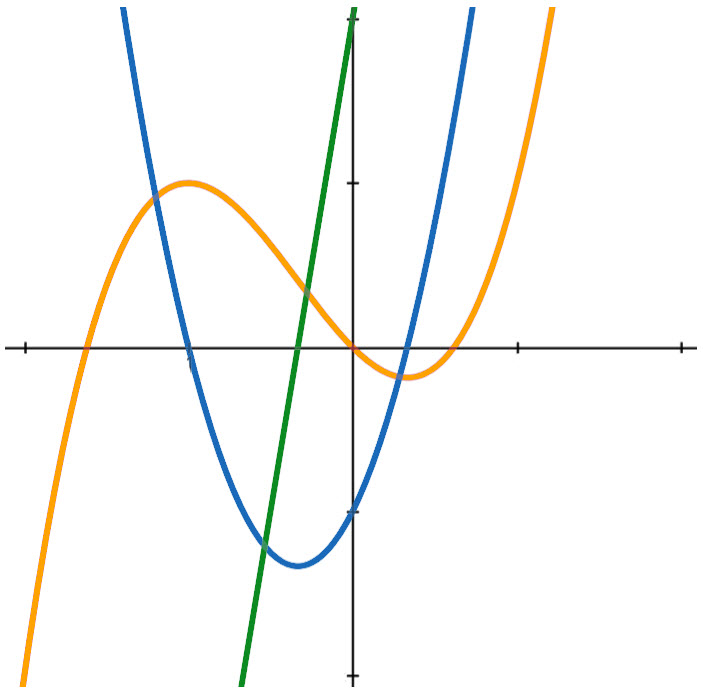
\(\bullet\text{ Graph of f(x), f'(x) and f”(x)}\)
\(\,\,\,\,\,\,\,\,\)
\(\bullet\text{ Newton’s Method}\)
\(\,\,\,\,\,\,\,\,x_{n+1}=x_n – \displaystyle \frac{f(x_n)}{f'(x_n)}\)