

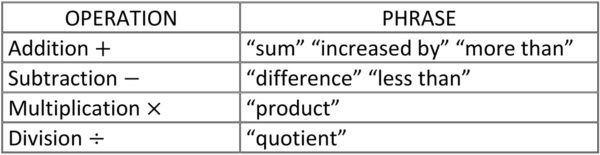
Writing equations from word problems involves translating words and phrases into mathematical symbols. Words such as “sum,” “difference,” “product,” and “quotient” help us identify which operations to use, while phrases like “is” and “equals” indicate an equal sign. Learning to write equations is an important skill for representing relationships and solving real-world problems in algebra.
Notes
Problems & Videos
Express as an equation
\(\textbf{1)}\) 10 is the sum of a number n and 5. The equation is \(10=n+5\)
“The sum of a number n and 5” means add n and 5.
\(\,\,\,\,\,\, n+5\)
“10 is” means the expression equals 10.
\(\,\,\,\,\,\, 10=n+5\)
“The sum of a number n and 5” means add n and 5.
\(\,\,\,\,\,\, n+5\)
“10 is” means the expression equals 10.
\(\,\,\,\,\,\, 10=n+5\)
\(\textbf{2)}\) The difference of a number x and 3 is 12. The equation is \(x-3=12\)
“The difference of a number x and 3” means subtract 3 from x.
\(\,\,\,\,\,\, x-3\)
“Is 12” means equals 12.
\(\,\,\,\,\,\, x-3=12\)
“The difference of a number x and 3” means subtract 3 from x.
\(\,\,\,\,\,\, x-3\)
“Is 12” means equals 12.
\(\,\,\,\,\,\, x-3=12\)
\(\textbf{3)}\) The product of 3 and a number y is 15. The equation is \(3\times y=15\)
“The product of 3 and a number y” means multiply 3 and y.
\(\,\,\,\,\,\, 3\times y\)
“Is 15” means equals 15.
\(\,\,\,\,\,\, 3\times y=15\)
“The product of 3 and a number y” means multiply 3 and y.
\(\,\,\,\,\,\, 3\times y\)
“Is 15” means equals 15.
\(\,\,\,\,\,\, 3\times y=15\)
\(\textbf{4)}\) A number m is the quotient of 18 and 6. The equation is \(m=18\div6\)
“The quotient of 18 and 6” means divide 18 by 6.
\(\,\,\,\,\,\, 18\div6\)
“A number m is” means m equals that expression.
\(\,\,\,\,\,\, m=18\div6\)
“The quotient of 18 and 6” means divide 18 by 6.
\(\,\,\,\,\,\, 18\div6\)
“A number m is” means m equals that expression.
\(\,\,\,\,\,\, m=18\div6\)
\(\textbf{5)}\) 5 less than a number n is 14. The equation is \(n-5=14\)
“5 less than a number n” means start with n and subtract 5.
\(\,\,\,\,\,\, n-5\)
“Is 14” means equals 14.
\(\,\,\,\,\,\, n-5=14\)
Notice that “5 less than n” is n minus 5, not 5 minus n.
“5 less than a number n” means start with n and subtract 5.
\(\,\,\,\,\,\, n-5\)
“Is 14” means equals 14.
\(\,\,\,\,\,\, n-5=14\)
Notice that “5 less than n” is n minus 5, not 5 minus n.
\(\textbf{6)}\) 9 increased by a number x is 12. The equation is \(9+x=12\)
“9 increased by a number x” means add x to 9.
\(\,\,\,\,\,\, 9+x\)
“Is 12” means equals 12.
\(\,\,\,\,\,\, 9+x=12\)
“9 increased by a number x” means add x to 9.
\(\,\,\,\,\,\, 9+x\)
“Is 12” means equals 12.
\(\,\,\,\,\,\, 9+x=12\)
\(\textbf{7)}\) 6 more than a number n is 25. The equation is \(n+6=25\)
“6 more than a number n” means add 6 to n.
\(\,\,\,\,\,\, n+6\)
“Is 25” means equals 25.
\(\,\,\,\,\,\, n+6=25\)
“6 more than a number n” means add 6 to n.
\(\,\,\,\,\,\, n+6\)
“Is 25” means equals 25.
\(\,\,\,\,\,\, n+6=25\)
\(\textbf{8)}\) The sum of two numbers is 42. The answer is \(x+y=42\)
Let x and y represent the two numbers.
“The sum” means add the numbers.
\(\,\,\,\,\,\, x+y\)
“Is 42” means equals 42.
\(\,\,\,\,\,\, x+y=42\)
Let x and y represent the two numbers.
“The sum” means add the numbers.
\(\,\,\,\,\,\, x+y\)
“Is 42” means equals 42.
\(\,\,\,\,\,\, x+y=42\)
\(\textbf{9)}\) The height is 3 more than the width. The answer is \(h=w+3\)
Let h represent the height and w represent the width.
“3 more than the width” means add 3 to w.
\(\,\,\,\,\,\, w+3\)
“The height is” means h equals that expression.
\(\,\,\,\,\,\, h=w+3\)
Let h represent the height and w represent the width.
“3 more than the width” means add 3 to w.
\(\,\,\,\,\,\, w+3\)
“The height is” means h equals that expression.
\(\,\,\,\,\,\, h=w+3\)
\(\textbf{10)}\) Steve is 4 years older than Kyle. The answer is \(s=k+4\)
Let s represent Steve’s age and k represent Kyle’s age.
“4 years older than Kyle” means add 4 to Kyle’s age.
\(\,\,\,\,\,\, k+4\)
Steve’s age equals that expression.
\(\,\,\,\,\,\, s=k+4\)
Let s represent Steve’s age and k represent Kyle’s age.
“4 years older than Kyle” means add 4 to Kyle’s age.
\(\,\,\,\,\,\, k+4\)
Steve’s age equals that expression.
\(\,\,\,\,\,\, s=k+4\)
\(\textbf{11)}\) x is 8 more than y. The answer is \(x=y+8\)
“8 more than y” means add 8 to y.
\(\,\,\,\,\,\, y+8\)
“x is” means x equals that expression.
\(\,\,\,\,\,\, x=y+8\)
“8 more than y” means add 8 to y.
\(\,\,\,\,\,\, y+8\)
“x is” means x equals that expression.
\(\,\,\,\,\,\, x=y+8\)
\(\textbf{12)}\) Twice a number x is 30. The answer is \(2x=30\)
“Twice a number x” means multiply x by 2.
\(\,\,\,\,\,\, 2x\)
“Is 30” means equals 30.
\(\,\,\,\,\,\, 2x=30\)
“Twice a number x” means multiply x by 2.
\(\,\,\,\,\,\, 2x\)
“Is 30” means equals 30.
\(\,\,\,\,\,\, 2x=30\)
\(\textbf{13)}\) Seven less than three times a number n is 20. The answer is \(3n-7=20\)
“Three times a number n” means multiply n by 3.
\(\,\,\,\,\,\, 3n\)
“Seven less than” means subtract 7 from that expression.
\(\,\,\,\,\,\, 3n-7\)
“Is 20” means equals 20.
\(\,\,\,\,\,\, 3n-7=20\)
“Three times a number n” means multiply n by 3.
\(\,\,\,\,\,\, 3n\)
“Seven less than” means subtract 7 from that expression.
\(\,\,\,\,\,\, 3n-7\)
“Is 20” means equals 20.
\(\,\,\,\,\,\, 3n-7=20\)
\(\textbf{14)}\) The quotient of a number x and 4, increased by 6, is 11. The answer is \(\frac{x}{4}+6=11\)
“The quotient of a number x and 4” means divide x by 4.
\(\,\,\,\,\,\, \frac{x}{4}\)
“Increased by 6” means add 6.
\(\,\,\,\,\,\, \frac{x}{4}+6\)
“Is 11” means equals 11.
\(\,\,\,\,\,\, \frac{x}{4}+6=11\)
“The quotient of a number x and 4” means divide x by 4.
\(\,\,\,\,\,\, \frac{x}{4}\)
“Increased by 6” means add 6.
\(\,\,\,\,\,\, \frac{x}{4}+6\)
“Is 11” means equals 11.
\(\,\,\,\,\,\, \frac{x}{4}+6=11\)
\(\textbf{15)}\) Five times the sum of a number x and 3 is 40. The answer is \(5(x+3)=40\)
“The sum of a number x and 3” means add x and 3.
\(\,\,\,\,\,\, x+3\)
“Five times the sum” means multiply the entire sum by 5.
\(\,\,\,\,\,\, 5(x+3)\)
“Is 40” means equals 40.
\(\,\,\,\,\,\, 5(x+3)=40\)
“The sum of a number x and 3” means add x and 3.
\(\,\,\,\,\,\, x+3\)
“Five times the sum” means multiply the entire sum by 5.
\(\,\,\,\,\,\, 5(x+3)\)
“Is 40” means equals 40.
\(\,\,\,\,\,\, 5(x+3)=40\)
\(\textbf{16)}\) The sum of three consecutive integers is 48. Let n represent the smallest integer. The answer is \(n+(n+1)+(n+2)=48\)
Consecutive integers are integers that differ by 1.
The first integer is n.
\(\,\,\,\,\,\, n\)
The next integer is one greater.
\(\,\,\,\,\,\, n+1\)
The third integer is two greater than the first.
\(\,\,\,\,\,\, n+2\)
Their sum is 48.
\(\,\,\,\,\,\, n+(n+1)+(n+2)=48\)
Consecutive integers are integers that differ by 1.
The first integer is n.
\(\,\,\,\,\,\, n\)
The next integer is one greater.
\(\,\,\,\,\,\, n+1\)
The third integer is two greater than the first.
\(\,\,\,\,\,\, n+2\)
Their sum is 48.
\(\,\,\,\,\,\, n+(n+1)+(n+2)=48\)
\(\textbf{17)}\) The length of a rectangle is 5 more than its width. Its perimeter is 50. Let w represent the width. The answer is \(2w+2(w+5)=50\)
The width is w.
The length is 5 more than the width.
\(\,\,\,\,\,\, l=w+5\)
The perimeter of a rectangle is twice the length plus twice the width.
\(\,\,\,\,\,\, P=2l+2w\)
Substitute the length and perimeter.
\(\,\,\,\,\,\, 50=2(w+5)+2w\)
\(\,\,\,\,\,\, 2w+2(w+5)=50\)
The width is w.
The length is 5 more than the width.
\(\,\,\,\,\,\, l=w+5\)
The perimeter of a rectangle is twice the length plus twice the width.
\(\,\,\,\,\,\, P=2l+2w\)
Substitute the length and perimeter.
\(\,\,\,\,\,\, 50=2(w+5)+2w\)
\(\,\,\,\,\,\, 2w+2(w+5)=50\)
\(\textbf{18)}\) A car travels at 60 miles per hour for t hours. The total distance traveled is 240 miles. The answer is \(60t=240\)
Distance equals rate times time.
\(\,\,\,\,\,\, d=rt\)
The rate is 60 miles per hour.
\(\,\,\,\,\,\, r=60\)
The time is t hours and the distance is 240 miles.
\(\,\,\,\,\,\, 240=60t\)
\(\,\,\,\,\,\, 60t=240\)
Distance equals rate times time.
\(\,\,\,\,\,\, d=rt\)
The rate is 60 miles per hour.
\(\,\,\,\,\,\, r=60\)
The time is t hours and the distance is 240 miles.
\(\,\,\,\,\,\, 240=60t\)
\(\,\,\,\,\,\, 60t=240\)
\(\textbf{19)}\) Sarah has $25 and saves $8 each week. After w weeks, she has $73. The answer is \(25+8w=73\)
Sarah starts with $25.
She saves $8 each week for w weeks.
\(\,\,\,\,\,\, 8w\)
Add her starting amount to the money saved.
\(\,\,\,\,\,\, 25+8w\)
Her total is $73.
\(\,\,\,\,\,\, 25+8w=73\)
Sarah starts with $25.
She saves $8 each week for w weeks.
\(\,\,\,\,\,\, 8w\)
Add her starting amount to the money saved.
\(\,\,\,\,\,\, 25+8w\)
Her total is $73.
\(\,\,\,\,\,\, 25+8w=73\)
\(\textbf{20)}\) A gym charges a $30 sign-up fee plus $15 per month. The total cost after m months is $120. The answer is \(30+15m=120\)
The one-time sign-up fee is $30.
The monthly cost is $15 times the number of months.
\(\,\,\,\,\,\, 15m\)
Add the sign-up fee and monthly costs.
\(\,\,\,\,\,\, 30+15m\)
The total cost is $120.
\(\,\,\,\,\,\, 30+15m=120\)
The one-time sign-up fee is $30.
The monthly cost is $15 times the number of months.
\(\,\,\,\,\,\, 15m\)
Add the sign-up fee and monthly costs.
\(\,\,\,\,\,\, 30+15m\)
The total cost is $120.
\(\,\,\,\,\,\, 30+15m=120\)
See Related Pages\(\)
\(\bullet\text{ Word Problems- Expressions}\)
\(\,\,\,\,\,\,\,\,\)
\(\bullet\text{ Solving Multi-Step Equations}\)
\(\,\,\,\,\,\,\,\,\)
\(\bullet\text{ Intro to Linear Equations}\)
\(\,\,\,\,\,\,\,\,\)