Proofs
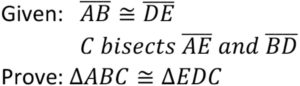
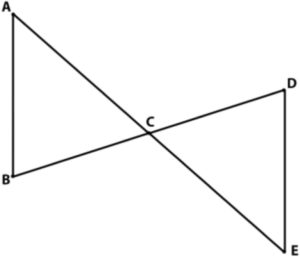
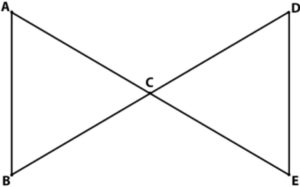
\(\textbf{1)}\) Given: \(C\) bisects \( \overline{AE} \) and \( \overline{BD} \) Show Proof Steps
\(\underline{\text{Statement}}\)
\(\underline{\text{Reason}}\)
\(C\) bisects \( \overline{AE} \) and \( \overline{BD} \) Given
\( \overline{AC} \cong \overline{CE}; \overline{BC} \cong \overline{CD}\) Definition of bisects
\(\angle ACB \cong \angle ECD\) Vertical Angles
\(\triangle ACB \cong \triangle ECD\) SAS triangle congruence
\( \overline{AB} \cong \overline{DE}\) CPCTC
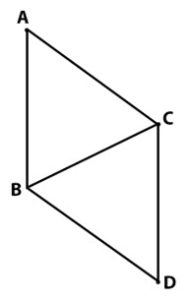
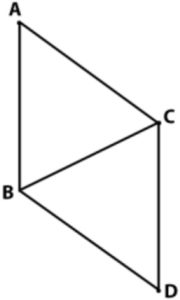
\(\textbf{2)}\) Given: \( \overline{AB} \parallel \overline{CD}\), \( \, \, \overline{AC} \parallel \overline{BD} \) Show Proof Steps
\(\underline{\text{Statement}}\)
\(\underline{\text{Reason}}\)
\( \overline{AB} \parallel \overline{CD}\) \( \overline{AC} \parallel \overline{BD} \) Given
\(\angle ACB \cong \angle DBC\) \(\angle ABC \cong \angle DCB\) Alternate Interior Angles
\( \overline{BC} \cong \overline{CB}\) Reflexive
\(\triangle ABC \cong \triangle DCB\) ASA triangle congruence
\(\angle A \cong \angle D\) CPCTC
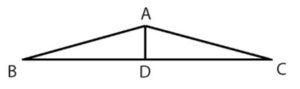
\(\textbf{3)}\) Given: \( \overline{AB} \cong \overline{AC}\), \( \, \, \overline{AD}\) bisects \( \overline{BC} \) Show Proof Steps
\(\underline{\text{Statement}}\)
\(\underline{\text{Reason}}\)
\( \overline{AB} \cong \overline{AC}\) Given
\( \overline{BD} \cong \overline{CD}\) Definition of bisects
\( \overline{AD} \cong \overline{AD}\) Reflexive
\(\triangle BDA \cong \triangle CDA\) SSS triangle congruence
\(\angle B \cong \angle C\) CPCTC
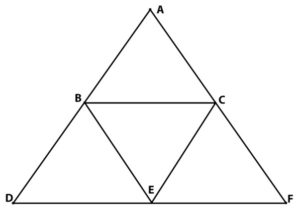
\(\textbf{4)}\) Given: \( \overline{AD} \cong \overline{AF}\), \( \, \, \overline{BD} \cong \overline{CF} \), \( \, \, E\) bisects \( \overline{DF} \) Show Proof Steps
\(\underline{\text{Statement}}\)
\(\underline{\text{Reason}}\)
\( \overline{AD} \cong \overline{AF}\) Given
\(\angle D \cong \angle F\) Isosceles Triangles
\( \overline{DE} \cong \overline{FE}\) Definition of bisects
\( \triangle DEB \cong \triangle FEC \) SAS triangle congruence
\( \angle DEB \cong \angle FEC \) CPCTC
See Related Pages\(\)
In Summary
Proving triangle congruence using CPCTC, or “corresponding parts of congruent triangles are congruent” theorem, is a key concept in geometry. Once we know that two triangles are congruent, we can conclude that any previously unknown corresponding parts must also be congruent.
Using CPCTC in proofs is typically covered in a high school geometry class.
CPCTC will only work if 2 triangles are know to be congruent. Therefore proofs using CPCTC usually also contain at least one of the following theorems, SSS, SAS, ASA, AAS, or HL. These theorems prove the congruence of triangles and are often used in the step prior to CPCTC.



 \(…\)
\(…\)
 \(…\)
\(…\)
 \(…\)
\(…\) \(…\)
\(…\)