
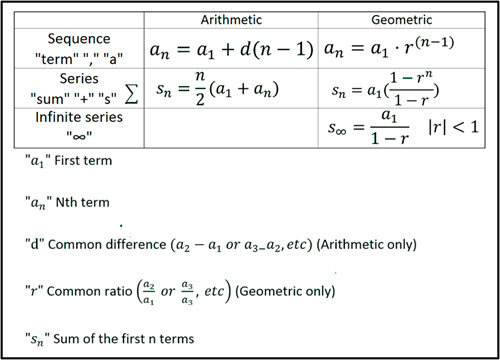
An arithmetic sequence is a list of numbers where each term changes by the same constant amount, called the common difference. The explicit formula \(a_n=a_1+(n-1)d\) can be used to find any term in the sequence. These problems practice finding next terms, writing rules, solving for missing values, and inserting arithmetic means.
Notes
Practice Problems
\(\textbf{1)}\) Find the next three terms of the sequence \(3, 7, 11,\ldots\) The answer is \(15,19,23\)
\(\,\,\,\,\,d=7-3=4\)
\(\,\,\,\,\,11+4=15\)
\(\,\,\,\,\,15+4=19\)
\(\,\,\,\,\,19+4=23\)
\(\,\,\,\,\,\text{The next three terms are }15,19,23\)

\(\,\,\,\,\,d=7-3=4\)
\(\,\,\,\,\,11+4=15\)
\(\,\,\,\,\,15+4=19\)
\(\,\,\,\,\,19+4=23\)
\(\,\,\,\,\,\text{The next three terms are }15,19,23\)
\(\textbf{2)}\) Find the next four terms of the sequence \(45, 38, 31,\ldots\) The answer is \(24,17,10,3\)
\(\,\,\,\,\,d=38-45=-7\)
\(\,\,\,\,\,31-7=24\)
\(\,\,\,\,\,24-7=17\)
\(\,\,\,\,\,17-7=10\)
\(\,\,\,\,\,10-7=3\)
\(\,\,\,\,\,\text{The next four terms are }24,17,10,3\)
\(\,\,\,\,\,d=38-45=-7\)
\(\,\,\,\,\,31-7=24\)
\(\,\,\,\,\,24-7=17\)
\(\,\,\,\,\,17-7=10\)
\(\,\,\,\,\,10-7=3\)
\(\,\,\,\,\,\text{The next four terms are }24,17,10,3\)
\(\textbf{3)}\) Find the rule of the sequence \(3, 7, 11,\ldots\) The rule is \(a_n=3+4(n-1) \text{ or } a_n=4n-1\)
\(\,\,\,\,\,a_1=3\)
\(\,\,\,\,\,d=7-3=4\)
\(\,\,\,\,\,a_n=a_1+d(n-1)\)
\(\,\,\,\,\,a_n=3+4(n-1)\)
\(\,\,\,\,\,a_n=3+4n-4\)
\(\,\,\,\,\,a_n=4n-1\)
\(\,\,\,\,\,a_1=3\)
\(\,\,\,\,\,d=7-3=4\)
\(\,\,\,\,\,a_n=a_1+d(n-1)\)
\(\,\,\,\,\,a_n=3+4(n-1)\)
\(\,\,\,\,\,a_n=3+4n-4\)
\(\,\,\,\,\,a_n=4n-1\)
\(\textbf{4)}\) Find the rule of the sequence \(45, 38, 31,\ldots\) The rule is \(a_n=45-7(n-1) \text{ or } a_n=-7n+52\)
\(\,\,\,\,\,a_1=45\)
\(\,\,\,\,\,d=38-45=-7\)
\(\,\,\,\,\,a_n=a_1+d(n-1)\)
\(\,\,\,\,\,a_n=45-7(n-1)\)
\(\,\,\,\,\,a_n=45-7n+7\)
\(\,\,\,\,\,a_n=-7n+52\)
\(\,\,\,\,\,a_1=45\)
\(\,\,\,\,\,d=38-45=-7\)
\(\,\,\,\,\,a_n=a_1+d(n-1)\)
\(\,\,\,\,\,a_n=45-7(n-1)\)
\(\,\,\,\,\,a_n=45-7n+7\)
\(\,\,\,\,\,a_n=-7n+52\)
Find the missing value
\(\textbf{5)}\) \(a_1=3,\,d=5,\,\) what is \(a_8\)? The answer is \(a_8=38\)
\(\,\,\,\,\,a_n=a_1+(n-1)d\)
\(\,\,\,\,\,a_8=3+(8-1)5\)
\(\,\,\,\,\,a_8=3+7(5)\)
\(\,\,\,\,\,a_8=3+35\)
\(\,\,\,\,\,a_8=38\)
\(\,\,\,\,\,a_n=a_1+(n-1)d\)
\(\,\,\,\,\,a_8=3+(8-1)5\)
\(\,\,\,\,\,a_8=3+7(5)\)
\(\,\,\,\,\,a_8=3+35\)
\(\,\,\,\,\,a_8=38\)
\(\textbf{6)}\) \(d=-2,\, a_5=10,\,\) what is \(a_1\)? The answer is \(a_1=18\)
\(\,\,\,\,\,a_n=a_1+(n-1)d\)
\(\,\,\,\,\,10=a_1+(5-1)(-2)\)
\(\,\,\,\,\,10=a_1+4(-2)\)
\(\,\,\,\,\,10=a_1-8\)
\(\,\,\,\,\,18=a_1\)
\(\,\,\,\,\,a_n=a_1+(n-1)d\)
\(\,\,\,\,\,10=a_1+(5-1)(-2)\)
\(\,\,\,\,\,10=a_1+4(-2)\)
\(\,\,\,\,\,10=a_1-8\)
\(\,\,\,\,\,18=a_1\)
\(\textbf{7)}\) \(a_1=7,\, a_6=22,\,\) what is \(d\)? The answer is \(d=3\)
\(\,\,\,\,\,a_n=a_1+(n-1)d\)
\(\,\,\,\,\,22=7+(6-1)d\)
\(\,\,\,\,\,22=7+5d\)
\(\,\,\,\,\,15=5d\)
\(\,\,\,\,\,3=d\)
\(\,\,\,\,\,a_n=a_1+(n-1)d\)
\(\,\,\,\,\,22=7+(6-1)d\)
\(\,\,\,\,\,22=7+5d\)
\(\,\,\,\,\,15=5d\)
\(\,\,\,\,\,3=d\)
\(\textbf{8)}\) Find the next three terms of the sequence \(-4, 1, 6,\ldots\) The answer is \(11,16,21\)
\(\,\,\,\,\,d=1-(-4)=5\)
\(\,\,\,\,\,6+5=11\)
\(\,\,\,\,\,11+5=16\)
\(\,\,\,\,\,16+5=21\)
\(\,\,\,\,\,\text{The next three terms are }11,16,21\)
\(\,\,\,\,\,d=1-(-4)=5\)
\(\,\,\,\,\,6+5=11\)
\(\,\,\,\,\,11+5=16\)
\(\,\,\,\,\,16+5=21\)
\(\,\,\,\,\,\text{The next three terms are }11,16,21\)
\(\textbf{9)}\) Find the next four terms of the sequence \(20, 16, 12,\ldots\) The answer is \(8,4,0,-4\)
\(\,\,\,\,\,d=16-20=-4\)
\(\,\,\,\,\,12-4=8\)
\(\,\,\,\,\,8-4=4\)
\(\,\,\,\,\,4-4=0\)
\(\,\,\,\,\,0-4=-4\)
\(\,\,\,\,\,\text{The next four terms are }8,4,0,-4\)
\(\,\,\,\,\,d=16-20=-4\)
\(\,\,\,\,\,12-4=8\)
\(\,\,\,\,\,8-4=4\)
\(\,\,\,\,\,4-4=0\)
\(\,\,\,\,\,0-4=-4\)
\(\,\,\,\,\,\text{The next four terms are }8,4,0,-4\)
\(\textbf{10)}\) Find the rule of the sequence \(6, 13, 20,\ldots\) The rule is \(a_n=6+7(n-1) \text{ or } a_n=7n-1\)
\(\,\,\,\,\,a_1=6\)
\(\,\,\,\,\,d=13-6=7\)
\(\,\,\,\,\,a_n=a_1+d(n-1)\)
\(\,\,\,\,\,a_n=6+7(n-1)\)
\(\,\,\,\,\,a_n=6+7n-7\)
\(\,\,\,\,\,a_n=7n-1\)
\(\,\,\,\,\,a_1=6\)
\(\,\,\,\,\,d=13-6=7\)
\(\,\,\,\,\,a_n=a_1+d(n-1)\)
\(\,\,\,\,\,a_n=6+7(n-1)\)
\(\,\,\,\,\,a_n=6+7n-7\)
\(\,\,\,\,\,a_n=7n-1\)
\(\textbf{11)}\) Find the rule of the sequence \(-2, 4, 10,\ldots\) The rule is \(a_n=-2+6(n-1) \text{ or } a_n=6n-8\)
\(\,\,\,\,\,a_1=-2\)
\(\,\,\,\,\,d=4-(-2)=6\)
\(\,\,\,\,\,a_n=a_1+d(n-1)\)
\(\,\,\,\,\,a_n=-2+6(n-1)\)
\(\,\,\,\,\,a_n=-2+6n-6\)
\(\,\,\,\,\,a_n=6n-8\)
\(\,\,\,\,\,a_1=-2\)
\(\,\,\,\,\,d=4-(-2)=6\)
\(\,\,\,\,\,a_n=a_1+d(n-1)\)
\(\,\,\,\,\,a_n=-2+6(n-1)\)
\(\,\,\,\,\,a_n=-2+6n-6\)
\(\,\,\,\,\,a_n=6n-8\)
\(\textbf{12)}\) \(a_1=-6,\,d=4,\,\) what is \(a_{12}\)? The answer is \(a_{12}=38\)
\(\,\,\,\,\,a_n=a_1+(n-1)d\)
\(\,\,\,\,\,a_{12}=-6+(12-1)4\)
\(\,\,\,\,\,a_{12}=-6+11(4)\)
\(\,\,\,\,\,a_{12}=-6+44\)
\(\,\,\,\,\,a_{12}=38\)
\(\,\,\,\,\,a_n=a_1+(n-1)d\)
\(\,\,\,\,\,a_{12}=-6+(12-1)4\)
\(\,\,\,\,\,a_{12}=-6+11(4)\)
\(\,\,\,\,\,a_{12}=-6+44\)
\(\,\,\,\,\,a_{12}=38\)
\(\textbf{13)}\) \(a_1=12,\,d=-3,\,\) what is \(a_9\)? The answer is \(a_9=-12\)
\(\,\,\,\,\,a_n=a_1+(n-1)d\)
\(\,\,\,\,\,a_9=12+(9-1)(-3)\)
\(\,\,\,\,\,a_9=12+8(-3)\)
\(\,\,\,\,\,a_9=12-24\)
\(\,\,\,\,\,a_9=-12\)
\(\,\,\,\,\,a_n=a_1+(n-1)d\)
\(\,\,\,\,\,a_9=12+(9-1)(-3)\)
\(\,\,\,\,\,a_9=12+8(-3)\)
\(\,\,\,\,\,a_9=12-24\)
\(\,\,\,\,\,a_9=-12\)
\(\textbf{14)}\) \(d=6,\, a_7=41,\,\) what is \(a_1\)? The answer is \(a_1=5\)
\(\,\,\,\,\,a_n=a_1+(n-1)d\)
\(\,\,\,\,\,41=a_1+(7-1)6\)
\(\,\,\,\,\,41=a_1+36\)
\(\,\,\,\,\,5=a_1\)
\(\,\,\,\,\,a_n=a_1+(n-1)d\)
\(\,\,\,\,\,41=a_1+(7-1)6\)
\(\,\,\,\,\,41=a_1+36\)
\(\,\,\,\,\,5=a_1\)
\(\textbf{15)}\) \(a_3=14,\,d=5,\,\) what is \(a_1\)? The answer is \(a_1=4\)
\(\,\,\,\,\,a_n=a_1+(n-1)d\)
\(\,\,\,\,\,14=a_1+(3-1)5\)
\(\,\,\,\,\,14=a_1+10\)
\(\,\,\,\,\,4=a_1\)
\(\,\,\,\,\,a_n=a_1+(n-1)d\)
\(\,\,\,\,\,14=a_1+(3-1)5\)
\(\,\,\,\,\,14=a_1+10\)
\(\,\,\,\,\,4=a_1\)
\(\textbf{16)}\) \(a_1=9,\,a_{10}=45,\,\) what is \(d\)? The answer is \(d=4\)
\(\,\,\,\,\,a_n=a_1+(n-1)d\)
\(\,\,\,\,\,45=9+(10-1)d\)
\(\,\,\,\,\,45=9+9d\)
\(\,\,\,\,\,36=9d\)
\(\,\,\,\,\,4=d\)
\(\,\,\,\,\,a_n=a_1+(n-1)d\)
\(\,\,\,\,\,45=9+(10-1)d\)
\(\,\,\,\,\,45=9+9d\)
\(\,\,\,\,\,36=9d\)
\(\,\,\,\,\,4=d\)
\(\textbf{17)}\) \(a_4=18,\,a_{10}=42,\,\) what is \(d\)? The answer is \(d=4\)
\(\,\,\,\,\,a_{10}-a_4=(10-4)d\)
\(\,\,\,\,\,42-18=6d\)
\(\,\,\,\,\,24=6d\)
\(\,\,\,\,\,4=d\)
\(\,\,\,\,\,a_{10}-a_4=(10-4)d\)
\(\,\,\,\,\,42-18=6d\)
\(\,\,\,\,\,24=6d\)
\(\,\,\,\,\,4=d\)
\(\textbf{18)}\) Is \(4, 9, 15, 22,\ldots\) arithmetic? The answer is no, it is not arithmetic.
\(\,\,\,\,\,9-4=5\)
\(\,\,\,\,\,15-9=6\)
\(\,\,\,\,\,22-15=7\)
\(\,\,\,\,\,\text{The differences are not constant.}\)
\(\,\,\,\,\,\text{So the sequence is not arithmetic.}\)
\(\,\,\,\,\,9-4=5\)
\(\,\,\,\,\,15-9=6\)
\(\,\,\,\,\,22-15=7\)
\(\,\,\,\,\,\text{The differences are not constant.}\)
\(\,\,\,\,\,\text{So the sequence is not arithmetic.}\)
\(\textbf{19)}\) Write the first five terms of the arithmetic sequence with \(a_1=-5\) and \(d=3\). The answer is \(-5,-2,1,4,7\)
\(\,\,\,\,\,a_1=-5\)
\(\,\,\,\,\,d=3\)
\(\,\,\,\,\,a_2=-5+3=-2\)
\(\,\,\,\,\,a_3=-2+3=1\)
\(\,\,\,\,\,a_4=1+3=4\)
\(\,\,\,\,\,a_5=4+3=7\)
\(\,\,\,\,\,\text{The first five terms are }-5,-2,1,4,7\)
\(\,\,\,\,\,a_1=-5\)
\(\,\,\,\,\,d=3\)
\(\,\,\,\,\,a_2=-5+3=-2\)
\(\,\,\,\,\,a_3=-2+3=1\)
\(\,\,\,\,\,a_4=1+3=4\)
\(\,\,\,\,\,a_5=4+3=7\)
\(\,\,\,\,\,\text{The first five terms are }-5,-2,1,4,7\)
Challenge Problems
\(\textbf{20)}\) Find the three arithmetic means of \(3\) and \(48\) The answer is \(\frac{57}{4},\frac{51}{2},\frac{147}{4}\)
\(\,\,\,\,\,3,\,\text{___},\,\text{___},\,\text{___},\,48\)
\(\,\,\,\,\,a_n=a_1+(n-1)d\)
\(\,\,\,\,\,48=3+(5-1)d\)
\(\,\,\,\,\,48=3+4d\)
\(\,\,\,\,\,45=4d\)
\(\,\,\,\,\,d=\frac{45}{4}\)
\(\,\,\,\,\,3+\frac{45}{4}=\frac{57}{4}\)
\(\,\,\,\,\,3+\frac{90}{4}=\frac{102}{4}=\frac{51}{2}\)
\(\,\,\,\,\,3+\frac{135}{4}=\frac{147}{4}\)
\(\,\,\,\,\,\text{The three arithmetic means are }\frac{57}{4},\frac{51}{2},\frac{147}{4}\)
\(\,\,\,\,\,3,\,\text{___},\,\text{___},\,\text{___},\,48\)
\(\,\,\,\,\,a_n=a_1+(n-1)d\)
\(\,\,\,\,\,48=3+(5-1)d\)
\(\,\,\,\,\,48=3+4d\)
\(\,\,\,\,\,45=4d\)
\(\,\,\,\,\,d=\frac{45}{4}\)
\(\,\,\,\,\,3+\frac{45}{4}=\frac{57}{4}\)
\(\,\,\,\,\,3+\frac{90}{4}=\frac{102}{4}=\frac{51}{2}\)
\(\,\,\,\,\,3+\frac{135}{4}=\frac{147}{4}\)
\(\,\,\,\,\,\text{The three arithmetic means are }\frac{57}{4},\frac{51}{2},\frac{147}{4}\)
See Related Pages
\(\bullet\text{ Geometric Sequences}\)
\(\,\,\,\,\,\,\,a_n=a_1 \cdot r^{(n-1)}…\)
\(\bullet\text{ Arithmetic Series}\)
\(\,\,\,\,\,\,\,s_n=\frac{n}{2}(a_1+a_n)…\)
\(\bullet\text{ Geometric Series}\)
\(\,\,\,\,\,\,\,s_n=a_1 \frac{1-r^n}{1-r}…\)
\(\bullet\text{ Infinite Geometric Series}\)
\(\,\,\,\,\,\,\,s_\infty = \frac{a_1}{1-r}\,\,\, |r| \lt 1…\)
\(\bullet\text{ Summation Notation}\)
\(\,\,\,\,\,\,\, \displaystyle \sum_{i=4}^{9} 3i-5 …\)
\(\bullet\text{ Recursive Sequences}\)
\(\,\,\,\,\,\,\, a_{1}=2, \, a_{n+1}=a_{n}+3…\)
\(\bullet\text{ Andymath Homepage}\)