

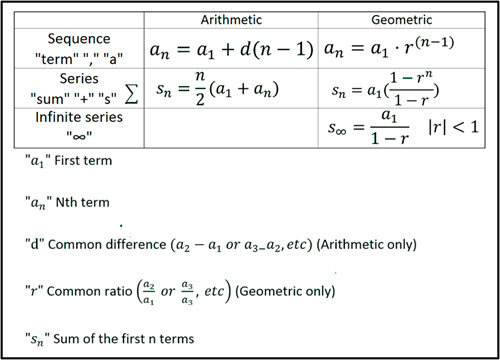
An infinite geometric series adds infinitely many terms where each term is found by multiplying the previous term by the same common ratio. The series only converges when the absolute value of the common ratio is less than 1. When it converges, the sum can be found using \(S_\infty=\frac{a_1}{1-r}\).
Notes
Practice Problems
Find the infinite geometric series
\(\textbf{1)}\) \(a_1=8 \,\, r=.75 \) The answer is \(32\)
\(\,\,\,\,\,\,S_\infty=\frac{a_1}{1-r},\,\,\,|r|\lt 1\)
\(\,\,\,\,\,\,|.75|\lt 1\)
\(\,\,\,\,\,\,S_\infty=\frac{8}{1-.75}\)
\(\,\,\,\,\,\,S_\infty=\frac{8}{.25}\)
\(\,\,\,\,\,\,S_\infty=32\)

\(\,\,\,\,\,\,S_\infty=\frac{a_1}{1-r},\,\,\,|r|\lt 1\)
\(\,\,\,\,\,\,|.75|\lt 1\)
\(\,\,\,\,\,\,S_\infty=\frac{8}{1-.75}\)
\(\,\,\,\,\,\,S_\infty=\frac{8}{.25}\)
\(\,\,\,\,\,\,S_\infty=32\)
\(\textbf{2)}\) \(a_1=.75 \,\, r=8 \) The answer is Divergent
\(\,\,\,\,\,\,S_\infty=\frac{a_1}{1-r},\,\,\,|r|\lt 1\)
\(\,\,\,\,\,\,r=8\)
\(\,\,\,\,\,\,|8|\gt 1\)
\(\,\,\,\,\,\,\text{Since } |r|\text{ is not less than }1\text{, the series diverges.}\)
\(\,\,\,\,\,\,S_\infty=\frac{a_1}{1-r},\,\,\,|r|\lt 1\)
\(\,\,\,\,\,\,r=8\)
\(\,\,\,\,\,\,|8|\gt 1\)
\(\,\,\,\,\,\,\text{Since } |r|\text{ is not less than }1\text{, the series diverges.}\)
\(\textbf{3)}\) \(\displaystyle\frac{1}{2}+\displaystyle\frac{1}{4}+\displaystyle\frac{1}{8}+\displaystyle\frac{1}{16}+ \cdots\) The answer is \(1\)
\(\,\,\,\,\,\,S_\infty=\frac{a_1}{1-r},\,\,\,|r|\lt 1\)
\(\,\,\,\,\,\,a_1=\frac{1}{2},\,\,\,r=\frac{1/4}{1/2}=\frac{1}{2}\)
\(\,\,\,\,\,\,\left|\frac{1}{2}\right|\lt 1\)
\(\,\,\,\,\,\,S_\infty=\frac{\frac{1}{2}}{1-\frac{1}{2}}\)
\(\,\,\,\,\,\,S_\infty=\frac{\frac{1}{2}}{\frac{1}{2}}\)
\(\,\,\,\,\,\,S_\infty=1\)
\(\,\,\,\,\,\,S_\infty=\frac{a_1}{1-r},\,\,\,|r|\lt 1\)
\(\,\,\,\,\,\,a_1=\frac{1}{2},\,\,\,r=\frac{1/4}{1/2}=\frac{1}{2}\)
\(\,\,\,\,\,\,\left|\frac{1}{2}\right|\lt 1\)
\(\,\,\,\,\,\,S_\infty=\frac{\frac{1}{2}}{1-\frac{1}{2}}\)
\(\,\,\,\,\,\,S_\infty=\frac{\frac{1}{2}}{\frac{1}{2}}\)
\(\,\,\,\,\,\,S_\infty=1\)
\(\textbf{4)}\) \(\displaystyle\frac{1}{2}-\displaystyle\frac{1}{4}+\displaystyle\frac{1}{8}-\displaystyle\frac{1}{16}+ \cdots\) The answer is \(\displaystyle\frac{1}{3}\)
\(\,\,\,\,\,\,S_\infty=\frac{a_1}{1-r},\,\,\,|r|\lt 1\)
\(\,\,\,\,\,\,a_1=\frac{1}{2},\,\,\,r=\frac{-1/4}{1/2}=-\frac{1}{2}\)
\(\,\,\,\,\,\,\left|-\frac{1}{2}\right|\lt 1\)
\(\,\,\,\,\,\,S_\infty=\frac{\frac{1}{2}}{1-\left(-\frac{1}{2}\right)}\)
\(\,\,\,\,\,\,S_\infty=\frac{\frac{1}{2}}{\frac{3}{2}}\)
\(\,\,\,\,\,\,S_\infty=\frac{1}{2}\cdot\frac{2}{3}\)
\(\,\,\,\,\,\,S_\infty=\frac{1}{3}\)
\(\,\,\,\,\,\,S_\infty=\frac{a_1}{1-r},\,\,\,|r|\lt 1\)
\(\,\,\,\,\,\,a_1=\frac{1}{2},\,\,\,r=\frac{-1/4}{1/2}=-\frac{1}{2}\)
\(\,\,\,\,\,\,\left|-\frac{1}{2}\right|\lt 1\)
\(\,\,\,\,\,\,S_\infty=\frac{\frac{1}{2}}{1-\left(-\frac{1}{2}\right)}\)
\(\,\,\,\,\,\,S_\infty=\frac{\frac{1}{2}}{\frac{3}{2}}\)
\(\,\,\,\,\,\,S_\infty=\frac{1}{2}\cdot\frac{2}{3}\)
\(\,\,\,\,\,\,S_\infty=\frac{1}{3}\)
\(\textbf{5)}\) \(\displaystyle\frac{1}{20}-\displaystyle\frac{1}{10}+\displaystyle\frac{1}{5}-\displaystyle\frac{2}{5}+ \cdots\) The answer is Divergent
\(\,\,\,\,\,\,S_\infty=\frac{a_1}{1-r},\,\,\,|r|\lt 1\)
\(\,\,\,\,\,\,a_1=\frac{1}{20}\)
\(\,\,\,\,\,\,r=\frac{-1/10}{1/20}=-2\)
\(\,\,\,\,\,\,|-2|\gt 1\)
\(\,\,\,\,\,\,\text{Since } |r|\text{ is not less than }1\text{, the series diverges.}\)
\(\,\,\,\,\,\,S_\infty=\frac{a_1}{1-r},\,\,\,|r|\lt 1\)
\(\,\,\,\,\,\,a_1=\frac{1}{20}\)
\(\,\,\,\,\,\,r=\frac{-1/10}{1/20}=-2\)
\(\,\,\,\,\,\,|-2|\gt 1\)
\(\,\,\,\,\,\,\text{Since } |r|\text{ is not less than }1\text{, the series diverges.}\)
\(\textbf{6)}\) \( \displaystyle \sum_{i=1}^{\infty} 4\left( \frac{1}{3} \right)^{i-1} \) The answer is \( 6 \)
\(\,\,\,\,\,\,S_\infty=\frac{a_1}{1-r},\,\,\,|r|\lt 1\)
\(\,\,\,\,\,\,a_1=4\)
\(\,\,\,\,\,\,r=\frac{1}{3}\)
\(\,\,\,\,\,\,\left|\frac{1}{3}\right|\lt 1\)
\(\,\,\,\,\,\,S_\infty=\frac{4}{1-\frac{1}{3}}\)
\(\,\,\,\,\,\,S_\infty=\frac{4}{\frac{2}{3}}\)
\(\,\,\,\,\,\,S_\infty=4\cdot\frac{3}{2}\)
\(\,\,\,\,\,\,S_\infty=6\)
\(\,\,\,\,\,\,S_\infty=\frac{a_1}{1-r},\,\,\,|r|\lt 1\)
\(\,\,\,\,\,\,a_1=4\)
\(\,\,\,\,\,\,r=\frac{1}{3}\)
\(\,\,\,\,\,\,\left|\frac{1}{3}\right|\lt 1\)
\(\,\,\,\,\,\,S_\infty=\frac{4}{1-\frac{1}{3}}\)
\(\,\,\,\,\,\,S_\infty=\frac{4}{\frac{2}{3}}\)
\(\,\,\,\,\,\,S_\infty=4\cdot\frac{3}{2}\)
\(\,\,\,\,\,\,S_\infty=6\)
\(\textbf{7)}\) \(a_1=12 \,\, r=\frac{1}{4}\) The answer is \(16\)
\(\,\,\,\,\,\,S_\infty=\frac{a_1}{1-r},\,\,\,|r|\lt 1\)
\(\,\,\,\,\,\,\left|\frac{1}{4}\right|\lt 1\)
\(\,\,\,\,\,\,S_\infty=\frac{12}{1-\frac{1}{4}}\)
\(\,\,\,\,\,\,S_\infty=\frac{12}{\frac{3}{4}}\)
\(\,\,\,\,\,\,S_\infty=12\cdot\frac{4}{3}\)
\(\,\,\,\,\,\,S_\infty=16\)
\(\,\,\,\,\,\,S_\infty=\frac{a_1}{1-r},\,\,\,|r|\lt 1\)
\(\,\,\,\,\,\,\left|\frac{1}{4}\right|\lt 1\)
\(\,\,\,\,\,\,S_\infty=\frac{12}{1-\frac{1}{4}}\)
\(\,\,\,\,\,\,S_\infty=\frac{12}{\frac{3}{4}}\)
\(\,\,\,\,\,\,S_\infty=12\cdot\frac{4}{3}\)
\(\,\,\,\,\,\,S_\infty=16\)
\(\textbf{8)}\) \(a_1=5 \,\, r=-\frac{1}{3}\) The answer is \(\frac{15}{4}\)
\(\,\,\,\,\,\,S_\infty=\frac{a_1}{1-r},\,\,\,|r|\lt 1\)
\(\,\,\,\,\,\,\left|-\frac{1}{3}\right|\lt 1\)
\(\,\,\,\,\,\,S_\infty=\frac{5}{1-\left(-\frac{1}{3}\right)}\)
\(\,\,\,\,\,\,S_\infty=\frac{5}{\frac{4}{3}}\)
\(\,\,\,\,\,\,S_\infty=5\cdot\frac{3}{4}\)
\(\,\,\,\,\,\,S_\infty=\frac{15}{4}\)
\(\,\,\,\,\,\,S_\infty=\frac{a_1}{1-r},\,\,\,|r|\lt 1\)
\(\,\,\,\,\,\,\left|-\frac{1}{3}\right|\lt 1\)
\(\,\,\,\,\,\,S_\infty=\frac{5}{1-\left(-\frac{1}{3}\right)}\)
\(\,\,\,\,\,\,S_\infty=\frac{5}{\frac{4}{3}}\)
\(\,\,\,\,\,\,S_\infty=5\cdot\frac{3}{4}\)
\(\,\,\,\,\,\,S_\infty=\frac{15}{4}\)
\(\textbf{9)}\) \(6+3+\frac{3}{2}+\frac{3}{4}+\cdots\) The answer is \(12\)
\(\,\,\,\,\,\,S_\infty=\frac{a_1}{1-r},\,\,\,|r|\lt 1\)
\(\,\,\,\,\,\,a_1=6\)
\(\,\,\,\,\,\,r=\frac{3}{6}=\frac{1}{2}\)
\(\,\,\,\,\,\,\left|\frac{1}{2}\right|\lt 1\)
\(\,\,\,\,\,\,S_\infty=\frac{6}{1-\frac{1}{2}}\)
\(\,\,\,\,\,\,S_\infty=\frac{6}{\frac{1}{2}}\)
\(\,\,\,\,\,\,S_\infty=12\)
\(\,\,\,\,\,\,S_\infty=\frac{a_1}{1-r},\,\,\,|r|\lt 1\)
\(\,\,\,\,\,\,a_1=6\)
\(\,\,\,\,\,\,r=\frac{3}{6}=\frac{1}{2}\)
\(\,\,\,\,\,\,\left|\frac{1}{2}\right|\lt 1\)
\(\,\,\,\,\,\,S_\infty=\frac{6}{1-\frac{1}{2}}\)
\(\,\,\,\,\,\,S_\infty=\frac{6}{\frac{1}{2}}\)
\(\,\,\,\,\,\,S_\infty=12\)
\(\textbf{10)}\) \(9-3+1-\frac{1}{3}+\cdots\) The answer is \(\frac{27}{4}\)
\(\,\,\,\,\,\,S_\infty=\frac{a_1}{1-r},\,\,\,|r|\lt 1\)
\(\,\,\,\,\,\,a_1=9\)
\(\,\,\,\,\,\,r=\frac{-3}{9}=-\frac{1}{3}\)
\(\,\,\,\,\,\,\left|-\frac{1}{3}\right|\lt 1\)
\(\,\,\,\,\,\,S_\infty=\frac{9}{1-\left(-\frac{1}{3}\right)}\)
\(\,\,\,\,\,\,S_\infty=\frac{9}{\frac{4}{3}}\)
\(\,\,\,\,\,\,S_\infty=9\cdot\frac{3}{4}\)
\(\,\,\,\,\,\,S_\infty=\frac{27}{4}\)
\(\,\,\,\,\,\,S_\infty=\frac{a_1}{1-r},\,\,\,|r|\lt 1\)
\(\,\,\,\,\,\,a_1=9\)
\(\,\,\,\,\,\,r=\frac{-3}{9}=-\frac{1}{3}\)
\(\,\,\,\,\,\,\left|-\frac{1}{3}\right|\lt 1\)
\(\,\,\,\,\,\,S_\infty=\frac{9}{1-\left(-\frac{1}{3}\right)}\)
\(\,\,\,\,\,\,S_\infty=\frac{9}{\frac{4}{3}}\)
\(\,\,\,\,\,\,S_\infty=9\cdot\frac{3}{4}\)
\(\,\,\,\,\,\,S_\infty=\frac{27}{4}\)
\(\textbf{11)}\) \(\displaystyle \sum_{n=1}^{\infty} 7\left(\frac{2}{5}\right)^{n-1}\) The answer is \(\frac{35}{3}\)
\(\,\,\,\,\,\,S_\infty=\frac{a_1}{1-r},\,\,\,|r|\lt 1\)
\(\,\,\,\,\,\,a_1=7\)
\(\,\,\,\,\,\,r=\frac{2}{5}\)
\(\,\,\,\,\,\,\left|\frac{2}{5}\right|\lt 1\)
\(\,\,\,\,\,\,S_\infty=\frac{7}{1-\frac{2}{5}}\)
\(\,\,\,\,\,\,S_\infty=\frac{7}{\frac{3}{5}}\)
\(\,\,\,\,\,\,S_\infty=7\cdot\frac{5}{3}\)
\(\,\,\,\,\,\,S_\infty=\frac{35}{3}\)
\(\,\,\,\,\,\,S_\infty=\frac{a_1}{1-r},\,\,\,|r|\lt 1\)
\(\,\,\,\,\,\,a_1=7\)
\(\,\,\,\,\,\,r=\frac{2}{5}\)
\(\,\,\,\,\,\,\left|\frac{2}{5}\right|\lt 1\)
\(\,\,\,\,\,\,S_\infty=\frac{7}{1-\frac{2}{5}}\)
\(\,\,\,\,\,\,S_\infty=\frac{7}{\frac{3}{5}}\)
\(\,\,\,\,\,\,S_\infty=7\cdot\frac{5}{3}\)
\(\,\,\,\,\,\,S_\infty=\frac{35}{3}\)
\(\textbf{12)}\) \(\displaystyle \sum_{k=1}^{\infty} 3\left(-\frac{1}{4}\right)^{k-1}\) The answer is \(\frac{12}{5}\)
\(\,\,\,\,\,\,S_\infty=\frac{a_1}{1-r},\,\,\,|r|\lt 1\)
\(\,\,\,\,\,\,a_1=3\)
\(\,\,\,\,\,\,r=-\frac{1}{4}\)
\(\,\,\,\,\,\,\left|-\frac{1}{4}\right|\lt 1\)
\(\,\,\,\,\,\,S_\infty=\frac{3}{1-\left(-\frac{1}{4}\right)}\)
\(\,\,\,\,\,\,S_\infty=\frac{3}{\frac{5}{4}}\)
\(\,\,\,\,\,\,S_\infty=3\cdot\frac{4}{5}\)
\(\,\,\,\,\,\,S_\infty=\frac{12}{5}\)
\(\,\,\,\,\,\,S_\infty=\frac{a_1}{1-r},\,\,\,|r|\lt 1\)
\(\,\,\,\,\,\,a_1=3\)
\(\,\,\,\,\,\,r=-\frac{1}{4}\)
\(\,\,\,\,\,\,\left|-\frac{1}{4}\right|\lt 1\)
\(\,\,\,\,\,\,S_\infty=\frac{3}{1-\left(-\frac{1}{4}\right)}\)
\(\,\,\,\,\,\,S_\infty=\frac{3}{\frac{5}{4}}\)
\(\,\,\,\,\,\,S_\infty=3\cdot\frac{4}{5}\)
\(\,\,\,\,\,\,S_\infty=\frac{12}{5}\)
\(\textbf{13)}\) \(0.6+0.06+0.006+0.0006+\cdots\) The answer is \(\frac{2}{3}\)
\(\,\,\,\,\,\,S_\infty=\frac{a_1}{1-r},\,\,\,|r|\lt 1\)
\(\,\,\,\,\,\,a_1=0.6\)
\(\,\,\,\,\,\,r=\frac{0.06}{0.6}=0.1\)
\(\,\,\,\,\,\,|0.1|\lt 1\)
\(\,\,\,\,\,\,S_\infty=\frac{0.6}{1-0.1}\)
\(\,\,\,\,\,\,S_\infty=\frac{0.6}{0.9}\)
\(\,\,\,\,\,\,S_\infty=\frac{6}{9}\)
\(\,\,\,\,\,\,S_\infty=\frac{2}{3}\)
\(\,\,\,\,\,\,S_\infty=\frac{a_1}{1-r},\,\,\,|r|\lt 1\)
\(\,\,\,\,\,\,a_1=0.6\)
\(\,\,\,\,\,\,r=\frac{0.06}{0.6}=0.1\)
\(\,\,\,\,\,\,|0.1|\lt 1\)
\(\,\,\,\,\,\,S_\infty=\frac{0.6}{1-0.1}\)
\(\,\,\,\,\,\,S_\infty=\frac{0.6}{0.9}\)
\(\,\,\,\,\,\,S_\infty=\frac{6}{9}\)
\(\,\,\,\,\,\,S_\infty=\frac{2}{3}\)
\(\textbf{14)}\) \(4+6+9+\frac{27}{2}+\cdots\) The answer is Divergent
\(\,\,\,\,\,\,S_\infty=\frac{a_1}{1-r},\,\,\,|r|\lt 1\)
\(\,\,\,\,\,\,a_1=4\)
\(\,\,\,\,\,\,r=\frac{6}{4}=\frac{3}{2}\)
\(\,\,\,\,\,\,\left|\frac{3}{2}\right|\gt 1\)
\(\,\,\,\,\,\,\text{Since } |r|\text{ is not less than }1\text{, the series diverges.}\)
\(\,\,\,\,\,\,S_\infty=\frac{a_1}{1-r},\,\,\,|r|\lt 1\)
\(\,\,\,\,\,\,a_1=4\)
\(\,\,\,\,\,\,r=\frac{6}{4}=\frac{3}{2}\)
\(\,\,\,\,\,\,\left|\frac{3}{2}\right|\gt 1\)
\(\,\,\,\,\,\,\text{Since } |r|\text{ is not less than }1\text{, the series diverges.}\)
\(\textbf{15)}\) \(0.4+0.04+0.004+0.0004+\cdots\) The answer is \(\frac{4}{9}\)
\(\,\,\,\,\,\,S_\infty=\frac{a_1}{1-r},\,\,\,|r|\lt 1\)
\(\,\,\,\,\,\,a_1=0.4\)
\(\,\,\,\,\,\,r=\frac{0.04}{0.4}=0.1\)
\(\,\,\,\,\,\,|0.1|\lt 1\)
\(\,\,\,\,\,\,S_\infty=\frac{0.4}{1-0.1}\)
\(\,\,\,\,\,\,S_\infty=\frac{0.4}{0.9}\)
\(\,\,\,\,\,\,S_\infty=\frac{4}{9}\)
\(\,\,\,\,\,\,S_\infty=\frac{a_1}{1-r},\,\,\,|r|\lt 1\)
\(\,\,\,\,\,\,a_1=0.4\)
\(\,\,\,\,\,\,r=\frac{0.04}{0.4}=0.1\)
\(\,\,\,\,\,\,|0.1|\lt 1\)
\(\,\,\,\,\,\,S_\infty=\frac{0.4}{1-0.1}\)
\(\,\,\,\,\,\,S_\infty=\frac{0.4}{0.9}\)
\(\,\,\,\,\,\,S_\infty=\frac{4}{9}\)
\(\textbf{16)}\) \(\frac{2}{3}+\frac{2}{9}+\frac{2}{27}+\frac{2}{81}+\cdots\) The answer is \(1\)
\(\,\,\,\,\,\,S_\infty=\frac{a_1}{1-r},\,\,\,|r|\lt 1\)
\(\,\,\,\,\,\,a_1=\frac{2}{3}\)
\(\,\,\,\,\,\,r=\frac{2/9}{2/3}=\frac{1}{3}\)
\(\,\,\,\,\,\,\left|\frac{1}{3}\right|\lt 1\)
\(\,\,\,\,\,\,S_\infty=\frac{\frac{2}{3}}{1-\frac{1}{3}}\)
\(\,\,\,\,\,\,S_\infty=\frac{\frac{2}{3}}{\frac{2}{3}}\)
\(\,\,\,\,\,\,S_\infty=1\)
\(\,\,\,\,\,\,S_\infty=\frac{a_1}{1-r},\,\,\,|r|\lt 1\)
\(\,\,\,\,\,\,a_1=\frac{2}{3}\)
\(\,\,\,\,\,\,r=\frac{2/9}{2/3}=\frac{1}{3}\)
\(\,\,\,\,\,\,\left|\frac{1}{3}\right|\lt 1\)
\(\,\,\,\,\,\,S_\infty=\frac{\frac{2}{3}}{1-\frac{1}{3}}\)
\(\,\,\,\,\,\,S_\infty=\frac{\frac{2}{3}}{\frac{2}{3}}\)
\(\,\,\,\,\,\,S_\infty=1\)
\(\textbf{17)}\) \(a_1=-10 \,\, r=\frac{1}{5}\) The answer is \(-\frac{25}{2}\)
\(\,\,\,\,\,\,S_\infty=\frac{a_1}{1-r},\,\,\,|r|\lt 1\)
\(\,\,\,\,\,\,\left|\frac{1}{5}\right|\lt 1\)
\(\,\,\,\,\,\,S_\infty=\frac{-10}{1-\frac{1}{5}}\)
\(\,\,\,\,\,\,S_\infty=\frac{-10}{\frac{4}{5}}\)
\(\,\,\,\,\,\,S_\infty=-10\cdot\frac{5}{4}\)
\(\,\,\,\,\,\,S_\infty=-\frac{25}{2}\)
\(\,\,\,\,\,\,S_\infty=\frac{a_1}{1-r},\,\,\,|r|\lt 1\)
\(\,\,\,\,\,\,\left|\frac{1}{5}\right|\lt 1\)
\(\,\,\,\,\,\,S_\infty=\frac{-10}{1-\frac{1}{5}}\)
\(\,\,\,\,\,\,S_\infty=\frac{-10}{\frac{4}{5}}\)
\(\,\,\,\,\,\,S_\infty=-10\cdot\frac{5}{4}\)
\(\,\,\,\,\,\,S_\infty=-\frac{25}{2}\)
\(\textbf{18)}\) \(\displaystyle \sum_{i=0}^{\infty} 2\left(\frac{3}{4}\right)^i\) The answer is \(8\)
\(\,\,\,\,\,\,S_\infty=\frac{a_1}{1-r},\,\,\,|r|\lt 1\)
\(\,\,\,\,\,\,a_1=2\left(\frac{3}{4}\right)^0=2\)
\(\,\,\,\,\,\,r=\frac{3}{4}\)
\(\,\,\,\,\,\,\left|\frac{3}{4}\right|\lt 1\)
\(\,\,\,\,\,\,S_\infty=\frac{2}{1-\frac{3}{4}}\)
\(\,\,\,\,\,\,S_\infty=\frac{2}{\frac{1}{4}}\)
\(\,\,\,\,\,\,S_\infty=8\)
\(\,\,\,\,\,\,S_\infty=\frac{a_1}{1-r},\,\,\,|r|\lt 1\)
\(\,\,\,\,\,\,a_1=2\left(\frac{3}{4}\right)^0=2\)
\(\,\,\,\,\,\,r=\frac{3}{4}\)
\(\,\,\,\,\,\,\left|\frac{3}{4}\right|\lt 1\)
\(\,\,\,\,\,\,S_\infty=\frac{2}{1-\frac{3}{4}}\)
\(\,\,\,\,\,\,S_\infty=\frac{2}{\frac{1}{4}}\)
\(\,\,\,\,\,\,S_\infty=8\)
\(\textbf{19)}\) \(\displaystyle \sum_{n=2}^{\infty} 5\left(\frac{1}{2}\right)^n\) The answer is \(\frac{5}{2}\)
\(\,\,\,\,\,\,S_\infty=\frac{a_1}{1-r},\,\,\,|r|\lt 1\)
\(\,\,\,\,\,\,a_1=5\left(\frac{1}{2}\right)^2=\frac{5}{4}\)
\(\,\,\,\,\,\,r=\frac{1}{2}\)
\(\,\,\,\,\,\,\left|\frac{1}{2}\right|\lt 1\)
\(\,\,\,\,\,\,S_\infty=\frac{\frac{5}{4}}{1-\frac{1}{2}}\)
\(\,\,\,\,\,\,S_\infty=\frac{\frac{5}{4}}{\frac{1}{2}}\)
\(\,\,\,\,\,\,S_\infty=\frac{5}{4}\cdot2\)
\(\,\,\,\,\,\,S_\infty=\frac{5}{2}\)
\(\,\,\,\,\,\,S_\infty=\frac{a_1}{1-r},\,\,\,|r|\lt 1\)
\(\,\,\,\,\,\,a_1=5\left(\frac{1}{2}\right)^2=\frac{5}{4}\)
\(\,\,\,\,\,\,r=\frac{1}{2}\)
\(\,\,\,\,\,\,\left|\frac{1}{2}\right|\lt 1\)
\(\,\,\,\,\,\,S_\infty=\frac{\frac{5}{4}}{1-\frac{1}{2}}\)
\(\,\,\,\,\,\,S_\infty=\frac{\frac{5}{4}}{\frac{1}{2}}\)
\(\,\,\,\,\,\,S_\infty=\frac{5}{4}\cdot2\)
\(\,\,\,\,\,\,S_\infty=\frac{5}{2}\)
\(\textbf{20)}\) \(18-12+8-\frac{16}{3}+\cdots\) The answer is \(\frac{54}{5}\)
\(\,\,\,\,\,\,S_\infty=\frac{a_1}{1-r},\,\,\,|r|\lt 1\)
\(\,\,\,\,\,\,a_1=18\)
\(\,\,\,\,\,\,r=\frac{-12}{18}=-\frac{2}{3}\)
\(\,\,\,\,\,\,\left|-\frac{2}{3}\right|\lt 1\)
\(\,\,\,\,\,\,S_\infty=\frac{18}{1-\left(-\frac{2}{3}\right)}\)
\(\,\,\,\,\,\,S_\infty=\frac{18}{\frac{5}{3}}\)
\(\,\,\,\,\,\,S_\infty=18\cdot\frac{3}{5}\)
\(\,\,\,\,\,\,S_\infty=\frac{54}{5}\)
\(\,\,\,\,\,\,S_\infty=\frac{a_1}{1-r},\,\,\,|r|\lt 1\)
\(\,\,\,\,\,\,a_1=18\)
\(\,\,\,\,\,\,r=\frac{-12}{18}=-\frac{2}{3}\)
\(\,\,\,\,\,\,\left|-\frac{2}{3}\right|\lt 1\)
\(\,\,\,\,\,\,S_\infty=\frac{18}{1-\left(-\frac{2}{3}\right)}\)
\(\,\,\,\,\,\,S_\infty=\frac{18}{\frac{5}{3}}\)
\(\,\,\,\,\,\,S_\infty=18\cdot\frac{3}{5}\)
\(\,\,\,\,\,\,S_\infty=\frac{54}{5}\)
See Related Pages
\(\bullet\text{ Arithmetic Sequences}\)
\(\,\,\,\,\,\,\,a_n=a_1 + d(n-1)\)
\(\bullet\text{ Geometric Sequences}\)
\(\,\,\,\,\,\,\,a_n=a_1 \cdot r^{(n-1)}…\)
\(\bullet\text{ Arithmetic Series}\)
\(\,\,\,\,\,\,\,s_n=\frac{n}{2}(a_1+a_n)…\)
\(\bullet\text{ Geometric Series}\)
\(\,\,\,\,\,\,\,s_n=a_1 \frac{1-r^n}{1-r}…\)
\(\bullet\text{ Summation Notation}\)
\(\,\,\,\,\,\,\, \displaystyle \sum_{i=4}^{9} 3i-5 …\)
\(\bullet\text{ Recursive Sequences}\)
\(\,\,\,\,\,\,\, a_{1}=2, \, a_{n+1}=a_{n}+3…\)