

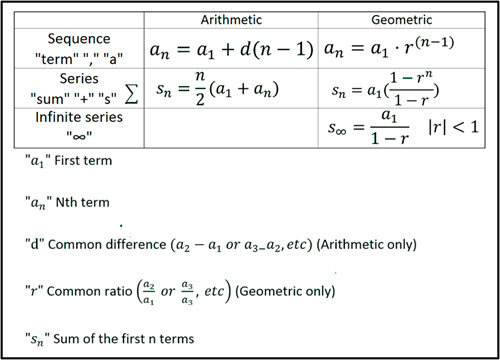
A geometric sequence is a pattern where each term is found by multiplying the previous term by the same common ratio. These problems practice finding missing terms, using the explicit formula \(a_n=a_1r^{n-1}\), solving for \(a_1\) or \(r\), and working with geometric means. Geometric sequences are useful for modeling repeated growth, decay, doubling, halving, and alternating signs.
Notes
Practice Problems
\(\textbf{1)}\) Find the next three terms of \(3,6,12, \ldots\) The answer is \(24,48,96\)
\(\,\,\,\,\,r=\frac{6}{3}=2\)
\(\,\,\,\,\,3,6,12,\ldots\)
\(\,\,\,\,\,12\cdot2=24\)
\(\,\,\,\,\,24\cdot2=48\)
\(\,\,\,\,\,48\cdot2=96\)
\(\,\,\,\,\,\text{The next three terms are }24,48,96\)
\(\,\,\,\,\,r=\frac{6}{3}=2\)
\(\,\,\,\,\,3,6,12,\ldots\)
\(\,\,\,\,\,12\cdot2=24\)
\(\,\,\,\,\,24\cdot2=48\)
\(\,\,\,\,\,48\cdot2=96\)
\(\,\,\,\,\,\text{The next three terms are }24,48,96\)
\(\textbf{2)}\) Find the next three terms of \(1,-3,9, \ldots\) The answer is \(-27,81,-243\)
\(\,\,\,\,\,r=\frac{-3}{1}=-3\)
\(\,\,\,\,\,1,-3,9,\ldots\)
\(\,\,\,\,\,9(-3)=-27\)
\(\,\,\,\,\,-27(-3)=81\)
\(\,\,\,\,\,81(-3)=-243\)
\(\,\,\,\,\,\text{The next three terms are }-27,81,-243\)
\(\,\,\,\,\,r=\frac{-3}{1}=-3\)
\(\,\,\,\,\,1,-3,9,\ldots\)
\(\,\,\,\,\,9(-3)=-27\)
\(\,\,\,\,\,-27(-3)=81\)
\(\,\,\,\,\,81(-3)=-243\)
\(\,\,\,\,\,\text{The next three terms are }-27,81,-243\)
\(\textbf{3)}\) Find the next three terms of \(\frac{2}{3},1,\frac{3}{2}, \ldots\) The answer is \(\frac{9}{4},\frac{27}{8},\frac{81}{16}\)
\(\,\,\,\,\,r=1\div\frac{2}{3}=\frac{3}{2}\)
\(\,\,\,\,\,\frac{3}{2}\cdot\frac{3}{2}=\frac{9}{4}\)
\(\,\,\,\,\,\frac{9}{4}\cdot\frac{3}{2}=\frac{27}{8}\)
\(\,\,\,\,\,\frac{27}{8}\cdot\frac{3}{2}=\frac{81}{16}\)
\(\,\,\,\,\,\text{The next three terms are }\frac{9}{4},\frac{27}{8},\frac{81}{16}\)

\(\,\,\,\,\,r=1\div\frac{2}{3}=\frac{3}{2}\)
\(\,\,\,\,\,\frac{3}{2}\cdot\frac{3}{2}=\frac{9}{4}\)
\(\,\,\,\,\,\frac{9}{4}\cdot\frac{3}{2}=\frac{27}{8}\)
\(\,\,\,\,\,\frac{27}{8}\cdot\frac{3}{2}=\frac{81}{16}\)
\(\,\,\,\,\,\text{The next three terms are }\frac{9}{4},\frac{27}{8},\frac{81}{16}\)
\(\textbf{4)}\) \(a_1=\frac{1}{3},\,r=3,\,\) what is \(a_4\)? The answer is \(a_4=9\)
\(\,\,\,\,\,a_n=a_1r^{n-1}\)
\(\,\,\,\,\,a_4=\frac{1}{3}(3)^{4-1}\)
\(\,\,\,\,\,a_4=\frac{1}{3}(3)^3\)
\(\,\,\,\,\,a_4=\frac{1}{3}(27)\)
\(\,\,\,\,\,a_4=9\)
\(\,\,\,\,\,a_n=a_1r^{n-1}\)
\(\,\,\,\,\,a_4=\frac{1}{3}(3)^{4-1}\)
\(\,\,\,\,\,a_4=\frac{1}{3}(3)^3\)
\(\,\,\,\,\,a_4=\frac{1}{3}(27)\)
\(\,\,\,\,\,a_4=9\)
\(\textbf{5)}\) \(r=-2,\, a_5=80,\,\) what is \(a_1\)? The answer is \(a_1=5\)
\(\,\,\,\,\,a_n=a_1r^{n-1}\)
\(\,\,\,\,\,80=a_1(-2)^{5-1}\)
\(\,\,\,\,\,80=a_1(-2)^4\)
\(\,\,\,\,\,80=16a_1\)
\(\,\,\,\,\,5=a_1\)
\(\,\,\,\,\,a_n=a_1r^{n-1}\)
\(\,\,\,\,\,80=a_1(-2)^{5-1}\)
\(\,\,\,\,\,80=a_1(-2)^4\)
\(\,\,\,\,\,80=16a_1\)
\(\,\,\,\,\,5=a_1\)
\(\textbf{6)}\) \(a_1=7,\, a_5=112,\,\) what is \(r\)? The answer is \(r=2\)
\(\,\,\,\,\,a_n=a_1r^{n-1}\)
\(\,\,\,\,\,112=7r^{5-1}\)
\(\,\,\,\,\,112=7r^4\)
\(\,\,\,\,\,16=r^4\)
\(\,\,\,\,\,r=2\)
\(\,\,\,\,\,a_n=a_1r^{n-1}\)
\(\,\,\,\,\,112=7r^{5-1}\)
\(\,\,\,\,\,112=7r^4\)
\(\,\,\,\,\,16=r^4\)
\(\,\,\,\,\,r=2\)
\(\textbf{7)}\) Find the next three terms of \(5,15,45,\ldots\) The answer is \(135,405,1215\)
\(\,\,\,\,\,r=\frac{15}{5}=3\)
\(\,\,\,\,\,45\cdot3=135\)
\(\,\,\,\,\,135\cdot3=405\)
\(\,\,\,\,\,405\cdot3=1215\)
\(\,\,\,\,\,\text{The next three terms are }135,405,1215\)
\(\,\,\,\,\,r=\frac{15}{5}=3\)
\(\,\,\,\,\,45\cdot3=135\)
\(\,\,\,\,\,135\cdot3=405\)
\(\,\,\,\,\,405\cdot3=1215\)
\(\,\,\,\,\,\text{The next three terms are }135,405,1215\)
\(\textbf{8)}\) Find the next three terms of \(64,32,16,\ldots\) The answer is \(8,4,2\)
\(\,\,\,\,\,r=\frac{32}{64}=\frac{1}{2}\)
\(\,\,\,\,\,16\cdot\frac{1}{2}=8\)
\(\,\,\,\,\,8\cdot\frac{1}{2}=4\)
\(\,\,\,\,\,4\cdot\frac{1}{2}=2\)
\(\,\,\,\,\,\text{The next three terms are }8,4,2\)
\(\,\,\,\,\,r=\frac{32}{64}=\frac{1}{2}\)
\(\,\,\,\,\,16\cdot\frac{1}{2}=8\)
\(\,\,\,\,\,8\cdot\frac{1}{2}=4\)
\(\,\,\,\,\,4\cdot\frac{1}{2}=2\)
\(\,\,\,\,\,\text{The next three terms are }8,4,2\)
\(\textbf{9)}\) Find the next three terms of \(-2,6,-18,\ldots\) The answer is \(54,-162,486\)
\(\,\,\,\,\,r=\frac{6}{-2}=-3\)
\(\,\,\,\,\,-18(-3)=54\)
\(\,\,\,\,\,54(-3)=-162\)
\(\,\,\,\,\,-162(-3)=486\)
\(\,\,\,\,\,\text{The next three terms are }54,-162,486\)
\(\,\,\,\,\,r=\frac{6}{-2}=-3\)
\(\,\,\,\,\,-18(-3)=54\)
\(\,\,\,\,\,54(-3)=-162\)
\(\,\,\,\,\,-162(-3)=486\)
\(\,\,\,\,\,\text{The next three terms are }54,-162,486\)
\(\textbf{10)}\) Find \(a_6\) if \(a_1=4\) and \(r=2\). The answer is \(a_6=128\)
\(\,\,\,\,\,a_n=a_1r^{n-1}\)
\(\,\,\,\,\,a_6=4(2)^{6-1}\)
\(\,\,\,\,\,a_6=4(2)^5\)
\(\,\,\,\,\,a_6=4(32)\)
\(\,\,\,\,\,a_6=128\)
\(\,\,\,\,\,a_n=a_1r^{n-1}\)
\(\,\,\,\,\,a_6=4(2)^{6-1}\)
\(\,\,\,\,\,a_6=4(2)^5\)
\(\,\,\,\,\,a_6=4(32)\)
\(\,\,\,\,\,a_6=128\)
\(\textbf{11)}\) Find \(a_7\) if \(a_1=81\) and \(r=\frac{1}{3}\). The answer is \(a_7=\frac{1}{9}\)
\(\,\,\,\,\,a_n=a_1r^{n-1}\)
\(\,\,\,\,\,a_7=81\left(\frac{1}{3}\right)^{7-1}\)
\(\,\,\,\,\,a_7=81\left(\frac{1}{3}\right)^6\)
\(\,\,\,\,\,a_7=81\left(\frac{1}{729}\right)\)
\(\,\,\,\,\,a_7=\frac{81}{729}\)
\(\,\,\,\,\,a_7=\frac{1}{9}\)
\(\,\,\,\,\,a_n=a_1r^{n-1}\)
\(\,\,\,\,\,a_7=81\left(\frac{1}{3}\right)^{7-1}\)
\(\,\,\,\,\,a_7=81\left(\frac{1}{3}\right)^6\)
\(\,\,\,\,\,a_7=81\left(\frac{1}{729}\right)\)
\(\,\,\,\,\,a_7=\frac{81}{729}\)
\(\,\,\,\,\,a_7=\frac{1}{9}\)
\(\textbf{12)}\) Find \(a_5\) if \(a_1=-3\) and \(r=4\). The answer is \(a_5=-768\)
\(\,\,\,\,\,a_n=a_1r^{n-1}\)
\(\,\,\,\,\,a_5=-3(4)^{5-1}\)
\(\,\,\,\,\,a_5=-3(4)^4\)
\(\,\,\,\,\,a_5=-3(256)\)
\(\,\,\,\,\,a_5=-768\)
\(\,\,\,\,\,a_n=a_1r^{n-1}\)
\(\,\,\,\,\,a_5=-3(4)^{5-1}\)
\(\,\,\,\,\,a_5=-3(4)^4\)
\(\,\,\,\,\,a_5=-3(256)\)
\(\,\,\,\,\,a_5=-768\)
\(\textbf{13)}\) Find the common ratio of \(4,20,100,500,\ldots\) The answer is \(r=5\)
\(\,\,\,\,\,r=\frac{\text{second term}}{\text{first term}}\)
\(\,\,\,\,\,r=\frac{20}{4}\)
\(\,\,\,\,\,r=5\)
\(\,\,\,\,\,\text{Check: }20\cdot5=100\text{ and }100\cdot5=500\)
\(\,\,\,\,\,r=\frac{\text{second term}}{\text{first term}}\)
\(\,\,\,\,\,r=\frac{20}{4}\)
\(\,\,\,\,\,r=5\)
\(\,\,\,\,\,\text{Check: }20\cdot5=100\text{ and }100\cdot5=500\)
\(\textbf{14)}\) Find the common ratio of \(12,-6,3,-\frac{3}{2},\ldots\) The answer is \(r=-\frac{1}{2}\)
\(\,\,\,\,\,r=\frac{\text{second term}}{\text{first term}}\)
\(\,\,\,\,\,r=\frac{-6}{12}\)
\(\,\,\,\,\,r=-\frac{1}{2}\)
\(\,\,\,\,\,\text{Check: }-6\left(-\frac{1}{2}\right)=3\)
\(\,\,\,\,\,r=\frac{\text{second term}}{\text{first term}}\)
\(\,\,\,\,\,r=\frac{-6}{12}\)
\(\,\,\,\,\,r=-\frac{1}{2}\)
\(\,\,\,\,\,\text{Check: }-6\left(-\frac{1}{2}\right)=3\)
\(\textbf{15)}\) Write an explicit formula for \(5,10,20,40,\ldots\) The answer is \(a_n=5(2)^{n-1}\)
\(\,\,\,\,\,a_1=5\)
\(\,\,\,\,\,r=\frac{10}{5}=2\)
\(\,\,\,\,\,a_n=a_1r^{n-1}\)
\(\,\,\,\,\,a_n=5(2)^{n-1}\)
\(\,\,\,\,\,a_1=5\)
\(\,\,\,\,\,r=\frac{10}{5}=2\)
\(\,\,\,\,\,a_n=a_1r^{n-1}\)
\(\,\,\,\,\,a_n=5(2)^{n-1}\)
\(\textbf{16)}\) Write an explicit formula for \(7,-14,28,-56,\ldots\) The answer is \(a_n=7(-2)^{n-1}\)
\(\,\,\,\,\,a_1=7\)
\(\,\,\,\,\,r=\frac{-14}{7}=-2\)
\(\,\,\,\,\,a_n=a_1r^{n-1}\)
\(\,\,\,\,\,a_n=7(-2)^{n-1}\)
\(\,\,\,\,\,a_1=7\)
\(\,\,\,\,\,r=\frac{-14}{7}=-2\)
\(\,\,\,\,\,a_n=a_1r^{n-1}\)
\(\,\,\,\,\,a_n=7(-2)^{n-1}\)
\(\textbf{17)}\) If \(a_1=6\) and \(a_4=162\), find \(r\). The answer is \(r=3\)
\(\,\,\,\,\,a_n=a_1r^{n-1}\)
\(\,\,\,\,\,162=6r^{4-1}\)
\(\,\,\,\,\,162=6r^3\)
\(\,\,\,\,\,27=r^3\)
\(\,\,\,\,\,3=r\)
\(\,\,\,\,\,a_n=a_1r^{n-1}\)
\(\,\,\,\,\,162=6r^{4-1}\)
\(\,\,\,\,\,162=6r^3\)
\(\,\,\,\,\,27=r^3\)
\(\,\,\,\,\,3=r\)
\(\textbf{18)}\) If \(a_3=20\) and \(r=2\), find \(a_1\). The answer is \(a_1=5\)
\(\,\,\,\,\,a_n=a_1r^{n-1}\)
\(\,\,\,\,\,20=a_1(2)^{3-1}\)
\(\,\,\,\,\,20=a_1(2)^2\)
\(\,\,\,\,\,20=4a_1\)
\(\,\,\,\,\,5=a_1\)
\(\,\,\,\,\,a_n=a_1r^{n-1}\)
\(\,\,\,\,\,20=a_1(2)^{3-1}\)
\(\,\,\,\,\,20=a_1(2)^2\)
\(\,\,\,\,\,20=4a_1\)
\(\,\,\,\,\,5=a_1\)
\(\textbf{19)}\) If \(a_2=18\) and \(a_5=486\), find \(r\). The answer is \(r=3\)
\(\,\,\,\,\,\frac{a_5}{a_2}=r^{5-2}\)
\(\,\,\,\,\,\frac{486}{18}=r^3\)
\(\,\,\,\,\,27=r^3\)
\(\,\,\,\,\,3=r\)
\(\,\,\,\,\,\frac{a_5}{a_2}=r^{5-2}\)
\(\,\,\,\,\,\frac{486}{18}=r^3\)
\(\,\,\,\,\,27=r^3\)
\(\,\,\,\,\,3=r\)
Challenge Problems
\(\textbf{20)}\) Find the three geometric means of \(3\) and \(48\) The answer is \(6,12,24\)
\(\,\,\,\,\,3,\,\text{___},\,\text{___},\,\text{___},\,48\)
\(\,\,\,\,\,a_n=a_1r^{n-1}\)
\(\,\,\,\,\,48=3r^{5-1}\)
\(\,\,\,\,\,48=3r^4\)
\(\,\,\,\,\,16=r^4\)
\(\,\,\,\,\,2=r\)
\(\,\,\,\,\,3,\,3(2),\,3(2)^2,\,3(2)^3,\,48\)
\(\,\,\,\,\,3,\,6,\,12,\,24,\,48\)
\(\,\,\,\,\,\text{The three geometric means are }6,12,24\)
\(\,\,\,\,\,3,\,\text{___},\,\text{___},\,\text{___},\,48\)
\(\,\,\,\,\,a_n=a_1r^{n-1}\)
\(\,\,\,\,\,48=3r^{5-1}\)
\(\,\,\,\,\,48=3r^4\)
\(\,\,\,\,\,16=r^4\)
\(\,\,\,\,\,2=r\)
\(\,\,\,\,\,3,\,3(2),\,3(2)^2,\,3(2)^3,\,48\)
\(\,\,\,\,\,3,\,6,\,12,\,24,\,48\)
\(\,\,\,\,\,\text{The three geometric means are }6,12,24\)
See Related Pages
\(\bullet\text{ Arithmetic Sequences}\)
\(\,\,\,\,\,\,\,a_n=a_1 + d(n-1)\)
\(\bullet\text{ Arithmetic Series}\)
\(\,\,\,\,\,\,\,s_n=\frac{n}{2}(a_1+a_n)…\)
\(\bullet\text{ Geometric Series}\)
\(\,\,\,\,\,\,\,s_n=a_1 \frac{1-r^n}{1-r}…\)
\(\bullet\text{ Infinite Geometric Series}\)
\(\,\,\,\,\,\,\,s_\infty = \frac{a_1}{1-r}\,\,\, |r| \lt 1…\)
\(\bullet\text{ Summation Notation}\)
\(\,\,\,\,\,\,\, \displaystyle \sum_{i=4}^{9} 3i-5 …\)
\(\bullet\text{ Recursive Sequences}\)
\(\,\,\,\,\,\,\, a_{1}=2, \, a_{n+1}=a_{n}+3…\)