
Notes

Questions
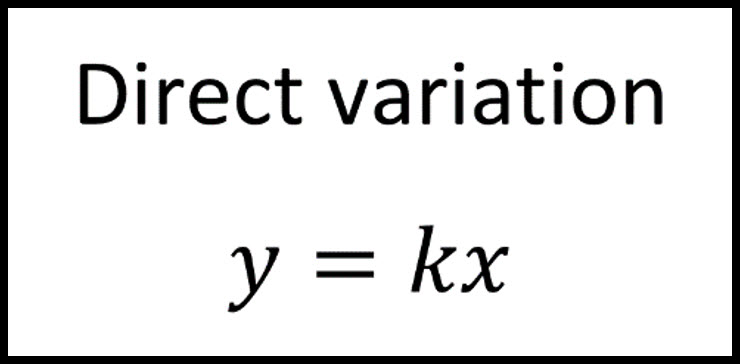
\(\textbf{1)}\) y varies directly with x. When x=3, y=10. What is y when x is 12? The answer is y=40 when x=12.
\(\textbf{2)}\) y varies directly with x. When x=5, y=15. What is y when x is 3? The answer is y=9 when x=3. 
\(\textbf{3)}\) y varies directly with x. When x=5, y=2. What is y when x is 10? The answer is y=4 when x=10.
\(\,\,\,\,\,\,y=kx\)
\(\,\,\,\,\,\,2=k5\)
\(\,\,\,\,\,\,\frac{2}{5}=k\)
\(\,\,\,\,\,\,.4=k\)
\(\,\,\,\,\,\,y=.4x\)
\(\,\,\,\,\,\,y=.4(10)\)
\(\,\,\,\,\,\,y=4\)
\(\,\,\,\,\,\,\)The answer is y=4 when x=10.
\(\,\,\,\,\,\,y=kx\)
\(\,\,\,\,\,\,2=k5\)
\(\,\,\,\,\,\,\frac{2}{5}=k\)
\(\,\,\,\,\,\,.4=k\)
\(\,\,\,\,\,\,y=.4x\)
\(\,\,\,\,\,\,y=.4(10)\)
\(\,\,\,\,\,\,y=4\)
\(\,\,\,\,\,\,\)The answer is y=4 when x=10.
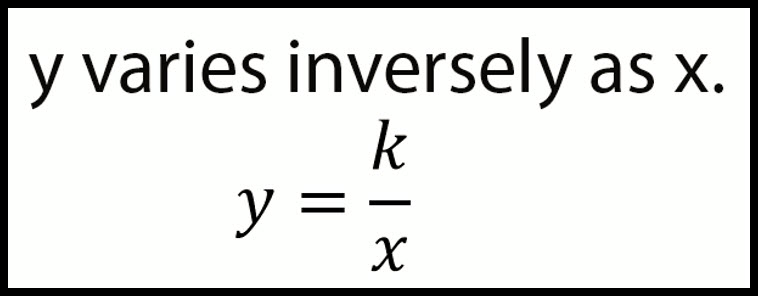
\(\textbf{4)}\) m varies inversely with n. When n=3, m=10. What is m when n is 6? The answer is m=5 when n=6
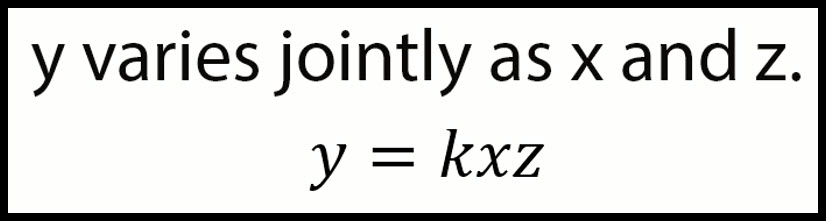
\(\textbf{5)}\) m varies jointly with n and z. When n=3 and z=4, m=18. What is m when n is 6 and z is 8? The answer is m=72 when n=6 and z=8
\(\textbf{6)}\) m varies directly with the square of n and inversely with w. When w=4 and n=2, m=5. What is m when w=8 and n=4? The answer is m=10 when w=8 and n=4