
Direct variation is a relationship where one variable is always a constant multiple of another variable. A direct variation equation can be written in the form \(y=mx\) or \(y=kx\), and its graph always passes through the origin, \((0,0)\). To decide whether an equation is a direct variation, check whether it can be rewritten as \(y=mx\) with no added or subtracted constant.
Notes
Direct Variation Linear Equations
\(y=mx \)
\(\text{Note: Always passes through the point (0,0)}\)
Practice Questions
Are the following linear equations direct variations?
\(\textbf{1)}\) \( y=3x \)\( \text{Yes, direct variation}\)\(\,\,\,\,\,y=3x\)\(\,\,\,\,\,\text{This is in the form }y=mx.\)\(\,\,\,\,\,\text{There is no added or subtracted constant.}\)\(\,\,\,\,\,\text{So this is direct variation.}\)
\(\textbf{2)}\) \( y=\frac{1}{2}x+3 \)\( \text{No, not direct variation}\)\(\,\,\,\,\,y=\frac{1}{2}x+3\)\(\,\,\,\,\,\text{Direct variation must have the form }y=mx.\)\(\,\,\,\,\,\text{The }+3\text{ means the equation does not pass through the origin.}\)\(\,\,\,\,\,\text{So this is not direct variation.}\)
\(\textbf{3)}\) \( y=2x-5 \)\( \text{No, not direct variation}\)\(\,\,\,\,\,y=2x-5\)\(\,\,\,\,\,\text{Direct variation must have no constant term.}\)\(\,\,\,\,\,\text{The }-5\text{ is a constant term.}\)\(\,\,\,\,\,\text{So this is not direct variation.}\)
\(\textbf{4)}\) \( y=-2x \)\( \text{Yes, direct variation}\)\(\,\,\,\,\,y=-2x\)\(\,\,\,\,\,\text{This is in the form }y=mx.\)\(\,\,\,\,\,\text{The constant of variation is }-2.\)\(\,\,\,\,\,\text{So this is direct variation.}\)
\(\textbf{5)}\) \( y=x \)\( \text{Yes, direct variation}\)\(\,\,\,\,\,y=x\)\(\,\,\,\,\,\text{This can be written as }y=1x.\)\(\,\,\,\,\,\text{This is in the form }y=mx.\)\(\,\,\,\,\,\text{So this is direct variation.}\)
\(\textbf{6)}\) \( y=3 \)\( \text{No, not direct variation}\)\(\,\,\,\,\,y=3\)\(\,\,\,\,\,\text{There is no }x\text{ term.}\)\(\,\,\,\,\,\text{This is not in the form }y=mx.\)\(\,\,\,\,\,\text{So this is not direct variation.}\)
\(\textbf{7)}\) \( y=-\frac{4}{5}x \)\( \text{Yes, direct variation}\)\(\,\,\,\,\,y=-\frac{4}{5}x\)\(\,\,\,\,\,\text{This is in the form }y=mx.\)\(\,\,\,\,\,\text{The constant of variation is }-\frac{4}{5}.\)\(\,\,\,\,\,\text{So this is direct variation.}\)
\(\textbf{8)}\) \( y=7x+1 \)\( \text{No, not direct variation}\)\(\,\,\,\,\,y=7x+1\)\(\,\,\,\,\,\text{Direct variation must have the form }y=mx.\)\(\,\,\,\,\,\text{The }+1\text{ makes this not direct variation.}\)\(\,\,\,\,\,\text{So this is not direct variation.}\)
\(\textbf{9)}\) \( y=0.25x \)\( \text{Yes, direct variation}\)\(\,\,\,\,\,y=0.25x\)\(\,\,\,\,\,\text{This is in the form }y=mx.\)\(\,\,\,\,\,\text{The constant of variation is }0.25.\)\(\,\,\,\,\,\text{So this is direct variation.}\)
\(\textbf{10)}\) \( y=x-9 \)\( \text{No, not direct variation}\)\(\,\,\,\,\,y=x-9\)\(\,\,\,\,\,\text{The equation has a constant term, }-9.\)\(\,\,\,\,\,\text{Direct variation cannot have a constant term.}\)\(\,\,\,\,\,\text{So this is not direct variation.}\)
\(\textbf{11)}\) \( 2y=6x \)\( \text{Yes, direct variation}\)\(\,\,\,\,\,2y=6x\)\(\,\,\,\,\,y=3x\)\(\,\,\,\,\,\text{This is in the form }y=mx.\)\(\,\,\,\,\,\text{So this is direct variation.}\)
\(\textbf{12)}\) \( 4y=8x+12 \)\( \text{No, not direct variation}\)\(\,\,\,\,\,4y=8x+12\)\(\,\,\,\,\,y=2x+3\)\(\,\,\,\,\,\text{The }+3\text{ means this is not in the form }y=mx.\)\(\,\,\,\,\,\text{So this is not direct variation.}\)
\(\textbf{13)}\) \( y-5x=0 \)\( \text{Yes, direct variation}\)\(\,\,\,\,\,y-5x=0\)\(\,\,\,\,\,y=5x\)\(\,\,\,\,\,\text{This is in the form }y=mx.\)\(\,\,\,\,\,\text{So this is direct variation.}\)
\(\textbf{14)}\) \( y-5x=2 \)\( \text{No, not direct variation}\)\(\,\,\,\,\,y-5x=2\)\(\,\,\,\,\,y=5x+2\)\(\,\,\,\,\,\text{The }+2\text{ means the equation is not in the form }y=mx.\)\(\,\,\,\,\,\text{So this is not direct variation.}\)
\(\textbf{15)}\) \( 3x-y=0 \)\( \text{Yes, direct variation}\)\(\,\,\,\,\,3x-y=0\)\(\,\,\,\,\,-y=-3x\)\(\,\,\,\,\,y=3x\)\(\,\,\,\,\,\text{So this is direct variation.}\)
\(\textbf{16)}\) \( 3x-y=4 \)\( \text{No, not direct variation}\)\(\,\,\,\,\,3x-y=4\)\(\,\,\,\,\,-y=-3x+4\)\(\,\,\,\,\,y=3x-4\)\(\,\,\,\,\,\text{The }-4\text{ means this is not direct variation.}\)
\(\textbf{17)}\) \( \frac{y}{x}=6 \)\( \text{Yes, direct variation}\)\(\,\,\,\,\,\frac{y}{x}=6\)\(\,\,\,\,\,y=6x\)\(\,\,\,\,\,\text{This is in the form }y=mx.\)\(\,\,\,\,\,\text{So this is direct variation.}\)
\(\textbf{18)}\) \( \frac{y}{x}=6+\frac{2}{x} \)\( \text{No, not direct variation}\)\(\,\,\,\,\,\frac{y}{x}=6+\frac{2}{x}\)\(\,\,\,\,\,y=6x+2\)\(\,\,\,\,\,\text{The }+2\text{ means this is not in the form }y=mx.\)\(\,\,\,\,\,\text{So this is not direct variation.}\)
\(\textbf{19)}\) \( x=4y \)\( \text{Yes, direct variation}\)\(\,\,\,\,\,x=4y\)\(\,\,\,\,\,\frac{x}{4}=y\)\(\,\,\,\,\,y=\frac{1}{4}x\)\(\,\,\,\,\,\text{So this is direct variation.}\)
\(\textbf{20)}\) \( x=4 \)\( \text{No, not direct variation}\)\(\,\,\,\,\,x=4\)\(\,\,\,\,\,\text{This is a vertical line.}\)\(\,\,\,\,\,\text{It cannot be written in the form }y=mx.\)\(\,\,\,\,\,\text{So this is not direct variation.}\)
See Related Pages\(\)
\(\bullet\text{ Graphing Linear Equations}\)
\(\,\,\,\,\,\,\,\,2x-3y=6 \) 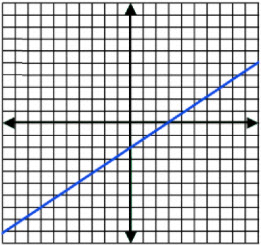
\(\bullet\text{ Slope Formula}\)
\(\,\,\,\,\,\,\,\,m=\frac{y_2-y_1}{x_2-x_1}\)
\(\bullet\text{ Net Change}\)
\(\,\,\,\,\,\,\,\,y_2-y_1\)
\(\bullet\text{ Point Slope Form}\)
\(\,\,\,\,\,\,\,\,y-y_1=m(x-x_1)\)
\(\bullet\text{ Parallel and Perpendicular Slope}\)
\(\,\,\,\,\,\,\,\,m_1=m+2,\,\,\,m_1=\frac{1}{m_2}\)
\(\bullet\text{ Distance Between a Point and a Line}\)
\(\,\,\,\,\,\,\,\,(3,4) \text{ and } y=\frac{3}{4}x−2\)
\(\bullet\text{ Finding x- and y- intercepts}\)
\(\,\,\,\,\,\,\,\,y=2x+4\)