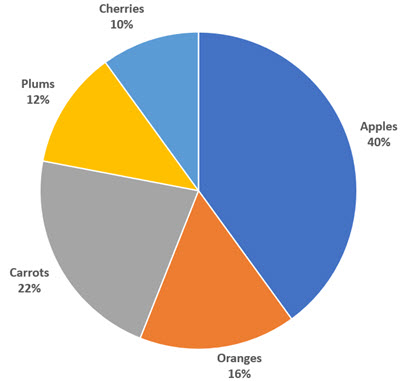
A pie chart is a circular graph that is used to show the relative proportions of different categories or groups. It is divided into segments, with each segment representing a different category and the size of the segment representing the proportion of the data that belongs to that category. To create a pie chart, the data is first organized into categories, and then the total value for each category is calculated. The proportions of each category are then represented as angles in a circle, with the total value for each category represented by a corresponding fraction of the circle. Pie charts are a useful tool for visualizing the relative proportions of different categories in a dataset and for comparing the proportions of different groups.